Thursday, January 27, 2022

The idyllic island life of Tinos, Greece


We spent about a week in summer 2021 in the small Cycladic island of Tinos. It is a small island, less than 40 kms in length, quite windy, rocky brown in colour, with shrubs and dry vegetation and dotted with small villages and cove beaches along its shore. It is quite slow and remote, living a life far away from the bustling lives we live. And the experience of living there for a week felt otherworldly almost, as if we had landed on a different planet altogether!

Typical Cycladic houses
Our time there was completely unplanned, each morning we decided what to do and where to go - the beach or the villages or hike or eat with a view or do nothing. We had nowhere to go, no time deadlines, no list to finish. And so time slowed down for us there – it was quite an experience. I loved the time we spent on its gorgeous beaches. Just swimming in its deep blue Aegean waters for hours at end.

I loved this Greek island holiday, with the sun and water around. But the highlight for me was the slowing down, that idyllic weightless feeling, which will always remain with me as the memory of this holiday.


Itinerary in Mykonos and Tinos

  • Day 1: Land in Mykonos; stay at Hotel Super Paradise Suites; explore Paradise Beach Club; dinner at Jackie O
  • Day 2: Ferry from Mykonos to Tinos; stay at the village of Kardiani; dinner at Sunset Bar, Kardiani
  • Day 3: Bianco beach; Lunch at Pastel Tinos; Chill at Sundara lounge on Agios Fokas beach; Dinner at Like Salt
  • Day 4: Driving across the island, visiting Pyrgos and Isternia villages; Lunch at Mayou Cafe, Isternia (my favourite); Dinner at O Ntinos near Kardiani bay
  • Day 5: Volax and Skalados villages; Kolimvithra (Kolibithra) beach; dinner at Kionia on Kionia beach
  • Day 6: Hiking around Steni; lunch at Cafe Apodrasi
  • Day 7: Kalivia beach & bar; Dinner at Drunk Sinatra
  • Day 8: Ferry from Tino to Mykonos; dinner at Scorpio
  • Day 9: Explore Mykonos Town; Agios Sostis beach; Principote beach bar; Nammos beach bar; dinner at Yalo at Platis Gialo beach
  • Day 10: Platis Gialo beach; fly back to Amsterdam


Getting to Tinos

The whole Greek islands ferry system is extremely well setup - there are daily ferries leaving from the harbour to multiple different islands around, and there are generally multiple options available. You can easily book any of them using the ferry hopper app. We took the ferry from Mykonos to Tinos. It was a huge one, coming from Athens to Mykonos, dropping passengers to a few other islands and then going back to Athens the same day.

Each island has a main harbour, and we boarded the ferry from Mykonos harbour. The corona check-in was quick, and we spent most of our time exploring the ferry and enjoying the views outside. The ferry had a posh escalator inside and had multiple levels to it. All the floors had a few cafes, restaurants and places to sit. While going to Tinos, we sat on the top floor so we could enjoy the open air and views of the sea around. It was extremely windy though and tough to sit on the top deck - guess it was a preview of what was to come.

First view of Tinos
It was a short ride in, as within 30 mins we were in Tinos. The approach to Tinos was scenic - slowly the island becomes visible and the white houses come into focus. The brightness of the sun made the houses sparkle amid the brown landscape, making the island almost shine. And the first look of the island told us already that it would be a quieter world than what we had left behind.

Tinos harbour
Also, the ferry manoeuvring as it was landing into the harbour was enjoyable to watch. The captains turn and park it as effortlessly as if it were a cycle! It was a pleasure to see it from the ferry as it turned, twisted and parked itself next to the marina.

As we got off, our car rental guy met us at the harbour itself. He had the car ready, we drove to their office and sorted out the papers. The town of Tinos felt small and cute; slow and sleepy in the hot summer air. We then bought groceries from the only local supermarket which was open on a Sunday. And then were ready for our Tinos adventure.


About the island

Tinos is a very small Greek island in the Aegean Sea, about 200 km2 in area. It is one of the quieter of the Cycladic group of Greek islands, which are known for their white and blue houses, dry vegetation and windy climate. The most famous of these islands are Santorini and Mykonos, with Tinos, Paxos, Naxos etc. being the quieter ones.

Kardiani Bay, from above
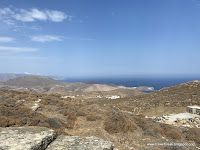
The capital of the island is the town of Tinos where the ferries from the islands arrive. And there is one main circular road which goes all along the island coast. At most places, you can see the blue sea, extending unto infinity. And all along this sea, are picturesque beaches in hidden coves. On the other side are tens of white villages dotting the whole island. The vegetation is dry, and the land looks bare. It is quite mountainous too, so the roads go up and down everywhere. And anywhere you turn, are some stunning views which fascinated us our entire time there.

Somewhere on the island
Population on the island is low. So when you drive, you can just see the villages far off, with no people nearby. Just lot of desert shrubs and brown vegetation. The north side of the island is supposedly windier, while the south side is less. So people tend to hangout more on the south beaches. Generally it’s a slow-paced island, but in October, it just gets much more slower. It’s like time has come to a standstill in this part of the world.


Our airbnb in the village of Kardiani

After landing in Tinos, we first drove towards our Airbnb in the cliff village of Kardiani. It was a 20 mins ride along the coast, and we got our first look into what the island was like - dry grasslands, sparsely populated. Our village was on a cliff and a bit tough to get to the first time as we missed the small road going down steeply towards the houses. Also our car didn't go all the way to the accommodation - we had to park it at the beginning of the village, and then walk the rest of the way through the typical narrow lanes with white Cycladic island houses on both sides.

The house was pretty and cute, with a traditional architecture. With the blue doors, and a deep pink bougainvillea plant along its door – the typical look of a Greek house we had imagined. The best part though was its terrace – an open-air seating area with an imposing view of the sea, the Ermoupouli and Giaros island far away and the setting of some spectacular sunrises and sunsets every day.

Kardiani during the day
From the terrace, we could see the whole village spread out below us along the cliff, the 3 churches of the village, the two bays down by the sea, the sea in between and the white houses on the two islands across the sea. The sunrises were quite scenic. The sun would come late to the village, as it rose on the other side of the cliff. And slowly it would come, warming up everything, one by one.

Kardiani at sunset
In the evening, the sun would slowly sink behind the cliffs, turning everything in the village a yellow hue. The calmness and gorgeousness of the moment is tough to describe. And the nights were enticing too. We could see the lights of the holiday homes next to the bays and the white houses across the sea, twinkling at night – it was all so charming. And the heavens came out too. The sky was so clear that we could see all the stars in the sky, the Milky Way and all the constellations too. Every night.

I had a great time at the Airbnb, taking in the fresh air of a real village, a place I haven’t stayed at for a long long while. It kind of brought back memories of my village in India, the simplicity in living - something we have all left way way behind.


Kardiani village

The village of Kardiani is quite a popular stop among the tourists on the island. All day there would be many of them walking along its streets, walking down to the beach, visiting the main churches in the village and taking photos. The church which was closest to our home had a beautiful bell tower, which looked even more fabulous at night, all lighted up in orange lights. There was an old part of the village too which we explored but felt the same to me as the new one. There was a small café in the centre of town where tourists would sit for a quick snack. And admire the lighted churches in the village. And there were tons of cats everywhere, at last 200 in the village itself. As they were everywhere on the island!

Kardiani cafe
The streets of the village were very similar to the other villages – painted white and houses on both sides with blue doors and windows. And loads of bougainvillea everywhere. It felt so refreshing every day when we came back after a long day on the beaches and across the island. All the streets were lighted up even at night, so it always felt alive.

One thing stuck in my mind though – the village felt so empty! Other than tourists, and the people running the café, we didn’t come across a lot of locals the entire week. I kept wondering where they were. Were they all staying indoors to avoid the wind, or were they generally introverted people, or were most of the houses just summer houses and empty now? With everyone back in Athens as the weather became cooler. I never got an answer to it and still wonder.


Tinos town

Tinos main street
Tinos is the main town of the island and is a small cute little place. The ferries come to Tinos, as well as you need to come here to buy anything you need. So it was the centre of life for the island. Thankfully it had lot of parking next to the sea, so it was easy to come here and explore the centre. It has a few museums too, but our time spent there was mostly to eat and shop😊. We ate at the Pastel Tinos one day which had a nice view of the harbour, and Drunk Sinatra on the main street which was supposed to be happening at night but felt quite empty😊.

The town seems quite spread out, and a mix of the old and new. We mostly spent our time along the main market street, which starts from the harbour, all the way to the Panagía Evangelístria (Lady of Tinos) church, which is one of the highlights of this island. It is a very important place of pilgrimage for Greek Orthodox Christians, and each year there is a festival when thousands of people come to visit the church and island.

Tinos main street
It is quite a vibrant street, lighted up at night. All along it, you have loads of tourist shops, as well as shops selling photos of Jesus Christ. Somehow it reminded us of Vaishno Devi. One evening, I walked to the church and it looked mesmerizing, all lighted up and shining. And even though it was locked, I peeked in and saw the décor which was quite grand.

Inside Lady of Tinos church
The next day before leaving Tinos, we went to the church again in the morning. It looked so different. More sober than at night. We went in too (given my fascination for churches) and it was different – a Greek Orthodox church. There was so much silver everywhere, some kind of incense being lighted, and the priest was chanting – definitely a different experience than the other European churches I have visited.


Beaches

Tinos is full of beaches as are all Greek islands I would assume. And most of the beaches are in protected coves, at places you wouldn’t know there was a beach till you get there. And which provide protection from the fast winds which overrun the island. Given the end of season, most of the beaches we went to felt quite private. At max there were not more than 12 people at any time (if at all). Some of the beach bars were still open, so there was at least some hulchul there, but the rest felt quite remote. And the water was such a deep Aegean blue, it felt like being in paradise always.

Bianco beach
Bianco beach: Each beach though similar was unique. The first beach we went to was Bianco beach, which also had a beach bar. It was near the town of Tinos and in a hidden cove. It was a course in obstacle driving getting there, it was down a downtrodden narrow extremely steep road down the mountain. And then suddenly you come to a small walkway to the beach bar. The beach bar had shut down for the season the day before, and they were packing up when we went there. But they still served us coffee while we swam😊.

All around the cove, there were holiday homes on the cliffs around. The water was a deep blue and it was a pleasure to swim there, though it did get a bit windy. I was swimming in the warm ocean after a year and a half, and it felt like such a freeing feeling. I decided that I would swim at least half the days I was on the islands!

Sundara beach bar: We went to Sundara beach bar and lounge one afternoon, located near Tinos town on the Agios Fokas beach and stayed there all evening, again swimming in the sea. The lounge was on a very long yellow sand beach which was popular as it was on the side of the island supposed to be less windy. And it was lined with 7-8 beach bars all along, still open as they were near the town and full of people. I swam along the beach on either side of Sundara and then we went for a long walk.

Sundara Lounge
The lounge was a good place to chill for sure. It was made of straw and wood, and had a very rustic feel to it. It had straw sun beds all along the beach for people to tan. Not for us though, we stayed inside under covers when not swimming. We saw the sun set on the city of Tinos, with its twinkling lights, and the straw umbrellas adding to the composition. We also saw loads of oldies there, out on holiday and spending their whole day at the beach bar, just playing games. I think this was the time that I finally started getting into the whole lazy beach holiday vibe. And it felt nice. The name of the lounge also reminded us of an old Hindi song from the 90s, and we danced to it in front of the lounge as a memory😊.

Kolimvithra cove
Kolimvithra beach: One of the days, after visiting some of the villages nearby, we drove towards a beach on the north side of the island. Even though that side is supposed to be windy, this one turned out not to be. It was the Kolimvithra beach, next to a village of the same name. It has one long yellow sand beach which was empty. And next to it, it has another beach in a cove which was completely sheltered from the winds. The water was a deep blue, the winds controlled and the experience outstanding. The restaurant on this beach was already closed for winter though.

But we still hung out there in the bay for 3 hours. I swam for a couple of hours and I loved it. The deep blue colour of the water was awesome. And there was a bit of a crowd here (12 people over the 3 hours!) which still felt like being popular 😉. There was even a lifeguard there! We also saw some jellyfish in the water here, though only after we had finished swimming. So we were safe.

Kalivia beach

Kalivia beach: One of the last beaches we went to was Kalivia beach which was located right below our Kardiani village. We would see the beach cove from our accommodation daily but ended up going there only on the last day. And what a find it was. There were 3 separate beaches in that bay, and we went to the one which was supposed to be less windy. And less windy it was. There was a beach bar there run by some locals who said as they lived there, they didn’t really need to wind up and leave. They were quite friendly too, so we had fun chatting with them.

We spent a few hours in the sun there, soaking in the heat and then the waves, just lazing around. It was a shallow beach, and though it had a few rocks, they were not so much that they would hinder our swimming. It was fabulous and I think my favourite beaches of all. As it was a relaxed day with no agenda, we made full use of it by just spending all our time in the water. And this was another beach with a lot of people, 12 at one point! So a good find overall.


Villages of Tinos

Loutra
Tinos is full of picturesque villages, with its white and blue houses perched on top of cliffs, in valleys and overlooking the sea, all across the island. Each one of them is so unique, so breath-taking, I didn’t get bored of admiring and photographing them throughout my trip. I always wonder if the people living there actually realise how glorious their places of abode are? I am sure they don’t, but for tourists they are really magnificent.

Church on the pass
We spent one full day visiting some picturesque villages towards the north of the island, one day hiking through some of the villages and every day seeing them on our drives anyways. The one full day, we spent visiting the villages of Pyrgos and Isternia, in the northern part of the island. It was a windy day when we drove from Kardiani to Pyrgos. We had to cross a pass in the mountains to get there. Right at the pass, there was a lonely remote church standing tall on top of the pass. And a windmill next to it. We stopped there (I seem to have quite a fascination for churches and visit all and any that come in my way when travelling😊).

Tinos view
Given it was a pass, it was extremely windy there. The church was unfortunately closed (as were most churches on the island) and we couldn’t stop long as the wind was too strong. We did however get to see some stunning views of the other side of the island from there. Mountains all the way down to the sea, and then the deep blue water till wherever the eyes can see. It’s a sublime feeling very difficult to explain.

The landscape on this side of the island was dry, but still had stone markings and fencing to separate fields. And it looked as if there was some agriculture here – we did see lots of goats and sheep too.

Pyrgos village
And as we kept driving on, in the middle of the mountains was this village - Pyrgos. It turned out to be one of the more touristy places we visited. Pyrgos (also known as Panormos) is quite a popular village in the north central part of the island, known for its marble art and architecture. There were loads of tourists walking around the village, as did we. We came across some charming views of the village, with its typical white houses with blue windows and doors. There were also loads of cafes in this village, especially the central square – this was so different than our own village.

Pyrgos street
It had a few market streets which were closed at that time, as were the churches. But there were loads of houses with the red and blue doors. And lots of bougainvillaea too. So all perfect for a picture opportunity😊. As usual, I felt I didn’t get to see a lot of locals around. so wondered again, why were the locals inside all the time? Or were most of the houses empty?

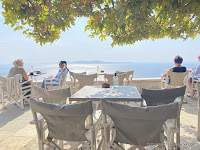
After Pyrgos, while coming back we stopped at Isternia village which was close to our village. We went to Mayou café and had lunch there. It had a stunning location, on a terrace overlooking the Aegean sea. As it was a sunny day and the café was protected from the wind (a bit), we sat there for hours. Eating, reading and just chilling in front of the sea, watching it to infinity and beyond. I could have sat there for a long while - it was my favourite restaurant of the island. After lunch at the restaurant, we walked through the village to the church and saw the markings for the coastal trail which we planned to do one of the days but never got the time. Then we came back and sat at the restaurant again😊.

Volax village from far
One of the other days, we drove to the village of Volax which is in the centre of the island. All around was a valley with huge boulders everywhere. It was a different landscape than the rest of the islands. And nestled in between those boulders from a different planet was this village. This might be the only village far away from everyone, I wonder why they did that! It was greener too, there were so many trees around. Maybe that’s why its residents came so far to settle?

Volax streets
Inside, it was similar to the others we had been to – white houses with blue painted doors and windows. The only difference being some of the doors were full of inscriptions in Greek. I don’t know what they are about but it felt like they recorded the history of the residents of the house. We also walked around the village and saw artichokes on the trees for the first time.

While driving back from Volax, we had seen a lot of villages around a valley, so we stopped at those villages too. The main one was Skalados through which the main road went. We walked a bit there and to the local church which was closed again! By this time, I think we had had enough of the typical Cycladic villages, and we didn’t really want to visit any more. So we left soon.


Hiking

One of the days, we decided to do a different activity and went hiking in the mountains, on this trail. It was supposed to be a ‘highlands’ trail, so we went up and down mountains all along. It turned out to be quite a scenic trek, but the wind hampered our progress a bit.

Our trek started and ended in the village of Steni, after a full loop. Steni was near the village of Volax where we had driven a few days ago. We parked behind the main church and started walking. The walk was through multiple villages; Steni -> Kechros -> Karya -> Exomvourgo -> Falatados -> Mesi -> Stenis. We missed two villages on the way Koumaros and Myrsini; Koumaros because it was too windy to risk going down a cliff to get to it and Myrsini because we got lost 😄.

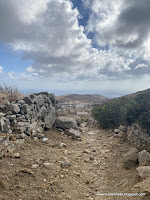
The trail was named M1 but not marked at many places, so we had to find our route as we went along. It was fun to walk through the first few villages. Some part of the trek was through the main roads, some through the hills and some tracks. As the weather was sunny, it was fun.

The start of the trail, Stenis felt like a much richer village than others we had passed - the houses were bigger here and felt more modern. They even had gardens and amenities we hadn’t seen earlier in the smaller villages. And its chimneys had birds of metal next to them, something I had seen in Pringles Bay in South Africa before.

Karya village (most likely)
Karya (or Karia) was all along a cliff and we ran into an artisan working on marble statues in his workshop there. Then we took a very roundabout route through multiple mountains to get to Exomvourgo. On the way there were 100s of churches everywhere, most of them closed. There was a point when I was standing on a hill and could count 15 churches I could see all around me.

On the way, I also walked up a hill without a path towards a church. It was closed but then I finally got inside a dovecote, which felt scary. It felt like ruins of a room with symbols all around. And inside, there was an eerie silence. I realised much later what they were – places made for doves and pigeons to nest, as a source of food for the people around. Apparently Tinos is famous for its dovecotes.

The feeling of being on that hill is difficult to describe. All around were these dried vegetation hills in brown, dotted every few kms with white houses. From here, we could see many gorgeous villages all around, all the way to the sea. And of course the many many churches everywhere. With an ominous wind blowing all around. It’s a scene difficult to describe and can only be experienced.

Somewhere on the hike
I tried to make my own way over mountains, to get to Exomvourgo but the paths were not well marked. So I went back to the main road to get there, realising I could have easily taken the direct route I was thinking of 😊. Anyways back on the main road, we walked past a few more villages, some vineyards, lots of animals (donkeys and cows) as well as fruit trees - figs, blackberries, lemons and so on. It felt like being in a real rural area, unlike most of Europe we know. And it felt nice to just let it go, be one with where we were...

Path to Exomvourgo
Exomvourgo (also called Compourgo) is a monastery on top of a hill, which overlooks a lot of the area around. The climb up to it was quite strenuous. And once there, the view was breath-taking. Of the mountains, villages and valleys below. Though that is when the wind got out of control and it got increasingly exhausting for us to walk.

We were going to walk down the mountain to the village of Koumaros but it got so dangerous to walk down, we just gave up on it and started walking to Falatados. It also turned out to be a much larger village – it even had apartments in it. And a beautiful church. We also saw Volax again from this side of the mountain and it felt good to recognise a village we had been to earlier – almost felt like we had built some familiarity with this island.

We got a bit lost after that and turned up in the village of Mesi before finally reaching Stenis. At the end of the day, we felt tired and stopped for lunch in Stenis, replenishing ourselves before heading back to our village. It turned out to be a fun day with some stunning views, but got too tiring too, not because of the long walk but the wind.


Restaurants

Eating out at places with breathtaking views was a definite highlight of the trip. The restaurants we went to all were different and quite unique, in terms of their food, location and views. Here is a list of some of them:

Pastel Tinos, Tinos city centre: It was a very small non-descript restaurant we went to the day we visited Bianco beach. It is near the harbour road in Tinos and offers a mix of cuisines. We sat outside for a bit, but then moved in because of the wind. The food there was very tasty and in huge quantities. And the view was interesting too, watching the ferries come and park themselves at the harbour all afternoon.

Drunk Sinatra, Tinos city centre: This restaurant looked very happening every time we were in Tinos City Centre. Except the day when we went there when it was very very quiet 😆. It had a pretty view of the main market street of Tinos though and looked quite exquisite at night with all its lights.

Like Salt restaurant
Like Salt restaurant, Tinos: The restaurant had great reviews and was located very close to Sundara Bar, on the Agios Fokas beach. In fact we ran into a few people there who were with us in Sundara. It is located along the beach, with some stunning sunset views. And amazing food. It serves Greek seafood cuisine and I would totally recommend it.

Kionia restaurant, Kionia: This must be the least fancy restaurant we went to on our trip. And this also was on the beach with a gorgeous view of the blue waters 😆 (such high standards we had on this island!). We went there as we were late for lunch and it was one of the few places still open at that hour. It was in a touristy part of town where lot of the hotels and touristy areas were located. The food felt quite touristy, but the location was amazing. Next to the beach, with sunbeds, lashing waves and a sunset! As usual, the food quantity there was quite a lot.

Sunset Bar, Kardiani: Our first meal on the island was at the sunset bar, very close to our village. It had an amazing location, above the Kardiani village and with a panoramic view of the sea below. It also had a luxurious setup and offered Japanese food. Though it turned out to be empty the day we went as it was its last day!

So we had our dinner at the restaurant, some amazing sushi, enjoying the surreal view. It was too windy though and we couldn’t stay long. But was a good introduction to the kind of awesome places we would visit over the next week.

Sunset from O Ntinos
O Ntinos, Kardiani Bay: This was a sea food restaurant in one of the bays right below our village. The food there was tasty, and the sunset views impressive. But the service there left a lot wanting – the waiter kept asking us every 20 mins if we wanted something more. That kind of left a bad taste in my mouth, so not impressed.

Mayou Cafe
Mayou café, Isternia: I think this was my favourite restaurant of the trip, sublime, grand and relaxing. It is a small restaurant with a terrace in the village of Isternia. It is located above the cliffs, with a view of the Aegean Sea and the islands beyond. When we were there, it was sunny. And felt amazing to just sit there for a few hours, enjoying the sun, the cool breeze and read a book. The feeling I got there was out worldly, and I would remember it for quite some time. The food there was also great by the way. I had fried egg pancakes which were surprisingly so tasty, I will remember them for a long while.

Cafe Apodrasi, Stenis: This was a small restaurant we stopped at for lunch after our hiking around Stenis. And maybe the only restaurant without a view. And we were very hungry, but there was only one person serving everyone and he took forever to get us our Greek pancakes (which had become a favourite of mine already). They were yum though, I loved them. Also he was the only one server the entire week who was wearing masks and asked us if we are vaccinated. So kudos for that 😊.

Beach bars: We went to Kalivia beach bar and Sundara lounge when we went swimming in the sea. We didn’t eat at most of these places, but they did have some great offerings. (Details in the beach section above). Overall the food was outstanding at all the restaurants with some breath-taking views – definitely a highlight of the trip for me.


Impressions

About the island: Tinos has very less vegetation, feels desert like and has very sparsely population. It is quite mountainous, so driving is the best way to get around

It is one of the windier Cycladic islands and we noticed it every day – sometimes it was too windy to even be able to walk comfortably. And apparently there is wind the whole year round. However, the locals seem fully comfortable with it and didn’t even bat an eye or give it a second thought. Even the restaurants and shops are all set up in such a way, that nothing even flutters even when wind speeds are too high.

There are too many cats on the island. I don’t know if I can explain how many! They are everywhere, and so many. The village we were living in, every 20 seconds we would pass by another cat. It was the same in the other villages we visited. Everywhere.

People and houses: People here felt quite closed and not so open, I don’t know why. It wasn’t what I was expecting. And a lot of the locals looked obese which was a surprise to me. Also, most of the houses in the island felt locked and closed always. They had small windows which were all made of wood and always closed. Maybe because of the wind, I didn’t see a lot of glass anywhere.

The whole feeling of the place felt very rural. We saw so many animals while trekking and exploring the island. Like goat, sheep, horse, cows, donkeys and so on. We also saw loads of fruits and fruit trees everywhere, artichoke, cones, and so on. And we heard roosters near our apartment, every morning from 6 to 11am. It felt nice to live in this uncomplicated world. I wondered though what do the locals do. There was some animal rearing, and tourism too. But wonder what else they do.

Churches: The churches on the island are Greek orthodox which are different from the usual. They also have so many churches, everywhere. In the middle of nowhere, you see this white building with a blue dome and the cross, among the brown desert landscape around it. At times, in one view of a valley, I could see 10-15 small churches at the same time. Though most of them were closed at all times.

A dovecote
There are loads of dovecotes too everywhere which for a while I assumed to be some kind of a religious building. But turned out to be a place for the doves and pigeons to stay.

Tourist season: The whole island shuts down once the summer tourist season is over, around end of September/October, after which it gets colder and windier. When we reached, lot of beach bars were no more open. And all these places employ people from Athens or elsewhere in the country, who come here every summer for work and then go back once the tourist flow reduces. So it’s very common to see the remnants of what would have been in summer.

Greek alphabet: An interesting aspect of the island was that all boards were written in the Greek alphabet. Even though similar, they were different than English. And I was trying to remember all the science and scientific constants we had learnt in school to be able to read the boards😊. It was fun to recall them all. But it also posed a problem as Google maps showed names in Greek which were then difficult to correlate with English names of places on reviews!

Driving: Driving was fun, as there were not too many roads anyways and no chances of getting lost. The roads were great, traffic was low and the views were breath-taking across all the mountains. Of panoramic views of the sea, ferries in it and islands beyond, the stunning villages on tops of hills, the valleys and so on. Sometimes there would be fogginess in the sea and you wouldn’t be able to see the islands. Sometimes it would be too windy. But always, there was so much peace and calm everywhere. 

We felt it every time when driving back home, especially later in the evening. I think it was at times like this, I felt this island was miles away from civilisation. As if in its own bubble. And it felt amazing, like floating above everything. I think this is the part of this holiday that I enjoyed the most, will remember the most. The peace, calm and distance from the world we live in otherwise…


Tuesday, November 23, 2021

Living the Madrid-ian life


In 2020, I spent a few weeks in Madrid during fall when the pandemic had slowed down a bit but most places around were still closed. The main reason to go to Madrid was just to get out of London for a change, so even though I did not get a chance to explore Madrid a lot, it was ok. I still got to see how it would be like living in Madrid and I enjoyed it totally.

Funnily enough, Madrid was shutdown, and travel to and from the city was not allowed, other than flying in! The flight there was an interesting experience for me too as I was flying for the first time since the lockdown and had to kind of re-learn it all. Some things were the same, but a lot had changed too.

The airport had more people than I expected, though there were boards everywhere telling people to be careful. In the airline lounges, only table service was allowed. So one could order food to eat on the table using the app. It actually felt quite luxurious rather than inconvenient. Also I had reached the airport 2 hours before the flight as I wasn't sure how many checks there were. That was something that hadn't happened for a long time. But turned out, I didn't really need to come in so early. Also, the flight turned out to be quite empty, with everyone sitting at a distance from each other (at least that used to be the case in fall 2020, it's changed ever since).

Autumn in Retiro
The views from the air felt very refreshing and almost freeing. After so long. And then I was in Madrid, where I spent the next 3 weeks. It was already getting cold and rainy as it was October, but we had some really sunny warm days too which were a welcome relief. It was a relaxed and comfortable stay for me. Most of the days, I went out for a daily walk to the areas around and just experienced how living in the city would be like.


Museums

The only touristy thing I could do was to visit some of the museums in the city. You could visit them only if you made a booking in advance. And given my new-found love for painting, it was the perfect activity for me 😊. There are many famous museums in Madrid, and I visited 4 of them - Thyssen Bornemisza, Reina Sofia, Sorolla and Prado. The Velazquez Palace, Crystal Palace and MAN museums are also worth a visit but I couldn't get to them.

Each of these museums had some evenings when they were free to visit, and I mostly booked my trips during those times. Because of the pandemic, they were all less crowded than usual and that gave me more time and space to enjoy them at my own pace. They all turned out to be quite different from each other too and that made it all more enjoyable.

Thyssen Bornemisza: The museum has paintings from the personal collection of the Thyssen family and it was my favourite of the lot. It housed paintings from medieval times to the modern ages. Given it was a personal collection, it had a wide variety of pieces, and was a nice way to see how art has evolved over the centuries. My blog on it is here.

Sorolla: This is the private house of the painter Sorolla which has been converted into a museum, full of his own paintings. It was a nice small house with a beautiful garden. And the paintings were just my type - bright and happy. My blog on it is here.

Outside Prado museum
Prado: I have visited Prado earlier but on this visit, I was able to explore only a part of the museum with limited paintings, as only one floor was open to visitors due to the pandemic. The museum is huge and has a lot of impressive art collected by Spain over the years. It also has the Botanico garden nearby which was full of autumn colours and nice to walk through.

Reina Sofia: This was my least favourite museums of the lot as it was a modern art museum. It is famous for its Dalis and Picasso's Guernica. And I liked a few of them, but for the most part it was too abstract for me. Walking to this museum was fun though. It seems like it is in the older part of town, and the streets around it were very pretty - old style cobbled lanes, with wooden grill windows and some very cute small bars and cafes all around. I wanted to come back there later someday, on the next visit. My blog on the museum is here.


Parks in Madrid

Autumn in Retiro
Retiro Park: We spent one of the sunny weekend days in the Retiro Park (Hyde Park of Madrid) and it was gorgeous. As it was fall, there were a few autumn colours and it looked extremely charming. With its yellow and orange tree lined avenues. There was a large lake in the centre but we stayed away as it was too crowded (Which by the way got completely empty during lunch and siesta time!). 


Lake in Retiro park
There is also the Crystal Gallery and Velazquez Palace within the park which houses an art collection and some sculptures. We however just walked around enjoying the views of the red and yellow leaves on the trees and taking in the beauty of nature all around, as it was a rare sunny day after a few cloudy and rainy ones.

Berlin Park
Parque de Berlin: One of the days, we walked to another nearby park, the Berlin Park. It was a usual park but near one of the fountains, they have remnants of the Berlin Wall - a few huge parts of it that were brought here when the wall fell. It was quite an interesting sight to see, especially at night with the twinkling lights coming on.


Shopping areas

Central Madrid
I spent a lot of time walking through Central Madrid when visiting the museums, and ambling through some of the shopping areas like Serrano street, Paseo del Prado, Paseo de Recoletos and the Colon area. There were tons of shops there, open air cafes and people enjoying a nice day out. 


Central Madrid
All the museums were along on these streets, one after the other. It was always fun to walk here, up and down (as Madrid seems like a hilly city), through wide boulevards with grand buildings on both sides, churches, monuments and other things to do. Sometimes you would run into random art structures on the sides, sometimes into benches to stop and stare, sometimes through grand architectural marvels and so on. It was a fun experience by itself and I always found something new to admire everytime.


Impressions of Madrid

Madrid from the top
I was staying in the Chamartin area and we had a rooftop apartment, so we enjoyed the views from the top everyday. On some clear days, we could even see the mountains at a distance and the small villages on top of them, which were lovely.

The area we were living in felt very modern and there were loads of new apartments (unlike many other European capitals), with some really stylish ones too. Some streets had some huge bungalows, all in different shapes and sizes. It was all very cosy and pretty, especially when walking along the small streets. There was a very fresh and open feel to the city everywhere, especially after the rains. The roads were wide and lined with green (and then yellow) trees. But there weren't a lot of parks around, which I missed a bit.

Streets of Madrid
I went a few times to the local Chamartin Market, which had lot of fish and fruits and meat. It was a small place and everyone in the market knew everyone. It was like coming into a small little town. We ate outside a few times too and terraces were most popular given the corona rules. They were covered though as it was already quite cold.

Everyone wore a mask when outside, which I found quite impressive. It was nice to interact with the locals too. And even though not everyone spoke English, people did try to speak in English and were extremely warm and friendly. I really liked that. Overall, I enjoyed my time there exploring the city and its museums. And almost feel like I know the city.

Even though it was all shut down, a friend did send me a long list of things to do, so here are a few from the list in case its helpful (and things are open!)
  • Puerta de Alcalá
  • Plaza Mayor
  • Royal Palace
  • Crystal Palace at Retiro Park (and the rest of the park is cool too, but it's a park...)
  • Circulo de Bellas Artes
  • Temple of Debod by sunset
  • Stroll in Gran Vía. Start at Plaza Cibeles and go up and down till Plaza de España
  • Walk around Justicia neighborhood
  • Local Markets: Vallehermoso, San Gines (near Prado)
  • Breakfast at San Ginés (churros with chocolate)
  • Tortilla at Juana la Loca or Casa Dani (located inside Mercado de la Paz)
  • Lunch at Ten con Ten - book a table or on the bar
  • Dinner at Casa Lucio (ask for the eggs)
  • Drinks at the City Hall's terrace


Sunday, October 24, 2021

Some weekend getaways from Delhi


Tijara fort, palace and hotel
This year I spent a few months early in the year in Delhi. Things were improving on the pandemic front but they were not safe yet. So we ended up doing a few day trips to outdoor places where the risk was lower. And surprisingly, we discovered more than a few gorgeous lakes and palaces we hadn't been to yet which was quite a pleasant surprise. Here are a few of those:
  • Damdama lake and Lost lake
  • Hidden lake
  • Safdarjung Tomb
  • Sunder Nursery
  • Tijara Fort-palace hotel
  • Neemrana Fort-palace hotel
  • Chandigarh

Damdama lake and Lost lake

Way to Damdama lake
This was our first day trip out of home after a very long lockdown. I had heard a few times about the Damdama lake before and finally we got a chance to visit it. The drive there was quite quick, about an hour or so from home, and through villages which felt so far from Delhi. But the lake turned out to be a bit of a downer. It was quite dry, with just a little bit of water in the centre. We walked all around it, where there were some of the Damdama village houses plus some farmlands where there were some plantations. The vegetation was dry all around except in the farms. 

There were some local fair rides and boat rides available for the lake but it felt too small to do that. So we didn't do those. There was a government tourist resort located right on the lake which had a few rooms and a restaurant. The restaurant wasn't working yet. There were some green grounds around too, so we just sat outside under the trees and had our lunch, enjoying the sounds of the birds and the openness around. 

After that, we drove to the Lost lake which was a bit tough to get to as there was no marked or clear google maps road to get to it. We could see it on Google maps and then kind of had to figure out a way to get there. We drove through a small village where our car got stuck in the sand for a few minutes! (There is a walking path from Damdama too, to get to the Lost lake but as we had a car, we didn't take that route)

The lost lake
The road was also almost missing, so we had to drive the car through the gaps in the ridge forest, through small ravines in the ground. It was a bit of an adventure ride, but somehow we made it there. The lake was a small one, surrounded by the ridge forest all around. There was no one there at that time. It was a pretty place and with the dusk lighting, looked even better. Just the dry vegetation all around on all the hills. We stopped for some time there before heading out before it got too dark. I realised that it would be more fun to trek up here than drive. Will keep it in mind for the future, as I can see myself visiting it again.


Hidden lake

Morning at Hidden lake
Apparently there are a lot of lakes in the Ridge forest, most of which I have never been to. So one of the other mornings, we went 'trekking' to another one, the hidden lake this time, near the village of Mangar. We walked about 30 minutes through the forests, up and down some small hills, making our way through all the dry vegetation to reach this lake which was picturesque in its own way. There was no one around and it was a nice calm way to spend a Delhi winter morning. The hike felt a bit too easy though.

Hidden lake
After a short stay there, we stopped at a hotel nearby - The Lalit Mangar to have breakfast. It felt like a nice place to come to for a staycation in Delhi. We had a nice long breakfast and soon I was back home to start work. After this walk, I was quite surprised by how there were so many interesting places nearby (albeit small-ish) which I didn't even know of before.


Safdarjung Tomb

Safdarjung fountains
One of the days, I was able to visit the Safdarjung tomb in Delhi, for the first time. It is quite a surprise given I have been in an around Delhi since 1997! Anyways on a nice sunny winter day and we spent some time exploring the area around. The tomb is a huge gorgeous monument built in typical Mughal style. With the red sandstone, the domes and minarets, the grand symmetry, it reminds one of all the other Mughal buildings of the era. And as expected, it is surrounded by a huge park, with the long rows of fountains and water on each side. 

Safdarjung fort
Safdarjung was a king of Oudh and a minister to one of the kings. He was apparently so powerful that he was able to construct such a huge tomb for himself, paying for it out of his personal wealth. But he had got so powerful that he wasn't allowed in the city while he was alive. This building is very similar to Humayun's Tomb (which I have not been able to visit yet!), but apparently is more flawed than that one. But of course, my eye couldn't see its flaws 😊.


Sunder nursery

Intricate ceiling carvings
 of Sunder Burj
I had heard about Sunder nursery quite often when in Delhi and I was very curious to see what it really was. So another winter morning, we went there to spend an afternoon in the park. It is a huge arboretum in old Delhi which has been opened relatively recently. It is owned by a private foundation which over the last 10 years has been trying to conserve the monuments as well as the parks in this area. 

There are about a dozen or so old buildings from Mughal times which had fallen into disrepair and now have been restored, for Delhites to come and enjoy. And the gardens around are well maintained to spend time, especially during winter. 

Sunder nursery
We walked around a few of the buildings and the Sunderwala Burj was the most impressive. The highly detailed workmanship on the ceiling was quite impressive. The gardens have also been landscaped with a lot of effort and look refreshing. There were loads of playgrounds for children, a few small ponds and canals to provide some coolness, a local farmers market for shopping and a few eating places, all making it a fun place to spend some time. We ate at the Fabcafe by the lake (Fabindia's cafe) within the nursery which has an impressive (though vegan) menu. Even though it was winter, it soon got hot and we ditched visiting Humayun's Tomb (again!). But I enjoyed the day out and can see myself visiting it again too. 


Tijara Fort-palace hotel

Tijara fort is one of three forts near Delhi which have been converted into hotels by Neemrana group of hotels. Surprisingly I did not even know about it till we decided to go there, and I loved the experience.

Fields on the way to Tijara
We left Gurgaon early morning and had planned for lunch at the fort, spending the day enjoying the warm Delhi winter sun and just exploring it. The fort is a 3-4 hours drive from Gurgaon, partly along the Gurgaon Jaipur highway and the rest through country roads. On the highway, the fastag wasn't working at the tolls and we saw a guy manually charging the fastags 😂 (so much for digitisation). From the highway, we took a turn at Daruheda and then the road was not as great as the highway. 

First look at Tijara fort
This hotel is located near the village of Tijara and we drove through some small villages on the way. It felt like a completely different world, driving through sarson khet and small town roads. I was again struck by the colourful clothes of women everywhere. And then we came by the fort on top of a small desert hill, in the middle of nowhere. From the bottom of the hill, it is still a 2km drive through a completely non existent road to get to the fort. And once on top, it is a completely different place.

Lunch location
The fort is on top of a cliff and made up of 3 separate parts (the reception and two rooms sections, one of which is called mardana section), a central dining and a whole side full of balconies and walkways. Each section is currently at a different phase of restoration. In fact the hotel was opened only in 2016 and is still being renovated. We spent some time exploring it all and loved it. The main reception building has the lunch place which overlooks the fields below with tractors, the village and faraway hills. And it was breathtaking. The food buffet was yum and the service excellent. It also has the hawa mahal which is a very well aired floor and a good place to spend some time.

The rooms
View from Hawa Mahal


Inside the hotel sections


The first section has half of the rooms and has mostly been renovated. There is lot of greenery around and there are lot of open spaces to sit on every floor. Each of the rooms has a name of its own, a mahal in its own right. Also the views from the top are stunning. 

Mardana mahal
The other rooms section, Mardana mahal, is still being completed. It has a huge courtyard in the centre, and has some good artwork and paintings all around. This is also the place where the evening tea is served every evening. We sat around the gardens for some time enjoying the calmness and the views around. We also took loads of photos as it was so gorgeous anywhere you looked. We hadnt realised earlier but it took us the whole day to just walk around all the areas in the fort.

Birds eye view
This whole fort-palace has been painstakingly redeveloped over the years and you can see remnants from the time when it was derelict. Some people's names are still written all over the walls. And there are photos from the time when it was bought to be developed. I really liked this place as it was like an oasis in the desert, a heaven away from everything. It is a place worth spending some time at.


Neemrana Fort-palace hotel

Neemrana palace isn't an unknown place but somehow we never managed to go there as it was always too close to Delhi to go to. But for this pandemic time, it was perfect. We did a day trip to the hotel, leaving early in the morning and were back by sunset, spending the day and lunch within the palace complex.

The fort-palace is located on a hill near the village of Neemrana, in Rajasthan. The drive is a bit long, about 2-3 hours and depending on traffic could get ever longer. The whole drive is on the Delhi-Jaipur highway, and when you come to the village, you just take a right and go through the village go up to the fort.

View of Neemrana village
Firstly, the village felt rich relatively. Most of the houses were pucca and one could see many huge houses. I guess being a tourist place definitely helps the economy of the neighbouring regions. And the first views of the palace from the village are stunning. There was music playing in the village the whole day (probably at a marriage) which felt like a good Rajasthani musical backdrop to our visit.

Neemrana fort
The hotel involves a lot of climbing, as it is built on a cliff. The king (or nawab) here was a small king without a huge kingdom, so his palace was also relatively smaller. The original fort was in ruins some years ago when the owners decided to buy it and they have built most of the buildings again, but in the old architectural style to make it look authentic. The original parts left are quite few. The architect and builders have to be commended though, the whole place looks original, as if it has been just been renovated. 

Jharokha
The hotel consists of the main reception area, and multiple room sections with a few pools and loads of open areas with outside sitting to just sit and enjoy the view. We spent the time before lunch just exploring it, and it was breathtaking. Every angle of the palace was pictureworthy. There is a lot of climbing involved though as the rooms are all at different levels, 10 floor equivalent actually. We walked around through a few of the areas, sat on some of the towers and took loads of photos. It felt exhilarating to be there.

Dusk time
The lunch buffet was average though, unlike Tijara fort who had authentic Rajasthani food which was quite tasty. After lunch, we sat in the gardens till sunset when the palace was all lighted up and you could see beautiful colours in the horizon. It looked really ethereal.

Lights at Neemrana
And by that time, the weather became very pleasant too. Some birds also came out and we saw two peacocks on the roofs. It was good to see the sunset from there, and slowly the village below got fogged a bit too. And by then, it was time to say goodbye and leave. We had a good day out there and enjoyed the service at the palace too, its (again) definitely a place we will come back to some time.


Chandigarh

This was not a weekend trip but I felt I had to write about it. I visited Chandigarh again after almost 25 years and was so impressed by the city. There isn't any other city like this in India, and it felt like I had come to a new country altogether!

We drove from Gurgaon in January early morning, and as expected there was fog to start with. The road along the way was much better than I expected. We first took the KMP and it was amazing, a whole bye-pass to delhi, built up above the ground, to avoid local traffic, it was amazing. And rest of the way was the GT road passing through all the big towns in this area - Sonipat, Panipat, Karnal and Ambala. At Sonipat, there was some construction going on but the rest was all done - with flyovers everywhere. All along the way there is continuous development and there were no empty patches. There were some amazing dhabe along the way. We did not stop there though as it was still the time of pandemic. The drive to Chandigarh felt like a breeze and the quality of driving was also quite good.

As it was the time that farmer protests were still going on near Delhi, we could see a lot of movement. Small groups of farmers driving back in tractors from Delhi and the new shift going to Delhi to take their place. It was quite impressive to see their motivation and organisation, given how cold everything was at that time.

And then Chandigarh was amazing. It is such a well planned city, with wide roads, service lanes everywhere, roundabouts, greenery and basically a lot of sense in it. There are sectors setup in squares and each sector is well planned, with a market and houses lined next to each other. The huge houses were also quite lovely. It was built completely from scratch after independence and you can see it. I just fell in love with the city.

It felt like such a relaxed place. The police is more active and less corrupt here. The rules for driving were quite different in the city. And I actually saw the locals all following driving rules which I have never ever seen before in India. It was quite a revelation to be here, and driving felt enjoyable and convenient.

Chandigarh ki galiyan
I also liked the vibe of the city. Great shopping. Outstanding food. Loud dressing. Fun loving people. People spend a lot, so the shops and all were also quite well stocked with good quality shoes and clothes. I even ended up buying some blingey things from there, which were still classy:). The food over our few days of staying there was to die for. Everywhere. People were relaxed as Chnadigarh has more retired people than working people. And the well planned greenery everywhere just blew my mind. It was like a dream to be there for the few days and I loved it.

Some of the days, we also visited the other similar areas around - Panchkula in Haryana and Mohali in Punjab. They have also been developed in a similar design but were not the same, the same vibe wasn't there. And 10 kms away is the area called Zirakpur, which was as much of a mess as anything else in India:).

There are a few touristy places in Chandigarh too - Sukhna lake, the rock garden and rose garden. But we did none of these. Just visited our friends, lot of who stay in Chandigarh and love it there. I really enjoyed the visit, and though it wasn''t a holiday, it felt like one because of the green and relaxed vibe of the city.