Showing posts with label 2019 DEC. Show all posts

Monday, March 9, 2020

City of Lakes and Palaces, Udaipur


Last year in December, I spent about two days with some friends in the city of lakes and palaces, Udaipur. The trip was planned last minute, so it was quite simple. And it turned out to be quite enjoyable, because of the lack of complexity. We just booked flight tickets and a high-end hotel. That was all that was needed. The rest was easy to arrange given how touristy the city is in terms of things to do and how to do those.

Windows...
I've visited Udaipur before, so this trip was not as much about exploring the place, as it was about rediscovering it, and looking at it from a different viewpoint. Of just being there and seeing all that is usually unseen. And I loved it, as I got to enjoy the slower pace of life of a tier 2 Indian city, plus the varied culture, deep history and warm weather it had to offer amid the very cold 2019 North India winter!


Udaipur is quite a popular destination among foreign tourists visiting India, and you get a glimpse of it on the plane itself. I was flying from Delhi and it was full of either non-Indians, or NRIs. And a lot of them were visiting Udaipur to attend a wedding 😊. When I landed there mid-day, it was warm and already felt nice given I was coming from the Delhi winter.

The airport at Udaipur is almost am hour away from the city, so I took an Uber to my hotel. As it was a long drive, I started chatting with the Uber driver and he told me a lot about the area of Udaipur, its people and so on. And as usual, I was excited about learning more about a new place.

Udaipur is part of the Mewar region of Rajasthan and is not a desert unlike the other parts of Rajasthan. It has mountains, a few lakes and hence a lot of greenery - something you never associate with Rajasthan. And it is the Marwar region which has most of the desert parts of Rajasthan, including Jodhpur, Bikaner, Barmer and Jaisalmer. There are apparently 9 different regions within Rajasthan, and they all have their own parallel histories.

Apparently Mewar was the only major region to fight the Mughals, Rana Pratap being their greatest warrior. And they did not bow their heads to the Mughals (at least initially, though some of his descendents chose to be friends with both the Mughals and the British).

Most of the people in the region are either Rajputs, Jains, Brahmins or adivasis. And there are not a lot of Gujjar or Jats in this region. The driver also gave me a quick lowdown on who are the ones who take most benefit of the reservation quotas but that discussion is for another day 😜.

Today, there are not a lot of income sources here as there are limited industries other than tourism. There is some zinc and silver works, some marble business and of course the local Rajasthani handicrafts. But mostly Udaipur has come to be synonymous with tourism, and of course, destination weddings. Recently, the Ambanis and Priyanka Chopra had their weddings in the city, which brought a lot of activity and attention to the city for a couple of months.

My visit was at the time of the CAA protests in India, and so I asked the driver his view on what was happening. He was quite a level headed person and talked about maintaining peace. He also mentioned that even though there are Muslims in Udaipur, it has mostly been a quiet place. Though recently Section 144 had been imposed here after a man ran away with a woman of a different religion, and then he was later killed. Apparently, the army had to be called in and the internet was taken down for a few days then. So whats happening right now in India, has been happening in smaller pockets for some time, without being in the news...

He also spoke about his experience of being a cab driver in the city, of the celebrities he had driven around and seen during the weddings, and of course the new market entrants. He drives for both Ola and Uber, but was a bigger fan of Uber as it has a perception of being more honest with their drivers. Apparently they track photos of their drivers regularly to make it safer, and Ola doesn't.

He also told me a funny incident which made me laugh. I had to wait a long time for him to come into the airport to pick me up, and later mentioned that he should have asked me to walk out to avoid the queue. And we could have avoided my 20 mins waiting time. He said he had stopped doing it as he has had people cancel his ride when he asked someone to walk a few meters from where they are. And then I realised, I am in India, where we don't walk as much as we do in London 😁.

During the drive to the hotel, we drove through some older and charming parts of town. There were loads of pretty buildings all around, many of them being mandirs. We crossed some boundary walls painted with tales of Rajasthan history. And drove past a part of the old town on Swarup Sagar lake, which looked quite picturesque against the waters. I wish I had got a photo of the place. The city is very small, and everything is within a 3.5 kms radius. Apparently, there are only 2 malls in town, one of which we crossed. Though I think we can do without them 😜. There are 2 main lakes in the city, Pichola and Fatehsagar. And most of the tourist areas are around them.

We were staying at the Trident hotel which is on the Pichola lake. It is part of the Oberoi hotel chain, and located in the same complex as the Udai Vilas palace. Both the hotels are located in a huge green area, lining the banks of the lake. Right outside, there is a row of high end art shops for tourists. And as I drove in, I was greeted with bright pink bougainvilleas lining the entrance of the hotel, welcomed by a person dressed in the traditional Rajasthani dress and entered the reception, all decorated with Rajasthani paintings and furniture.

All around the hotel, I saw the same. Lavish manicured gardens, lot of place to sit outside, a swimming pool with sunbeds, lot of local art inside and so on. All the luxuries that people associate with a holiday in Rajasthan. And as much as I was impressed with the hotel and its luxuriousness, a part of me did not like being there. Somehow, it felt so posh, so not me.

When I travel in India, I want to (for as long as I can) not feel like an outsider. I want to feel like a local, who does not need to stay at such a fancy place to enjoy her own country. Everyone was being extremely deferent, bowing when they didn't need to and answering in English even when I was speaking to them in Hindi 😳. It has nothing to do with the hotel, which was quite nice actually. It is a weird feeling which I cannot explain, but I really felt out of place there. Its the kind of feeling I have when I stay at too luxurious places, especially in India. And I had this feeling in the hotel the entire weekend. Except of course when I went to Shilpgram (more on that later).

City Palace during the day
Anyways, after checking in we decided to explore the hotel grounds. The whole complex is located on the banks of Lake Pichola, and they have a private boat house near the hotel. So we walked there and enjoyed stunning views of the City Palace and Lake Palace across the lake. There also seemed to be many mandirs and palaces all around the lake. We also noticed lot of people boating that time in the lake, enjoying the dusk views of the city. We however just sat there for an hour or so, seeing the sun set. And the whole city slowly came alive, with its lights slowly lighting up. It was quite uplifting just sitting there under the sky, with the sounds of the lake around and a light wind blowing...

City Palace at night
We then came back and had dinner at the hotel. They had a song and dance program going on at that time, with local singers and dancers. And we sat outside, enjoying the food and the performances. The singers sang a couple of local songs. And the two women danced to the ghoomar and the typical matka dance. I was amazed at the quality of the dancers, especially when they almost seemed to be gliding on the floor. And one of the dancers danced with up to 5 matkas on her head, which never ceases to be amazing. The dinner was tasty too, but very expensive!

The next day was our one Udaipur sightseeing day, and we spent it exploring the City Palace in the morning and the Shilpgram in the evening. We started with a breakfast in the hotel. It was so sunny and warm, that all I wanted to do was be outside. The whole time! So we had our breakfast sitting outside in the sun, with a view of Nahargarh fort up on a mountain nearby.

Lake Palace from City Palace
We booked a taxi for the day, and the driver took us to all the spots. We started with a visit to the City Palace. The Palace was quite crowded that day, but we still got to see the whole place over the next couple of hours. The City Palace was built in four different stages, by different rulers. With each king adding a section later, based on the prevalent architectural designs of his time. And it is quite huge and grand, with architecture ranging from the old to the British times.

King's throne
The complex has two hotels inside plus one section where the king currently lives. The part that is open to the public is divided into the Palace, the Museum, and the Crystal Gallery. And most of the things to see are in the 'Museum'. These are mainly the residential quarters, the many open courtyards and lots of art displays to walk through. With lots of paintings and sculptures everywhere. All of which is what you would expect from a Palace.

For me though, there were three highlights of the visit. One was the ode to Maharana Pratap, who is one of the most famous son of Mewar. He lived and died fighting for Mewar's independence. It always gets me thinking - what is the right approach to life? To fight for what is right, even if tough? Or to take the easier way out, if it improves your life? And I never get a quick answer to this.

Maharana Pratap led a tough life and never enjoyed the life of a king as he was always at war with Akbar. And in the end, he lost his life to the war too. Was he right? To fight for his freedom? Or were his descendants the smarter ones? Who made peace with Akbar (and later the British) and ruled their kingdoms all the way till Independence. Some people would always respect Maharana Pratap for his stance, while some may disagree with him for fighting. I am always in the first category, but I sometimes do wonder, if it is better to not take that stand?

Peacock courtyard
The second highlight of the palace for me was the artwork - all the stone mosaics, inlaid stone and mirror works, and the paintings found everywhere in the palace, covering the walls, the roofs and the floors, and especially in the peacock courtyard. The quality of the inlaid work was brilliant. Each piece of stone cut and embedded in to the walls to create the beautiful designs. I cannot even imagine the time and skill it would have taken to create all these masterpieces.

Art work
Inlaid stone work


Paintings on the walls
There was a small room which was painted roof to floor and I could have spent hours just admiring the paintings all around. The peacock courtyard also was exquisite and my favourite. And there was one section which had all the silver articles of the king, including a wedding mandap and a chariot. All were quite impressive to see.

Views of the city
The last highlight of the Palace for me were the many exquisitely designed windows through which one could enjoy the views of the city. I enjoyed all the views from the palace windows, of the city on one side, and the Lake Pichola and Lake Palace on the other. All of them would have made for some nice evening views for many a century. In one of such rooms, we also realised that the marbles used in the construction everywhere were quite cold. My friends put their cheeks to the stone and it provided a nice cooling feeling given how hot it was otherwise. No wonder marble is so popular in houses in Rajasthan.

After the long time spent walking in the Palace, we went looking for authentic Indian food for lunch. Our driver took us to 'Gordhan Thal', a restaurant serving the traditional Rajasthani Thali. The place was not very high end, but the food there was amazing, the highlight for me was the chaas they served! The restaurant was next to the railway line and I for the first time saw the Palace on Wheels train going past. I didn't realise it was still going strong, after so many years.

After lunch, we first went to the local market called Hathi Pol and bought some silver jewellery, local jootis, bandhini and the famous Jaipuri rajais. It was nice to walk in the bazaar looking at the creative work of the local artisans. Next we went to the Shilpgram, a handicraft festival starting that day, just outside town, behind the Fatehsagar lake. And that was the highlight of the whole trip for me.

Shilpgram had a very casual feel to it, it was full of locals rather than tourists. And it had 100s of sellers from across India, selling all handcrafted stuff. From shawls from Kashmir, to Rajasthani paintings, to sarees from the South. It was a treat to the eyes and a shoppers paradise. I wanted to buy so much as everything felt so unique and stunning, but had to restrain myself.

Grand finale
Then we walked into the cultural program of the day, which was dances from East India. There was Bihu, Manipuri, Naga and Odissi dance performances among many others. And I loved them, especially the bamboo dance from Nagaland and the folk dances from the East. The finale was a grand entrance of all the dancers on stage, to one combined song. And it felt like a grand finale. I felt quite lucky that we had walked in to watch the oerformance at the right time.

After the dance finale, we ate at the local food stalls. For barely Rs. 100 per person, we had amazing chole kulcha and lot of golgappe. It was a treat which the Trident could not match 😁. And that was the end of the day of exploring Udaipur. We had had a very long day and were ready to call it a day soon.

Grounds of the Trident
The next day, we had a few hours before leaving for the airport. So we spent time in the hotel itself, eating breakfast in the open, and then just walking around in the grounds. The grounds were huge and green, with lot of place to walk around. It was also surrounded by an old fort wall all along the lake. I sat outside for a bit, with a view of the greenery, lot of birds, and the lake. And then it was time to head back to Delhi.

I had an interesting experience with the Uber going back to the airport though. Each and every Uber I ordered cancelled on me when I told them where I was going. In fact one of them came to the hotel and left after I told him I had to go to the airport! It was quick a surprise, that this is how Uber works in India. Anyways I got a hotel taxi and had another long one hour drive to the airport. And then soon was off.

Though short, Udaipur turned out to be a nice break, and what I enjoyed the most was the small town and relaxed feel of the city. It felt so different from Delhi where everyone is in a hurry. And even though we had a short trip, and didn't do a lot, there is a lot more to do in the city, and here is a longer list (in case you need it)

1) City palace (Including the museum and crystal gallery)
2) Kumbhalgarh fort - It is a bit of a drive from Udaipur, located in a jungle. And apparently, it has a wall surrounding the fort, like the Great Wall of China. The wall is so huge that even a jeep can drive over it.
3) Temples - Ranakpur Jain Mandir, Jagat Mandir, Jagdish Mandir in old city, Sinaji Mandir to Lord Krishna, Ropeway to Karni Mata Mandir (it has views of the lake and the city, and you also have the option to walk up to the top)
4) Gardens - Saheliyon Ki Baadi, Maniklal Verma garden, Gulabag garden
5) Boating in Lake Pichola and Fatehgarh lake
6) Classic car collection
7) Shopping at Hathi Pol, Bapu Bazaar, Maldas street (walking)
8) Hotels - Other than the famous Udai Vilas, Taj Lake Palace and Leela Palace, the Chunda Palace is a stunning hotel built like a palace which could be a good option

Thursday, February 13, 2020

The enchanting Himalayas (2)


Day 4 - Drive to Renukaji lake, stop at Paonta Sahib on the way, stay at the HPTDC hotel "The Renuka"

Today we drove from Uttaranchal to Renukaji lake in Himachal, and it took us most of the day to get there. We also realised that we had taken good roads as a given, when it is not always so. And sometimes, it can take much longer to get somewhere if the roads are not what Google Map expects them to be.

On the way to Renukaji, the first part of the drive was going down the mountains; then a bit in the valleys, and the last part was back in the mountains. The drive down was stunning as before, but it did get too hot and sunny and we didn't get down the car much. Except at the maggi point 😁.

In the valley drive, part of the drive was next to a huge river canal. We also drove by a place called Asan Barrage which was a huge lake next to the canal and offered water sports during summer time. We stopped near there to have the Chakotra, a local fruit of the citrus orange family. Apparently it is known as Pomelo in English. It is much much larger in size than an orange, has a very thick skin (up to an inch or so), pinkish and longer slices and tastes yummy with sea salt. It took 5 of us 10 mins to finish one of those fruits! We also bought a few for the rest of the journey.

Paonta Sahib gurudwara
We next stopped at Paonta Sahib on the way, which is a huge gurudwara made of white marble, on the banks of river Yamuna, its history linked to the history of Sikhism. Guru Gobind Singh, the last Guru of sikhism had stayed here and planned some of his resistance against the Mughals from here. His weapons from that time are also kept in this gurudwara.

Banks of Yamuna
We had a quick langar there, and bought some local ber from town. We also did a short walk to the Yamuna which barely had any water flowing through it here. What was most appealing about this gurudwara was its location, right on the banks of the river and with the mountains surrounding the Gurudwara from all sides. I think its location added to its spirituality.

After a bit of drive in the valley, we reached Himachal and were back to driving through the mountains again. We got some grand views of the valleys below and the villages across the valley during this drive. The mountains were greener and covered in forests. The road was much narrower this time though.

We stopped at a chai stop on the way, where there was an old style khat kept outside, to enjoy the views below. The weather had got very hot and sunny by then too, so we were very happy to take a break and walk around. The route we had followed was through Mandara. We soon reached a dam, which had a huge lake next to it and from there, the last 4 kms to the lake were the worst ever. It was barely a road, very muddy and barely there. We started to have doubts whether the place would be worth it or not.

Renukaji lake
We were thankfully pleasantly surprised when we reached the lake. It almost looked heavenly. The lake is in the middle of the mountains, though not in a valley. Just surrounded by mountains. It sparkles, like a green emerald, all due to the reflections of the forests from all sides. There were loads of tourists there in the evening by the time we reached. But still it felt away from it all...

Renukaji lake is named after the temple of Renukaji, who was Lord Parshuram's mother. Legend says that Lord Parshuram used to stay in this area, in his father's ashram. His mother had once jumped into the lake to save herself from a king who was trying to abduct her. But once a year, she appears at this lake, to meet her son. And that's when a grand mela is held at the lake, every year. To celebrate the meeting of the mother and son. I think religion and mythology also added to the heavenliness of this place, somehow.

The Renuka
We were staying at the Himachal Pradesh government's HPTDC hotel called "The Renuka", right on the banks of the lake. It was a nice newly built hotel, spread over 2 floors, with simple, cheap and convenient rooms. Service though was quite average. We quickly checked in and then started exploring the area. There weren't many buildings there, just the Renuka, a few forest guest rooms, the Mandir, and an ashram. There were loads of tourists initially when we reached, some of them boating and the rest walking around. But they all left by 5 pm as they may have been driving back home the same day.

We first walked around the lake, along the pedestrian path which went all around. On one side were deep woods, and the other side was the lake. And at some places there were enclosures of the local zoo. We saw the barking deer, sambhar and spotted deer, all eating away to glory in their enclosures. Then we came to two of the black bear enclosures, one of which was walking around and entertained us. The second one was sleeping in its cave. And last were the leopards but they had been locked in their cages by then.

The zoo had closed by then and there was no one else on the walk other than us. But it turned out to be quite a refreshing walk for a few kilometres, right when the sun was setting. The lake was like a wetland and it had an interesting flora and fauna. It was full of birds, some of which migrate here during some seasons. We saw lots of monkeys and langurs in the forests around. And I heard there are leopards too. There were loads of grasses in the water and many types of trees on the side. The view around had everything - high mountains covered in forests, a lake, wetlands and tons of animals and birds. With no humans around, it felt like we were in the wild.

Ashram on the banks of the lake
Towards the end of the walk, we came to a small temple to Renukaji, which has a water spring right next to it. It is supposed to be holy and healthy, so we drank some cold mineral water from there. All along the walk, the lake reflected the green of the forests all around. And towards the end, the reflection of the local ashram. Every scene on this walk was breath-taking.

After the walk, and after layering ourselves with many other warm clothes, we went to the Mandir next door for the aarti at 630 pm. It had gotten very cold by then and it was tough to make oneself go out for the aarti, but we somehow did. There are three small temples here, one dedicated to all of Lord Vishnu's avatars, one of which is Lord Parshuram. Second is dedicated to Lord Parshuram. And the third is Renukaji's temple.

The old statue from
Treta Yug
The aarti happens in Parshuramji's temple and we all sat there while the panditji got the aarti ready. We talked to him during this time and it was a knowledge increasing and inspiring discussion. Apparently Parshuramji is not allowed to be in many places. So he has temples or can exist only here at Renukaji, in Orissa, at Mahendargarh (where he is said to have retired) and the Konkan. Panditji said that his last 9 generations have been praying at this mandir which was impressive. He also said that the statue of Parshuramji at this temple is from the Treta Yug. It did look old, but maybe not that much.

Another very interesting part about this mandir was that the prasad and dakshina that the Panditji gave us, included some money too. I've never seen this before! I was somehow very impressed with all I saw. We found the aarti to be quite a spiritual experience. Being in this remote place in the mountains, with barely 3-4 buildings and very few people around. And praying to God. It felt ephemeral and eternal at the same time.

After the aarti we were back to our hotel and had a Pahadi dinner. The local dishes of the state include dishes made in curd. All of which the hotel had run out of! But whatever they made was extremely tasty. Or we felt so after the long and cold day. Again, we called it a night soon as it was so cold; all we wanted to do was get into our blankets and go off to sleep.


Day 5 - Drive back to Dehradun and visit IMA

Morning at the lake
We had asked the hotel to get breakfast ready by 8 am and they had been surprised. We realised in the morning, why that had been the case! The morning was very cold, and no sunlight came into this gap till about 930 am as the place was surrounded by high mountains. And it takes a long time for it to reach the lower reaches of the lake. So everything and everyone wakes up late here. Also in the morning, the lake was lined with a layer of vapour which was blowing the whole time. It was quite a magical view. I tried capturing it on my camera and managed to capture a bit at least.

Morning at the lake
We had been unable to see the leopards last evening, so we went for a walk around the lake again in the morning. Around 9 am. And the leopards were not out then either. We waited a bit and then the handler let them out. There were two couples of leopards there. And they were majestic. One of the leopards jumped onto a branch and gave us nice poses. I hate seeing animals in constrained spaces. But I must say, I still enjoyed looking at them for some time. Lazing in the sun, ignoring us. But being alert at the same time. I still feel if I could keep any pet I want, I would want a leopard. I just love their eyes, and how they move. So royal and majestic!

We then spoke to the handler for some time. He told us that they only fed the leopards once a day in the evening. And fasting happens for all animals on Tuesdays (looks like they are also Hindus 😜 ). All the animals in this zoo are those that were found injured in the areas around and brought here to revive. He was also saying that these leopards don't come near the cage edges as people poke them with sticks. Also the bear stands on its feet entertaining people, as people then throw him food. Both are such wrong behaviours from the tourists, it pains me to hear such stories.

Parshuramji's mandir
As we were walking back, the sun had finally come out and the whole valley had brightened up. It had definitely become warmer. Back from our morning walk, we went to the mandir again. The whole place felt even prettier in the morning as the sun was out and everything looked brighter. I was surprised by how big and clean the mandir was, definitely an inspiration for other mandirs.

After the visit, we bought some rusk to feed the fishes in the lake. And we had just started when the monkeys around picked up our husk packets and made good with them 😮.

Overall I really loved the place. It had a very serene feel to it, especially in the mornings and evenings when no tourists were around. It was very peaceful, very quiet, very immune. I am sure this place can be made more tourist friendly, with more hotels and restaurants. But selfishly, I didn't mind not having it all then. We had the place to ourselves. And I definitely did not mind it. The lake did get busy after 11 am. But by then we had left, so it didn't matter to me 😊.

While coming back, we could have gone to Jamu peak from where you can get a good view of the lake and the ashram where Parshuramji's father used to reside. But we didn't have time. So we started back. This time we wanted to avoid the 4km broken road we had taken going in. So we took the route through a town called Sataun. The guys at the HPTDC hotel had told us to take this road. It was definitely a shorter route but much worse for much longer. And not as enjoyable as far as the driving was concerned. So clearly asking the hotel guys didn't help us much. (They had told us the wrong time for the aarti and leopard feeding too in fact). The road was broken for at least 40% of the time, till we got to the plains. The local drivers though are more used to these tough roads and drive very fast. They would swoosh past us while we were trying to avoid all the potholes.

This route was also along a huge valley with some stunning views of the villages on the opposite sides. There were large green terrace fields on the other side, next to the villages. We saw lot of locals out and about that day given how sunny it was. They were all smiling and wearing Himachali topis. They were dressed in the typical Pahadi clothes of this region and spoke in a singsong accent. This area is known as Sinaur, and the people are easygoing, relaxed and happy in their lives. Even though they lead quite a difficult life. We saw lot of women and children also walking on the road carrying huge loads of leaves on their heads. There were also lot of small schools on the way, so this place wasn't as godforsaken as it initially appeared.

During the drive, we ran into a person standing near a bridge in a village, asking us for a lift. We stopped to tell him that our car was already full. He said its ok, he will find another ride. Then he asked us where we were from, and so on, starting to chat with us as if he (and us) had all the time in the world to talk about normal topics 😊. It felt very weird, as no one just generally talks to people anymore. We are always in a hurry, aren't we?

Sataun
Sataun was the last village before the plains and it was on a plateau on the opposite side of the valley, where you could go using an aerial ropeway, across the valley. Like Henna did in the movie Henna.

This route was definitely shorter and then we were soon in the valley, on our way to Dehradun. The valley road was lined with litchi and mango trees and we bought some very tasty and huge local guavas from the roadside vendors. There were lot of river beds on the way which were full of trucks picking up the stones. My guess is they are all taking the rocks illegally? Coming down the plains felt like a downgrade, back to the heat and dust and too many people. And driving also felt much worse today. We also noticed people were on their phones more often than not, even on two wheelers :))

The rest of the day we spent in Dehradun, visiting some of the places we had lived in in the 90s. All the time feeling, how the city has changed since then. Dehradun has always been famous as an education centre, for its schools and universities. This has been the case since British times but even since then, there are newer institutes opening up all the time. And you can't miss it, with all the noticeboards put up everywhere. The entrance to Dehradun was full of trash, lining both sides of the road. For a couple of kms. It is a scene which stayed with me for a bit. What have we all done to such a beautiful city?

After entering town, we first went to IMA - the Indian Military Academy, which trains the officers of the Indian Army before they join the forces. This institute is a small standalone campus which was built by the British and it still retains some of the old buildings from those times.

Chetwode Building
The most famous of these is the Chetwode Building, where the graduation ceremony, called the passing out parade (POP) happens. Even after so many years, I found the building impressive. And it brought back memories of waking up at 7 am to go and watch the parade there in the cold winter mornings. We then drove around the campus to look at all the places we used to stay when we there. And again, I was again super amazed by the wide tree lined roads and the greenery all around. Memories from old times, and the trees are still there.

FRI main building
Right next to IMA is FRI - the Forest Research Institute - where the IFS officers are trained. The main building of FRI is grand and it too brought back memories of old times. And the icing on the cake were the Mussoorie hills right behind. They provide such a captivating background. The grounds at this building are huge and you can see it is very popular with the locals. There were 100s of people walking in its grounds, out for a picnic.

The FRI campus is full of forests and trees, and I remember us cycling here as kids. It feels like a different world all together, the safe and green life of cantonments! The accommodation in both these campuses include some massive British bungalows which stand tall and strong even till today. And it was a pleasure to see it all again.

After that, we went to visit one of the resorts in nearby areas and saw how wide and far Dehradun has extended. The road kept on going and there were tons of huge houses, located on the river beds. The govt just keeps selling all the land. Turning this hill side place to a normal huge city. The resort though was located in the lap of greenery and it felt like a good place to come away from the city for a short break.

In the evening, we celebrated 2020 New Year party in town, army style. And I again loved the twinkling lights of Mussoorie in the background. They are just so serene and calming. And being in Dehradun also made me miss the small town living in India, which Delhi and Bombay cannot offer.


Day 6 - Drive back from Dehradun to Delhi

The last day was quite lacklustre, as it was all about the drive back to Gurgaon. The weather was sunny and data connections were back, so that was helpful. We again took the Deoband road to Meerut. In Meerut we took a rural road to get to our friends' place for lunch which was through the back lanes through villages and sugarcane fields. It was a narrow road and felt interesting to drive through. Sometimes I am surprised how close to cities, life still goes on like it did many years ago. These villages were 2-3 kms from town but still felt years away from any city life.

Traditional kohlu
The highlight of the drive back from Meerut was us picking up a few sugarcane stalks from one of the farmers on the way, so we could eat it raw. He gave us more than what we wanted, and refused to take any money for it. How big hearts farmers have? We also saw a kohlu on the way which is the traditional way of making gud (jaggery). This is how gud was made in the villages before the sugar mills led to its downfall. The whole process looked quite unhygienic, though my parents insisted it was hygienic due to multiple rounds of refinement that the juice goes through. We also drank many glasses of the sugarcane juice while waiting to buy the raw gud and it was one of the tastiest juices I have had in a long time.

Diving back to Delhi was full of traffic jams and it brought us back from the mountains to the plains life very quickly. How people drive, are always in a hurry and that isn't changing anytime soon 😊.

We had a lovely time in the mountains, bringing back memories, but also a lot of peace and simplicity in our lives. I also reflected on the life of the people in the mountains. It felt awesome to be there, because it was so disconnected from the plains. But the downside is the Pahadi people still live their lives in relatively low modernity. What is development for them, should they or should they not change their lives? I don't know the answer to that, but would tend to go with - let them live their lives like they are living. And not corrupt it was the busy-ness we all have in our lives.


P.S. I know the state is now known as Uttarakhand, but the name Uttaranchal sounds so much more soothing to the ears that I prefer to use it 😊.

The enchanting Himalayas (1)


(This is my 200th blogpost. And I am happy I wrote it about the magical Himalayas 😊)

This winter I got a chance to visit the Himalayas after many years. We went to Uttaranchal and Himachal for a few days and enjoyed warm sunny times even though it was winter. The temperatures during the day were warmer than in Delhi and the sun was out everyday, which made the experience even better than expected. We spent a few days driving through the hills and enjoying the raw nature of the Himalayas. And being there brought back all my childhood memories of time spent in the mountains.

Gorgeous Himalayas
As a kid, I have spent some months every year in the mountains of Kashmir, Himachal, Uttaranchal, Sikkim and Arunachal. And those were fun times. We would just drive for hours, stop and picnic wherever we wanted, spend time walking up and down through forests and just enjoy the fresh air every day. It was also the time of no phones and internet, or sometimes even regular electricity. So when we were in the mountains, we spent all our time just exploring nature, as there wasn't much more else to do.

Things have definitely changed now. You can use your GPS in the mountains, there is internet and data everywhere, and you can research and see photos beforehand of where you are going. But a lot remains the same, which I really valued on this trip. Being in the Himalayas still feels like being far away from civilisation, they are so pristine and untouched even now. This simplicity comes from its people. People in these areas still stay in beautiful remote villages and have uncomplicated relaxed lives. It felt so refreshing to see all the simplicity and calmness there. And of course the air was refreshing too, definitely a well deserved change after the unhealthy air of Delhi. And we all totally loved our time there.


We spent a few days in the Shivaliks, one day in Renukaji lake in Himachal and some time in Dehradun where we had stayed for 3 years in the 90s. We also spent a few days going to and from Delhi to Dehradun. Our itinerary was as follows:
Day 1 - Drive from Delhi to Dehradun
Day 2/3 - Drive to Shivaliks, stay there; trek, explore the town and enjoy the sunset
Day 4 - Drive to Renukaji lake, stop at Paonta Sahib on the way, stay at the HPTDC hotel "The Renuka"
Day 5 - Drive back to Dehradun and visit IMA
Day 6 - Drive back from Dehradun to Delhi


Day 1 - Drive from Delhi to Dehradun

Our first day was spent mostly driving from Delhi to Dehradun. The drive takes about 6 hours as per Google maps. And in reality, much longer given the quality of roads and driving in India. As we got out of Delhi, we saw markings of Meerut Expressway, and got very excited given the amazing quality of the road during the first hour. But that happiness was not to last long, as the expressway was only till Ghaziabad. The rest of the way, there was no sign of any expressway at all 😂.

Also, this was the time of the student protests going on in the country and the government had stopped data services in many districts in Western UP, expecting problems. So as soon as we entered Ghaziabad, there was no signal. And we had to use the original Indian navigation systems on the way - stopping and asking passersby for the way 😜. So a lot of times we wondered if we had taken a wrong turn and missed the expressway but turned out we hadn't.

The route we were taking was Gurgaon -> Ghaziabad -> Meerut -> Deoband -> Dehradun. And as soon as you leave Delhi and other such big cities, you realise the rest of India still retains its relaxed small town living vibe. Which is so different than life in these big cities. I feel it every time. And I don't think it is only because I don't live in India anymore, I think even in India, so many people are very far from life outside their metros.

We reached Meerut within 3 hours and stopped there for lunch. Meerut is my and my brother's birthplace but we have never been there after the first 3 years of my life. We drove through Meerut Cantt, which was green and spaced out unlike the rest of Meerut. Driving through any Cantt area always feels like being home and it felt the same here too. We stopped at a friend's place for lunch and then were off to Dehradun. We took the toll road from Deoband which had been recently constructed and was almost like an expressway.

All along our drive there were loads of very small towns. And there was literally no empty area between them. Uttar Pradesh is really the densest state in India and it was quite visible during the drive. Driving was all over the place, with all kinds of vehicles moving together on the road at their own speeds and their own rules. All along the road we saw miles and miles of sugarcane fields. And the roads were full of trucks carrying sugarcane to the mills, as this was harvest season.

The road to Dehradun was mostly good after Meerut. A lot of places, the road circuited the towns and crossed them from the outskirts. In Deoband, the expressway literally went over the town. We also saw loads of huge mosques from the road which provided a nice skyline over the town.

Towards the end, we drove past some 30 mins of small hills, right next to a river, to get to Dehradun. They were not high at this point but you start to get the feeling that you are leaving the plains and off to the mountains. And right when we were out of the mountains, we got our data signal back too as we were now in Uttaranchal.

Even in the small mountain patch, there was so much trash thrown around, it was depressing. This green area is known as Rajaji tiger reserve though I doubt there are any tigers left here. And the road was lined with monkeys, thousands of them all along (this hasn't changed in the last 25 years when I was last here). They sit next to the roads, waiting as passengers throw them food all along the highway.

Dehradun doesn't feel like a mountain town anymore though. It used to be a nice small town when I grew up there. Green, clean and cold, given it was in the foothills. That has changed now. It felt so much bigger now, it looks like there has been a lot of uncontrolled development for the last few years. It still has the narrow roads of old. But the traffic has increased multifold.

One thing about Dehradun hasn't changed yet though, you can still see the twinkling lights of Mussoorie in the background at night, and the mountains during the day. And that is still the same. (Apparently the town is now dirtier but can't see that from down below 😁). The twinkling lights brought back scenes from my childhood again, when so often we would sit outside and just enjoy watching the twinkling lights of the mountains at night.

We drove a bit in town and visited St Josephs Academy where my brother had studied for a few years. It was started in 1934 by the British and had a very huge campus. I don't think we build such schools anymore. Just walking in there felt like having come to a different era. Dehradun was a popular place with the British and the Europeans during the British Rule given its cooler climate. That's why there are so many old educational institutes here, famous schools like Doon school and Welhams but also government institutes like IMA and FRI (which I will write about later).

We also then drove past the Ghanta Ghar which was the centre of town and a memory from my childhood as our schoolbus used to drive past it everyday. It felt weird to relive memories from a different time. Scenes I remembered which had been put in the back closet of my mind for so long.


Day 2 - Drive to Shivaliks, see sunset

Today, most of the day was spent in the drive from Dehradun to the Shivaliks. In the evening, we just enjoyed a magnificent sunset and called in an early night. Google Maps showed the drive would take us about 3 hours but given how we were back in Himalayas after many years, we stopped a lot and took our own sweet time to reach our destination. The weather was perfect, the sun was out and the sky was blue. It definitely helped in taking spectacular photos.

The first half of the drive was in the Doon valley itself. It was a wide valley with wide river beds next to the road. It was green all around with lot of sugarcane plantations and litchi trees on the sides. The road was lined with villages all along and was densely populated throughout. And all of them had similar names, a pre-fix and then 'wala'. Ranging from Suddhowala, Jassowala to Dharmawala and so on. And you can also see the overhang from the British times, with a lot of places still having very English names - like Herbertpur.

There was a lot of traffic there though and it still felt like being in the plains. The villages did not feel like mountain villages at all as they had huge houses and even buffaloes there. The residents looked like they were from the plains, and were a mix of Hindus and Muslims. They were also selling lot of local fruits on the roadside which looked very inviting and healthy. After Herbertpur, we slowly moved into the mountains, and as soon as we got up there, everything changed. The air got cooler, the people simpler and the views captivating.

The roads on the mountains were quite good. They were narrow though and at times it felt scary looking down. Again it brought back memories of the 80s. When we used to drive so much in the mountains. For hours at a stretch. And in much less comfortable vehicles! So this time we stopped quite often to take photos, or just stretch our legs.

Villages in the mountains
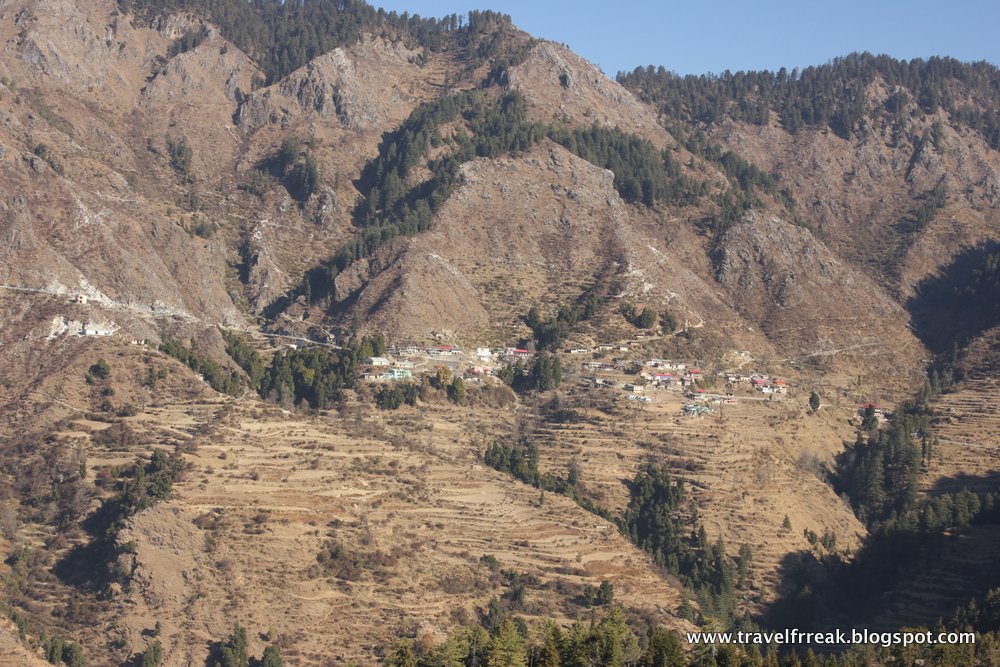
Every turn was so picturesque, with the bright sun, the bare mountains and the imposing villages on top of them. The mountains were huge, sometimes forested and sometimes bare. And on most of them you could spot some picturesque villages. I was very impressed with all these majestic views of villages on every turn. It felt almost unreal that in today's age, people would live such isolated lives, in places which seem almost unreachable to us. We also passed by a few locals on the streets, lot of them wearing the Himachali caps and all walking slowly. Smiling at us, when we passed them.

Village on a hill
Each of these villages had terrace farms around them. Sometimes all the way down till the valley. And you could see some goats and cows grazing around them. I also noticed that the cows here were of smaller size than the typical cows from the plains. We stopped at a maggi spot and I came across a small village which was made up of just a few houses on the mountain (spot them in the photo). And the only way to go up was walking. With all your luggage! This was just the starting of my fascination for these picturesque villages in these mountains. And I stopped everywhere to click a photo. I felt these are more captivating and natural than the alpine ones. But they don't get their due.

A tough trek down
At some point on the drive, we stopped at a spot to take a few photos. In a few minutes a passing vehicle dropped an old man. And then we saw him pick up his huge heavy bag and walk down to his village which was quite a walk down, on the cliff far away. Walking on the mountains has to be a slow moving activity, and he kept walking down, slowly. Everyday life in the mountains is tough. And I wish I could be as healthy as that old man I saw, who walked down the mountains, with a huge load on his back. One day I would like to go and live in one of these villages to actually experience how people can live like this even today...

There were tons of bikers on the road, all coming here for a weekend away from Delhi. Going for biking trips (especially on Bullets) is definitely something that has picked up in recent times. We also passed a few areas where there was snow and sleet on the road, left in the wake of the mountains where there is no sun. A biker group had skid there too before we came.

Villages in the mountains 
Before reaching our destination, we stopped at a picnic spot which had a hut to sit under and eat lunch. And I was saddened to see the trash next to it. Overall the mountains were so clean, but at places where tourists would stop, you can see so much trash. It pained my heart to see how heartless people can be with their own country. At times I picked up some of the trash to keep in the car, but it was too much for me to be able to do much.

View from our accommodation
Soon after the picnic spot, we came to a greener part of the mountains. There were pine covered mountains here unlike the bare brown mountains most of the way. And soon we came to our accommodation. It was an old English bungalow on top of a mountain peak. And had spectacular views of the mountains all around. We could see till 100s of miles, at range after range of smaller mountains in front. And there were trees all around. It totally felt like being in a fairytale. And our relaxation on the trip started here.

Sunset from the peak
We had reached our destination in time to see the sunset there, and were mind-blown with the view from the sunset point, which was on top of a peak. We could see snow covered ranges on one side and the sun setting on the other, over 10-15 different mountains of varying height. It was a magical feeling being on top of the mountains and watching this 360 degrees surreal scene. As the sun set, more and more colours came out in the sky - pinks, oranges and reds. And the colours varied depending on whether it was on the setting side or the other. This view lasted for at least half an hour, and felt really magical.

The snow covered peaks far off
As soon as the sun set, the weather changed and it got very very cold all of a sudden. In the mountains, it is customary to call it a day very early. So we came back and had our dinner early. Food feels tastier when in the mountains, and you eat a lot more when here. We were all guilty of that. We then spent time indoors playing cards and called it a night soon. The temperatures outside were around -10 degrees and the bungalow was quite cold inside even with the heaters. So it felt nice to be tucked under the blanket as early as possible.

Things have definitely changed here since we used to travel in the mountains around 20 years ago. We had no electric heaters then, or even electricity. We used bukharis, a locally made device for heating, known quite often for killing people with too much carbon monoxide if someone forgot to close it down before going to sleep. Also, we used to have generators only for a few hours in the evening to do all we wanted to do. But now there is electricity and cable tv all day. It felt different and more convenient now. But still it felt magical to be in the lap of nature, and feel that for a bit of time you are disconnected from the fast pace of life in the plains.


Day 3: In the Shivaliks, a small trek and the sunset again

The day today was quite a relaxed one. We just spent time casually exploring the areas around, as the main aim was to just be in the woods and take in the fresh air. We were lazy that day but my dad woke up early in the morning to see the sunrise at the same peak where we had seen the sunset the day before. And the colours were even brighter than the sunset the day before (we know it as we all saw the photos later on).

Spot the village
After a heavy breakfast, we all set out for our trek - we were going to visit one of the caves in the region, said to be linked to Mahabharat, which were an hour's drive from where we were staying. On the way, we again saw some magnificent views of the majestic mountains around, the deep valleys below and the dangerously perched villages all around.

The roads were of good quality, though quite narrow all the way, and every turn got us to a new viewpoint. It was very tough to not want to stop everywhere and just take in the scene. The sky was coloured a much deeper blue here, the hills more green and the sun very bright - it all felt very refreshing. Also, some of the mountains were fully forested but a lot of them were totally brown and bare too. It might have something to do with the wind or the sun direction I guess.

Villages in the lap of mountains
We gained height on the drive and started to encounter snow, on the road and in the forests. This was from the snowfall which had fallen a bit earlier in the starting of December. This was all the leftover snow, in the shadows wherever there was no direct sunlight.

The trek we were going on started from a forest rest house, but as we were driving towards it, we saw some of the cars had stopped and parked much before the resthouse. We were thinking of still taking our cars ahead, but then decided to park and walk the 3.5 kms till the resthouse. And it turned out to be a good idea, as soon we saw a lot of snow on the road, and there would have been no way we could have driven on it!

Snow on the trail
So we started walking on the snow and it was fun. The trail was wide enough and flat as it was still the road, and there was a lot of snow there, on the road, on the sides, on top of the trees, everywhere. Some of it had also turned to sleet. It made the walk quite interesting as at times, we were all slipping and falling (but not too badly). The whole trail had high deodar trees all around. And far off, we could see high mountain ranges (Himachal ranges I think), with their peaks covered in snow. The blue, white and green all around made for some very bright photos.

After walking around 3.5 kms, we came to the forest rest house which was from the British times (built in 1848). We stopped and had our picnic lunch there. We ran into a few local goatherds on the way and then some locals who were walking back to their village. They were carrying supplies on their head and mentioned that the next few weeks, they would be doing regular trips to the plains to stock up their groceries for the winter months. As the roads will soon close and make it tough for them to get out. It's a life most of us can't imagine, right? They also spoke Hindi with a Pahadi accent, and in a singsong voice. I really liked the accent, it was so calming, so friendly and cheerful to listen to.

Snow covered Himachal range
From the guest house, there was 2.5 kms of steep climb to the caves, but as we had already walked a lot, we decided to call it a day and walk back. While walking back, we ran into a lot more tourists on the trail, some of them walking in heels! Clearly they were tourists from Delhi, here for the weekend, with no idea what to expect in the mountains! And some had come here just to see the snow. Once they walked 5 mins in the snow, they were ready to walk back. Also as expected, we saw a lot more trash on this route too. It was quite disappointing to see it all. In fact, I decided that going forward, every time I go to the mountains in India, I will always carry a few plastic bags with me, to clean up as much trash I can.

We finished our trek in about 3.5 hours and then drove back to our accommodation, enjoying the grand views of the mountains all the way back. Again, we could see the multiple mountain ranges till where the eyes could see, with haze in between. And there were a few hotels on the way too, though most were in the large towns nearby.

I also learnt a bit more about the Pahadi people of these regions. The Uttaranchal region is made up of mostly the Kumaonis from the Kumaon hills, the Garhwalis from Garhwal and Jaunsars from this Jaunsari region. They lead simple lives living in the mountains, graze animals and farm one crop in a year in their terraced farms. They do have tough lives and are generally not rich but are still laid back, content and happy people. Religion is quite important in these mountainous regions and there are lot of temples all around. Dahasu Devta is the most revered devta in this region.

The evening sky
Once back, we went to see the sunset again as we had missed it by a few minutes the last day. And it felt as magical today as yesterday. Snow covered mountains on one side of the peak, and layers of mountains coated in hues of orange, yellow and red on the other. And this lasted for almost an hour after sunset. It was truly a spectacular show.

Our guide then told us, that in these mountains, there was some wildlife, like langurs, monkeys and leopards. The leopards generally come out at night, sometimes to eat the local dogs. Our guide told us to not fear them though and just walk back if we see one. I've heard this so many times, but I don't really know if I can remain calm at such a time or not. Either because of fear or even the excitement of seeing such an animal out in the wild! Am not looking to test it out soon though 😝.

Picturesque villages
After that, we walked into town for a bit. Most of it looked new and only one of the buildings seemed to be original, made of wood. To deal with the growth in tourists I suppose. The streets were all full of eating places and some hotels. We did come across one unique shop here though. It was selling some 10 different types of rajma, and many other spices and lentils which were local from this region. I found it quite interesting, to see all these different varieties available. And stocked up on a few too. I am sure, if nothing else, this is more organic than what we get in the plains.

The town looked quite touristy, and quite dirty I must say. Walking through the town, it did not even feel that the place was in the mountains. Seeing scenes like this I wonder, as much as I and everyone else enjoys exploring such new places in the mountains, we also bring so much trash along with us. Very soon these places lose their charm. Is it worth it?

At night, from our accommodation, we could see a lot of the twinkling lights of the villages till far away. That is when I realised there were lot of villages here. All far away and distributed, but still this place was more populated than I expected. Till quite late at night, there was still some moonlight and we could see the contours of the mountain ranges till very far. It looked especially scenic, with the twinkling stars and the moon in the sky. And we could also see more stars in the sky than usual. This was all so captivating, I loved the time I spent outside in the night sky that day.


continued... The enchanting Himalayas (2)


Monday, January 12, 2015

Trip down memory lane - Bombay


Memories from Dec 2019

I visited Bombay again last year, for a few days in December, and spent most of my time catching up with old friends and reliving old memories. I stayed in Bandra and met friends in the nothern suburbs. And I saw a side of Bombay I hadn't experienced much when I had lived there for 2 years. It was interesting, rediscovering a side of the city I thought I knew. Am penning down a few scattered thoughts from those days

Bandra villages
I stayed in Bandra with my friends over the 5 days and explored it like I have never done before, on foot 😊. Bandra feels like a small island in the sea called Bombay. It has always been different and has still retained its uniqueness and charm till now. With its catholic history and population, small villages and large churches in between the modern markets, the old bungalows and lack of high rises, lot of narrow winding roads and the slow pace of life it somehow has still managed to retain. Bandra also has a huge Christian population which was all too visible in December with the Christmas decorations and shopping going on all around.Its very difficult to explain how it is different from the rest of the city, only a Bandra-ite can feel it.

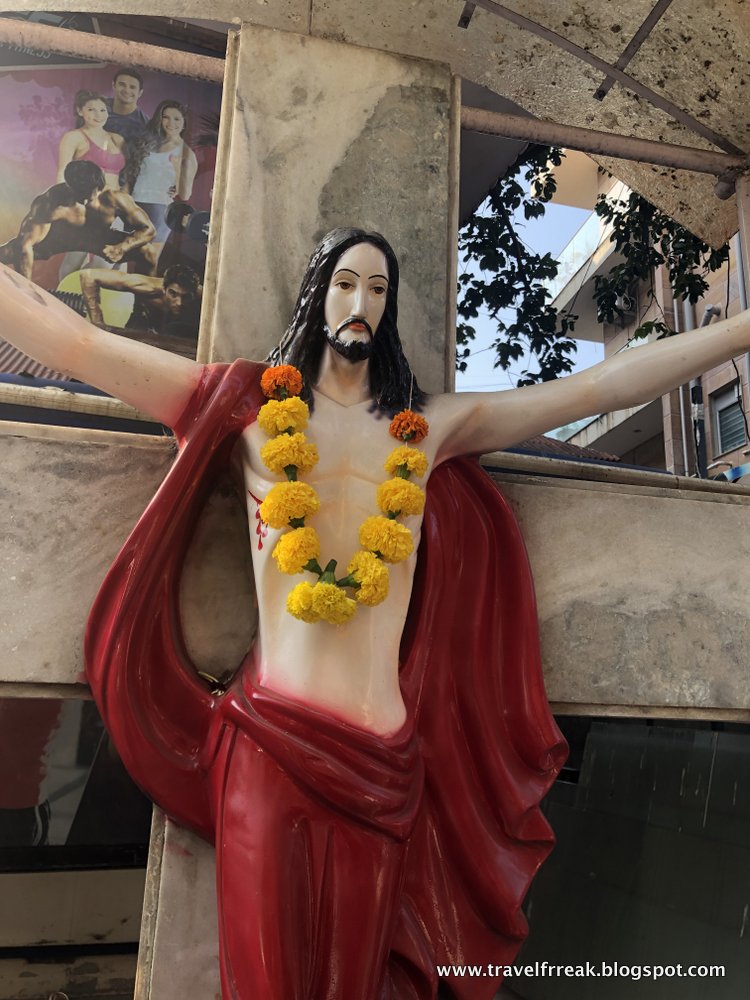
Jesus statues on corners
When meeting friends within Bandra, I generally walked to those places and enjoyed the views all around while walking. I once went through a village around Chapel Road which still felt like a village. With its narrow single lane roads and the old bungalows with English names, in need of repair but still standing as proud remnants from a different age. Those bungalows are so pretty, with their huge glass windows, green surroundings and an old colonial feel. I was also surprised to see that each turn of the road had a statue of Jesus Christ, wearing a flower 'mala'. Clearly, Jesus had been indianised here 😊. I also saw a lot of bungalows while walking from Carter road to Band stand, on the side and easily missed. Their beauty never fails to surprise me.

Bandra bungalows
Bandra also has awesome restaurants. With specialty dessert shops and international cuisines. And I loved spending time at Carter Road and Band Stand as usual. The houses on these roads have grown in height now, with the rich building up and up all the time. These sea side roads were quite popular haunts of mine during my time there. And walking there in the sea breeze is something I will always remember Bombay for. And this time I relived that feeling again, for old times sake 😊.

And on this walk, I saw the reality of Bombay again. As I walked back, I saw handicapped people on the streets at night, begging. And the clash between the rich and the poor of Bombay is something I never got used to when there. And till today, I can't deal with it. So I took an auto and came home rather than see this on the streets and feel helpless.

I made the one obligatory trip to Sobo one day, how can I leave Bombay without going to Nariman Point 😊? We went from Bandra to Sobo late at night so the traffic was bearable. And I loved the charm of old Bombay at night, driving in speed on the sea link, watching the newly developed skyline of Worli and Lower Parel and the beautiful new bungalows on Worli sea face, the old money of Pedder Road and of course, the cool breeze while speeding on Marine Drive. How many times have I driven here, with the windows open and friends around. The feeling I get when being here is of a simpler and younger time, when the world felt within reach. And it still feels the same!

I loved all the buildings of old and the vibe of Bombay, even at midnight. We then went to Gateway of India and walked around that lane. The Taj was twinkling and the road was lined with small old hotels from an old era. At the end was the fisherman village and their boats flapping in the sea. I think visiting Sobo is a must do for me always, for nostalgia sake. And it never fails to deliver. Being here, next to the sea always makes me feel alive and fresh.

On this trip, I also visited areas like Powai and Kanjurmarg where I had never been before. These places don't feel the same as Worli or South Bombay or Bandra, areas I spent all my time in and around. The two Bombays feel a world apart, as if they are from two different planets. One is from the old times, with grand buildings, the sea, lot of space and greenery and a poshness to it. The other is modern, filled with high rises, no space, lot of people and a hurriedness to it. Though Powai felt different. The drive was on Eastern Highway which was quite green. And Powai was also very green, with its modern high rises and green spaces.

Each of these suburban areas have become self-sufficient now with lots of restaurants and other activities, to keep people busy, so that they don't feel the need to step out (given how bad traffic still is). And restaurants have become a big part of people's lives. Even BKC has become a happening place now, with tons of eating places. I remember when I had once gone to BKC in the 2010s, we had to walk around a lot to ultimately only find a cafe to sit in. Restaurants have really bloomed now. There are awesome places everywhere, each chain has a restaurant in every area now it seems. I ate at a lot of restaurants and loved the ambiance there. My north Indian palate missed the north indian tinge to the food though!

View from Madh
One of the days, I wanted to get out of the city and we all managed to go to Madh Island. It is kindoff within Bombay but feels a long way off given all the driving you have to do to get there. But once there, you feel you have left the chaos of the city behind. We spent a full day in a hotel on the beach and it was lovely. Quiet, relaxed and not a lot of people around. The beach had yellow sand, some waves and lot of palm trees, to give it a real holiday feel. I would recommend anyone in Bombay to go to Madh when looking for a quick break. Its not out of the world, but definitely a convenient oasis within chaos.

And just like that, my trip was over. When I left, I had the same bitter sweet feeling I get every time I visit the city 😊. I don't like it but I still love so many things about it. The vibe of the city, its people and its sea. Its safety. It has so many layers, its sometimes difficult to understand how it all stays together. There is a positivity and earnestness all around. And perseverance and enterpreneurship, which is tough to find at a lot of other places. But the infrastructure and inequality always puts me off. And that feeling hasn't changed over the years. With the rich and the poor living in contrast together. Its tough to live with all this. And nothing is changing. In fact it may be getting worse.

But I do look at the city fondly now, always reliving the amazing memories it gave me over the awesome two years I spent there...


Memories from Dec 2014

I don't like Bombay!

Its a truth that I have said out loud many times before, but in some corner of my heart I always wanted to re-confirm my views. And they are confirmed again..

I visited Bombay this winter for a couple of days - a place I spent an amazing two years of my life, filled with friends and parties and restaurants and horse races and and rains and the lights at night and the sea faces and late night drives and mountain drives and ghats and the sea and the beaches and travels and so on... Every time I remember those two years of my life, I remember the great moments.. But all of them are not enough to pull me back!

The city
As my flight landed, and I spent the next three days in the city, I realised that nothing has changed at all, for the better or worse! The highrises were going higher and higher, still co-existing with the slums, the well to-do were still living their lives oblivious to the poverty around, Mumbaikars are still as helpful as before, the city still as safe to walk around, the buildings still look as dirty as before, its still hot in winters 😊, people still are running for their daily lives, women still walk around without worrying about their safety, slums havent reduced and the traffic remains as frustrating!!!!

As I said, nothing has changed at all. I don't know why I was expecting it to change either as its just been 4 years but I was...

The city
It did feel nice to be back, remembering the names of places we used to hangout at, the sea face, Phoenix Mills, Atria mall, CCD at Carter Road, Marine Drive, Bachelors, Lower Parel.. Trying to remember again the best ways to beat the traffic.. Getting frustrated with the traffic and going to Mahalaxmi Race Course for a lunch at Gallops - still makes you feel you are in a different world, away from Bombay, away from the madness.. Bandra with its beautiful bungalows and tree-lined roads from a colonial era... Looking at Colaba and Marine Drive, wondering what a pretty city it must have been at some time..

The good parts of Bombay remain, you just come to the city and then you feel as if you always belonged here. Nobody questions where you are from.. Nobody cares.. All these good things are still there.. But then there is the infrastructure which just kills it all for me. You waste more time in traffic than anything else. Its just these things which make me feel happy to not be back. Someday when that changes, I may want to go back to Bombay, but for now, I don't...