|
| Nainital at night |
Our itinerary was as follows:
Day 1: Drive from Gurgaon to Nainital
Day 2: Drive to Pangoot and do part of Kunjhakarak trek
Day 3: Visit Bhimtal
Day 4: Trek to Tiffin Top, explore Naini lake and walk all around it
Day 5: Drive back to Gurgaon
Getting there
One of the reasons we picked Nainital to go to was its proximity to Delhi. It was less than 7 hours away which made it quite convenient to get there. We had to cross all of Delhi though which may have been half the journey 😋. So we started early and after a 8.5 hour drive including breaks, we reached Nainital well in time before 4 pm to enjoy a bit of the views and feel of the place on that day itself.
The drive overall was much better than I expected, as I had been to Jim Corbett a few years ago and that road had been tough to drive on. But either that was a different road or these have been built in the last few years - this route was a nice highway drive for most of the way, with only a 1 hour patch which had broken roads and took an hour to cover 30 kms!
Most of the way, we passed by small towns, skirting most of them through by-passes and sometimes driving through their bazaars. Even though close to Delhi, these towns felt years away from the metropolis. Some were rural, some tier 3 towns. It felt as if life is still going on in a different era here. It all feels so rusty and dusty here, so surreal.
Getting there
One of the reasons we picked Nainital to go to was its proximity to Delhi. It was less than 7 hours away which made it quite convenient to get there. We had to cross all of Delhi though which may have been half the journey 😋. So we started early and after a 8.5 hour drive including breaks, we reached Nainital well in time before 4 pm to enjoy a bit of the views and feel of the place on that day itself.
The drive overall was much better than I expected, as I had been to Jim Corbett a few years ago and that road had been tough to drive on. But either that was a different road or these have been built in the last few years - this route was a nice highway drive for most of the way, with only a 1 hour patch which had broken roads and took an hour to cover 30 kms!
Most of the way, we passed by small towns, skirting most of them through by-passes and sometimes driving through their bazaars. Even though close to Delhi, these towns felt years away from the metropolis. Some were rural, some tier 3 towns. It felt as if life is still going on in a different era here. It all feels so rusty and dusty here, so surreal.
The upside of this drive were the beautiful fields and orchards that we drove through. There were miles of wheat and sugarcane crops surrounding us. There were some mango orchards we crossed which would soon bear fruit. We even stopped a few times on the way, to have our meals in the fields or buy local fresh fruits. It was quite green along the way, but in terms of development, most of the area didn't seem to have much. It felt rural, in a different era totally.
 |
| Fields of Bazpur |
Apparently lot of farmers from Punjab had moved here many years ago and developed this whole area into a rich and enterprising place, completely disconnected from the rest of UP we has just passed. We even stopped at a local farmers market here which had an amazing variety of products. We ate one of the tastiest jalebis ever from this local market. And also we stocked up on fresh vegetables to cook during our stay.
Right after Bazpur, we started going up the mountains, from Kaladoongi. It was a short one hour drive, and there was a sudden change in the air and temperature. There were forests on all sides and we could feel the air improving slowly. Apparently this is tiger region and we saw lot of danger signs warning us of potential wildlife, though all we saw were the usual langurs and monkeys on the way! Even though we stared hard, trying to spot a tiger somehow 😊. It was sunny and warm that day and a nice short mountain ride got us to Nainital very soon.
Our accommodation
We were staying slightly before Nainital, in Sukhatal in a friend's holiday home. It was a typical mountain house, built along the mountain, with a steep climb of 80 steps leading to it. Given space constraints in the mountains, there was no parking space. So I had to quickly learn how to park a car very close to the side of a mountain, so that it's not hit by passing vehicles! It was quite a learning for me, how to use every inch of available space, without the luxury we have in the plains.
The apartment was built in wood, cosy and comfortable for an enjoyable mountain stay. Like all the mountain houses are. The view in front was captivating, we could see the mountain in front filled with houses all the way up. And it twinkled brilliantly at night.
Given the existing pandemic we were cooking at home and avoiding going out much. Our home was self-sufficient. So we cooked and ate at home mostly, while appreciating the view of town from the window. And it was a totally away from the crowds kind of holiday. Also life in the mountains is very different, very slow. We got into it very quickly, and just lived like that over the next few days.
The first day we walked out to the the nearest hotel to ask if we could park our car there, and also ask them for a few tips on where to trek nearby. They had no clue! It was surprising, but not so much too. Clearly most tourists who come here don't trek, so there isn't a lot of information available.
We also went to the nearby market in Sukhatal to buy milk. It was a nice short walk, just going down the mountains. Walking on the road among the trees was pretty, but tough too because of the coming and going cars. In Sukhatal, there were a few small shops and buildings. But it felt like there were too many people there, so we came back up quickly. (After corona, just seeing crowds is enough to scare you off).
And every night, we would retire to our mountain home, eating and sleeping early, while enjoying the twinkling lights of the town across the valley. The days got dark and cold very quickly. It was tough to imagine how cold it would get as soon as the sun set, given how warm the days were, but it was so. We even had to sleep wearing thermals! So an early night in was always the best option. And it was charming to watch the twinkling lights in front, as the day ended.
Right after Bazpur, we started going up the mountains, from Kaladoongi. It was a short one hour drive, and there was a sudden change in the air and temperature. There were forests on all sides and we could feel the air improving slowly. Apparently this is tiger region and we saw lot of danger signs warning us of potential wildlife, though all we saw were the usual langurs and monkeys on the way! Even though we stared hard, trying to spot a tiger somehow 😊. It was sunny and warm that day and a nice short mountain ride got us to Nainital very soon.
Our accommodation
 |
| View from window |
The apartment was built in wood, cosy and comfortable for an enjoyable mountain stay. Like all the mountain houses are. The view in front was captivating, we could see the mountain in front filled with houses all the way up. And it twinkled brilliantly at night.
Given the existing pandemic we were cooking at home and avoiding going out much. Our home was self-sufficient. So we cooked and ate at home mostly, while appreciating the view of town from the window. And it was a totally away from the crowds kind of holiday. Also life in the mountains is very different, very slow. We got into it very quickly, and just lived like that over the next few days.
The first day we walked out to the the nearest hotel to ask if we could park our car there, and also ask them for a few tips on where to trek nearby. They had no clue! It was surprising, but not so much too. Clearly most tourists who come here don't trek, so there isn't a lot of information available.
 |
| Nainital in the hills |
And every night, we would retire to our mountain home, eating and sleeping early, while enjoying the twinkling lights of the town across the valley. The days got dark and cold very quickly. It was tough to imagine how cold it would get as soon as the sun set, given how warm the days were, but it was so. We even had to sleep wearing thermals! So an early night in was always the best option. And it was charming to watch the twinkling lights in front, as the day ended.
About the town
Nainital is quite a small town, settled around a small lake nestled in the mountains. The lake is the life and soul of the town. Tallital and Mallital are its two ends. One side of the lake has the Mall road, as usual built by the British. And the other side there is a walking path called thandi sadak. All the way up the mountains, are the hotels and houses of the residents. On one side of the lake the population is much more dense (Where the sun shines all day) while the other is quite sparsely populated. The Raj Bhavan is on the less sparsely populated side of town. And the mountains beyond the lake on both sides are more populated too, all the way to the top. They just don't have a view of the lake from where they are.
Nainital was settled by the British, as another spot for their summer holidays and you can see all the signs. The main road in town is called The Mall (like in Shimla, Mussoorie, Dalhousie and all the other Indian hill stations settled by the British). And it is lined with old colonial buildings and loads of gorgeous churches. There are also famous British schools, like the Sherwood school in Nainital. All from British times.
This place would have been like heaven more than 50 years ago, but now is not as pretty as then. Its become more crowded and definitely dirtier. The administration try to manage traffic well, making it one way and later on only pedestrian for some time in the evening. Its still well managed but seems to be growing without control. As we were there on weekdays, it was quieter than usual, so I ended up liking up. But I can imagine it not being as fun in the peak tourist season. Of course, if you can stay away from the city (like we did) in the mountains, then you can actually enjoy what the mountains have to offer - peace, quiet and calm. And go in to the crowded town only if needed.
We didn't explore Nainital much though, as we were staying away from crowds. One morning we drove by the lake, and one evening after finishing a trek to Tiffin Top, we went for a stroll in town, after sunset. We walked to the city centre given how crowded the traffic is. We first walked next to the High court (which was an old British building) all the way up to St Thomas Church - in the wilderness. It was a charming little church, in the middle of tall coniferous trees. It could have been the one I had photographed in Scotland! I could have been in Scotland. Except that there was garbage around, which reminded me that I was in India (after being in the West for so long, the lack of cleanliness on the streets, especially in the mountains in India hits my eyes too much!)
From the church, we walked down to the city center which is all around the lake. At Mallitaal, there is a Jama Masjid, a huge gurudwara and a mandir. It felt nice to see it all next to each other peacefully. And next to it was a cricket ground (clearly all religions are represented here 😂). There was a cricket game going on there - what a place to play cricket, isn't it?
 |
| In the Naini lake |
 |
| View from below |
 |
| Naini lake |
Then we walked back all the way along The Mall which had been made pedestrian only for the evening. We started with a break at the Army rest and recoup centre at the start of this walk. Just walking into the campus felt like a breath of fresh air, so open and relaxed all of a sudden. Being in army areas does that to me. Also, we had stayed at this place about 25 years ago, on our first visit to Nainital. We were kids then and had great memories from here, it felt nice to visit the place again after decades.
We then walked on the mall, all along the south side of the lake. It was mostly empty, and was a fun walk. Towards the end we shopped for the famous Nainital handicrafted and scented candles. Similar to the ones we had bought 25 years ago.
One of the evenings, we walked to Sukhatal which was 5 mins from where we were staying and went in for a walk into the Kumaon university campus. From the outside, it looked very inviting, full of nicely built buildings, spread along a valley. But once we were inside, it was completely different. It was a very small campus, full of run-down buildings. I really wondered if was really a university? Especially when you compare it to some of the larger campuses elsewhere.
Overall, I found Nainital less touristy than I expected, but that could be just because of Covid. We went in March when things were at their best, but it was still too cold for tourists to go to the mountains. That being said, the town is dirty and I seemed to notice it all the time. There was just so much plastic, everywhere. Even on the trails in the middle of forests! Its heartbreaking to see that. I wish someone would clean it. And people would stop making it so dirty. Then such places could rival any of the European places we visit in the Alps.
Around Nainital - Trek up Tiffin Top
One day we decided to do a short trek near our accommodation and picked up Tiffin Top. It is one of the peaks which have a panoramic view of the Naini Lake. It has a few routes up and we picked the walking path, away from all the touristy pony ride ones.
One of the evenings, we walked to Sukhatal which was 5 mins from where we were staying and went in for a walk into the Kumaon university campus. From the outside, it looked very inviting, full of nicely built buildings, spread along a valley. But once we were inside, it was completely different. It was a very small campus, full of run-down buildings. I really wondered if was really a university? Especially when you compare it to some of the larger campuses elsewhere.
Overall, I found Nainital less touristy than I expected, but that could be just because of Covid. We went in March when things were at their best, but it was still too cold for tourists to go to the mountains. That being said, the town is dirty and I seemed to notice it all the time. There was just so much plastic, everywhere. Even on the trails in the middle of forests! Its heartbreaking to see that. I wish someone would clean it. And people would stop making it so dirty. Then such places could rival any of the European places we visit in the Alps.
Around Nainital - Trek up Tiffin Top
One day we decided to do a short trek near our accommodation and picked up Tiffin Top. It is one of the peaks which have a panoramic view of the Naini Lake. It has a few routes up and we picked the walking path, away from all the touristy pony ride ones.
The way up started from Bara Patthar, near where we were staying and first passed through a few lanes with huge bungalows, hidden in the trees. They felt like a good place to live in the hills, away from everything else. And then there was a steep rocky path up the mountain, surrounded by trees on both sides. The path was mostly empty and shaded all the way. We did pass a few trekkers going up but very limited. And there were a few rhododendron trees along the way too. With the shade from the trees, it felt very fresh to trek up.
When we reached the top, there was a viewpoint with a 360 degrees view of the hills around. We could see all the developments along the hills, the city, the lake, Sherwood school, Raj Bhavan, and the villages on the other side. We could also see the snow covered Himalayas including Nanda Devi much beyond as it was a clear and sunny day. There was a cool breeze flowing and it felt exhilarating to be there there.


Then we visited our friends who lived on one of the hills around the lake. Getting there was a bit tough. There was no way to understand the route, so we continuously talked on the phone to them while driving. And it was tough - it was a steep narrow one way road up a mountain, through villages and under construction places. And at times it looked like we will never get there.
 |
| From top of Tiffin Top |
The peak had a few small snack shops and lot more people who had come on ponies from the town. As expected, the peak was a lot dirtier than the unused track we went up. After spending some cool moments on the top, we headed back to civilisation. It took us total of 2 hours to go up and be back. It was a nice short trek, totally worth doing. For its glorious views and the fresh walk up.
 |
| Panoramic view from Tiffin Top |
Trekking in Pangoot
I had a bit of a tough time finding treks to go on near Nainital, as most visitors who come here don't do trekking at all. Anyways after researching a bit online, I was able to find a few which were easy and looked fun. And as expected, they were all empty. The first one I found was the Kunjhakarak trek.
It starts in the village of Pangoot, which is about 40 mins from Nainital. The whole trek sounds amazing - it is about 36 kms, takes two to three days to complete and takes one through dense deodar, rhododendron and oak forests. A part of it also follows the Kosi river which sounded fun. And the best part was that it was mostly a downhill walk or through the plains and the valley. We did just a short portion of this trek, but it was fun nonetheless. It also turned out to be quite a well maintained trail too.
First we drove towards Pangoot village. The first 10-15 mins of the drive were a bit painful. Also because it was my first time driving in the narrow Indian mountain roads. And the roads were full! I soon realised that the local taxis here were the worst drivers. They were so used to this kind of driving, that they felt more comfortable than us. So they were rash and always honking - always in a hurry. It was as if they wanted to jump over the car in front and get ahead. I found the ones driving personal cars, especially from the plains so much more better drivers here. Even the ones from Delhi (and that's saying something!)! Clearly they were scared of mountain driving and driving much safer than the locals.
There were a few points of interest on the start of the way. We saw a bird's eye view of Naini lake and it was quite captivating. The day was a bit cloudy though, so we couldn't see the faraway snow covered peaks of the Himalayas from the Himalaya Darshan point. But once the sights were over, the roads were empty and there was no one. We soon drove into the Naina Devi bird reserve and there were just empty jungles all around. Huge tall trees shading everyone.
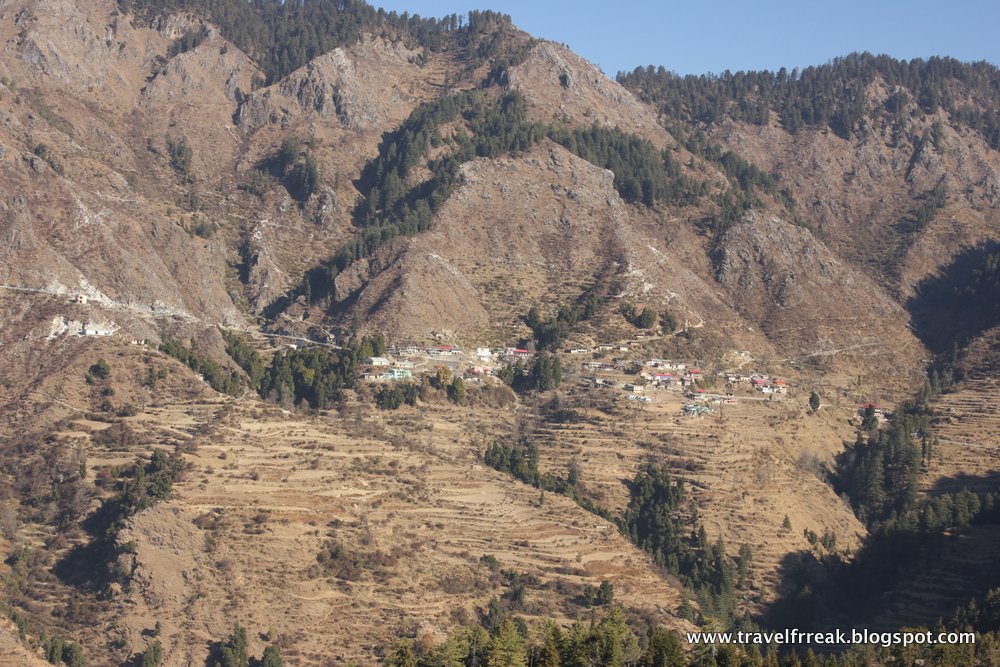
Once in the village of Pangoot, there were a few forest camps around. But it was still quite empty with very few people. And no one knew about treks even there! So we just found a path and started walking, assuming it was the Kunjhakarak trek. By this time, the sun came out and everything looked gorgeous. All around us were trees. Lots of rhododendrons, some full of red flowers high above. (The rhododendrons trees were all bunched together). At some parts of the trek, there were loads of bamboo plantations all along the cliffs. And the rest were all deodar trees.
Also the place was full of birds. At one point we could see 10-15 birds flying. But mostly we could just hear their constant chirping all around continuously. We also saw langurs and monkeys but they were again high above on the treetops. I observed a few jumping from tree to tree, showing us their antics. There were also a few empty streams and waterfalls on the way which would be full of water during the rainy season. And we came to a bridge where one way went up to a temple and one to a village.
We decided to walk up to a village that we had seen when we were on the other side of the valley. On the way, we ran into a few mountain dogs which we thought were kept there to bark and intimidate any visitors. The village was on the side where there was full sunlight. We walked up, and found the huts in a clearing and there were many bungalows there. It turned out later that it was not a village but a resort. All these bungalows were still being built. And I just thought to myself, after that this area will become polluted too, and lose its charm.
We walked a bit beyond the village and the vegetation was changing from deodar to pines. I also picked up a few cones from here, for home decoration. At this point we finally ran into a few people who were on the trek, away from the madness of the city. Anyways, this was the point where we turned back and walked back to the Pangoot village. We ended up walking about 5 hours total and enjoyed the time in nature, healing and refreshing as always.
As we walked through the village, we saw that there was a lot tourist hotels coming up on the other side. But there were less crowds than Nainital. We had tea at the Himalayan Cafe, with a view of the mountains in front. And started the drive back to Nainital.
On the way back we stopped at Tilbury rest house. It was built by the British, in 1921. The forest rest house in an old style bungalow, on top of a hill, surrounded by wild forests on all sides. You can even trek there from Pangoot village. It has 2 rooms available, and a guard who cooks for you if you come to stay here. And its easily bookable through the Uttaranchal forest website. We saw 5-6 honey badgers there, called bijju or maten by the locals. It turned out they were yellow-throated Himalayan martens. This is definitely the place to stay, the next time we visit. On top of a hill, in total seclusion. Surrounded only by raw nature, nothing else.
Bhimtal
One of the days, we drove to Bhimtal to meet some family friends there, do a small trek and generally spend the time around that lake as it was expected to be less crowded than Nainital. And the day turned out to be completely different. And better 😊.
It was a short drive to Bhimtal. We passed through the whole town of Nainital for the first time after being here for 2 days. We stopped just for a bit at The Mall, to take a few photos. It was busy, but still not too crowded. After crossing the town, we came to the other side of the mountain, which was less crowded. It was definitely the poorer part of town too, as the few houses there were too close to each other.
And then it was a drive through the mountains, to Bhimtal. It was an easy drive. We passed through a town called Bhowali which was quite big. And then at the bottom was Bhimtal. It had got very very hot by the time we reached. We walked a bit around the lake but felt it was too hot.
I had a bit of a tough time finding treks to go on near Nainital, as most visitors who come here don't do trekking at all. Anyways after researching a bit online, I was able to find a few which were easy and looked fun. And as expected, they were all empty. The first one I found was the Kunjhakarak trek.
It starts in the village of Pangoot, which is about 40 mins from Nainital. The whole trek sounds amazing - it is about 36 kms, takes two to three days to complete and takes one through dense deodar, rhododendron and oak forests. A part of it also follows the Kosi river which sounded fun. And the best part was that it was mostly a downhill walk or through the plains and the valley. We did just a short portion of this trek, but it was fun nonetheless. It also turned out to be quite a well maintained trail too.
First we drove towards Pangoot village. The first 10-15 mins of the drive were a bit painful. Also because it was my first time driving in the narrow Indian mountain roads. And the roads were full! I soon realised that the local taxis here were the worst drivers. They were so used to this kind of driving, that they felt more comfortable than us. So they were rash and always honking - always in a hurry. It was as if they wanted to jump over the car in front and get ahead. I found the ones driving personal cars, especially from the plains so much more better drivers here. Even the ones from Delhi (and that's saying something!)! Clearly they were scared of mountain driving and driving much safer than the locals.
 |
| Naini lake from above |
 |
| On the trek |
Also the place was full of birds. At one point we could see 10-15 birds flying. But mostly we could just hear their constant chirping all around continuously. We also saw langurs and monkeys but they were again high above on the treetops. I observed a few jumping from tree to tree, showing us their antics. There were also a few empty streams and waterfalls on the way which would be full of water during the rainy season. And we came to a bridge where one way went up to a temple and one to a village.
 |
| Village from far |
We walked a bit beyond the village and the vegetation was changing from deodar to pines. I also picked up a few cones from here, for home decoration. At this point we finally ran into a few people who were on the trek, away from the madness of the city. Anyways, this was the point where we turned back and walked back to the Pangoot village. We ended up walking about 5 hours total and enjoyed the time in nature, healing and refreshing as always.
As we walked through the village, we saw that there was a lot tourist hotels coming up on the other side. But there were less crowds than Nainital. We had tea at the Himalayan Cafe, with a view of the mountains in front. And started the drive back to Nainital.
 |
| Tibury forest guest house |
Bhimtal
One of the days, we drove to Bhimtal to meet some family friends there, do a small trek and generally spend the time around that lake as it was expected to be less crowded than Nainital. And the day turned out to be completely different. And better 😊.
It was a short drive to Bhimtal. We passed through the whole town of Nainital for the first time after being here for 2 days. We stopped just for a bit at The Mall, to take a few photos. It was busy, but still not too crowded. After crossing the town, we came to the other side of the mountain, which was less crowded. It was definitely the poorer part of town too, as the few houses there were too close to each other.
 |
| Bhimtal lake |
We also passed through a small temple on our walk. Later we realised this was a 1000 years old mandir which was next to the lake when this place was not even inhabited. We saw a photo of what it would have looked like then. It felt so soothing, and look what it has become now. A thing of beauty, destroyed forever.


Then we visited our friends who lived on one of the hills around the lake. Getting there was a bit tough. There was no way to understand the route, so we continuously talked on the phone to them while driving. And it was tough - it was a steep narrow one way road up a mountain, through villages and under construction places. And at times it looked like we will never get there.
And once when we reached there, it felt like heaven. It was a gorgeous bungalow in a huge space, overlooking the lake at its feet, with a 180 degree view of the valley. It was magical! We ended up cancelling the trek and spending the whole time at their place. The next few hours were just surreal - sitting with this view, seeing the sun set down. And floating away to a different place altogether. It made me question what we are all doing with our lives. Very few are actually able to live the retirement life we all want to. At least some people we know are living it
We had planned to do the Karkotak trail up the mountain, but left it as we found lounging at the bungalow so much more enjoyable. It was tough to leave the place. But we had to, and drove back while it was still daylight. While crossing Nainital, we realised it became less crowded and pedestrian only at night. So we planned to come here the next day. The visit to our friends place was definitely the highlight of this trip.
Coming back
Coming back was similar and uneventful, though we stopped at Khurpatal which was a small lake on the way where there were a few houses. It was so hot that we didn't wait there too long. And on the way back in UP, we had one of the best sugarcane juice I've had in my life. We ended up drinking many glasses of it, the taste still imprinted in my mind. And just like that, the short sojourn to the Himalayas was over. I do want to spend more time here than I have done till now.
Map
What more to do
There are lot more things to do which we didn't get a chance to do. There are a few more shorter treks to do to get good views of Naini and the mountains - Naina peak (also called China Top), Himalaya Darshan Point and Snow View peak. And if you go further from Pangoot, you can do the Guano hills and Lands end trek. Nainital is also famous for the Phool Dei festival which happens in the spring time.
We had planned to do the Karkotak trail up the mountain, but left it as we found lounging at the bungalow so much more enjoyable. It was tough to leave the place. But we had to, and drove back while it was still daylight. While crossing Nainital, we realised it became less crowded and pedestrian only at night. So we planned to come here the next day. The visit to our friends place was definitely the highlight of this trip.
Coming back
Coming back was similar and uneventful, though we stopped at Khurpatal which was a small lake on the way where there were a few houses. It was so hot that we didn't wait there too long. And on the way back in UP, we had one of the best sugarcane juice I've had in my life. We ended up drinking many glasses of it, the taste still imprinted in my mind. And just like that, the short sojourn to the Himalayas was over. I do want to spend more time here than I have done till now.
Map
What more to do
There are lot more things to do which we didn't get a chance to do. There are a few more shorter treks to do to get good views of Naini and the mountains - Naina peak (also called China Top), Himalaya Darshan Point and Snow View peak. And if you go further from Pangoot, you can do the Guano hills and Lands end trek. Nainital is also famous for the Phool Dei festival which happens in the spring time.