Showing posts with label 2018 APR. Show all posts

Tuesday, December 11, 2018

Caribbean diaries (2) - Miami, Panama City and San Salvador


Caribbean diaries (1) - Haiti, Trinidad, Martinique

Miami

Fort Lauderdale from the air
Miami was a base for us when I was in the Caribbean and I flew in and out from there many times (6 times at last count). So I got to see it lot more from the top than on the ground 😁. And it looked just like I had imagined. The skyline while landing in Miami was always enchanting. A mix of the high rises in the city, with sun and waves all around it. And while landing at places nearby, like Fort Lauderdale, you can see the retirement houses lining the coast, with their huge houses, swimming pools and palm trees all around. The whole coast is densely populated, with lots of buildings and palm trees lining it for tens of kilometres. Also once when I was landing, we also flew over a long stretch of swamps all the way to Miami, which made for pretty pictures. So from the top, it was definitely a different experience every time.

Miami downtown from the air
The airport experience though was never great. There were always long queues for immigration, lot of confusion and very rude staff every time. There was a lack of clear directions in the airport, especially when taking connecting flights between terminals. Immigration took forever, with the attendants very rude to you if you do anything out of the ordinary, like take out your phone! And the US flights are quite low in service anyways. The whole experience just leaves a very bad taste in the mouth. And it made me decide to avoid connecting through US airports as much as I can.

During my stay in the Caribbean, I twice stayed there for a night between flights (once in Fort Lauderdale and once in Miami), and once spent a whole weekend in Miami. My first night there was spent in Hyatt House hotel in Fort Lauderdale which was quite a disappointment. The hotel was very downmarket and full of very random and scary people. It barely had any facilities or eating options. I tried walking to the nearby mall but the sidewalk was closed. So I decided to order in the food and what came was so American - a lot of food! Overall my experience wasn't great and I would never recommend the hotel to anyone. But the drive there from Miami had been quite refreshing, with palm trees and holiday homes everywhere, and a nice relaxed vibe to the air. So clearly, there was something better in the offing in Miami.

Retirement communities
So I turned up there again, for a weekend, when we stayed in Miami and ended up doing nothing much really 😀. We were staying in a huge airbnb in one of the gated communities in the city and it was an amazing experience. Staying in a 7-8 bedroom house with multiple living places and its own pool was definitely a unique experience. We walked around the area a bit and got to see some of the huge luxurious houses around which were interesting.

The whole vibe of the city was so relaxed and it was raining the whole weekend. So we ended up just doing indoor stuff at a slow Floridan pace. Our first outing was a brunch in the warm weather at Morgans which was a nice start to the day. And we spent the rest of the day shopping at the Sawgrass shopping mall.  We spent some time walking in the Design District and Birknell, both of which seemed fun to explore. They were full of graffiti and street paintings everywhere. The city felt spotlessly clean, well lighted and quite posh. In the evening we went for dinner to Beaker and Gray and called it an early night.

The next day also, the weather wasn't too great. So we spent the rest of the day lounging in the Mandarin Oriental hotel, with a view of the waterfront. And so the weekend was done, without having done anything much. As expected, the ubers as is everything in the US were huge. But surprisingly, most of the drivers did not speak English which felt a bit of a surprise as we were in the US! But I guess, Miami is a lot more spanish as compared to the rest of the country.

Swamplands?
My last night in Miami was when I had missed a flight and ended up staying 24 hours in the city. I stayed at the W hotel in the city centre with a beautiful view outside of a river and a nice park. But the world cup was going on at that time and I ended up spending the whole day inside itself. So inspite of having spent so much time in Miami, I still haven't explored much of what it has to offer outdoors. And even after having been to Miami 4 times, I haven't managed to visit the South Beach yet! Maybe I need to go on another trip to Miami then?


Panama City

Boats moving towards Panama Canal
I barely spent 24 hours in Panama City but it somehow left an impression on me. A good one, one which makes me want to visit it again. The first view I have of Panama is of flying in and seeing the country from the air. When land slowly comes into view, and you can see hundreds of ships making its way into the Panama Canal. And then, we saw lot of beaches with high rises and resorts next to it, followed by vast lands of rainforests and then we landed in Panama City. As soon as we started driving through the city, I experienced a kind of richness which was missing in all the other places I had visited in the Caribbean.

The waterfront
And it turned out to be exactly that. Panama is quite rich and well developed as compared to most of its neighbouring countries. Most of it comes from the Panama Canal and its consistent stream of revenue, but over the years Panama has developed into a successful South American hub. A lot of the well educated people from around Central and South America come and work there, and its a nice melting pot of immigrants from across the continent.

A view of Panama city
The city felt very modern and lot safer than some of its neighbours. Again, I spent most of my time in the office and the hotel in the city centre which looked fab. The waterfront was full of people enjoying walks. There were malls, offices and apartments in highrises all next to the waterfront. And hills nearby behind the highrises. They all made for fascinating shots at sunset. There was the typical beach-ey feeling about the city, which felt relaxed and luxurious. And somehow I came back with the feeling that I want to spend more time there for sure one day.

My biggest surprise on the visit: Panama is a rich and well developed country, and a popular place for expats in Central and South America to come and work.


San Salvador

I spent two days in San Salvador, the capital city of El Salvador but again spent most of my time in the hotel and the office. I did get a good sense of the country though, based on the small visits I had outside and time I spent with some locals. The people in ELS are Mestizos and I could easily merge with them. In fact, many people spoke to me in Spanish when I was there 😀.

ELS is a poorer country as compared to Panama and very unsafe. We again had strict instructions to not go anywhere without security. I noticed lot of guards outside buildings walking around with armed guns, which clearly indicated that we hadn't got the wrong advice!

A view of San Salvador
There were lots of malls around. And the nice areas felt very nice. I went out to two malls for lunch and dinner and liked the vibe I noticed there. Good restaurants and people out in the warm weather enjoying the nice meals. Also the country felt a lot more conservative than what I had imagined all of Latin America to be like. In fact, there was something there which made it feel a lot like India - with its so many potholes and the difference between the rich and the poor.

As I said, I did not get to see much of the country. I had the option to go and see a volcano which was very near. However, I debated going there and decided against it after hearing how unsafe the city is. So I decided to leave instead for the airport, which again was a nice drive. I passed through lot of hills and green dense forests on the way to the airport. I did feel sad leaving without exploring the country, but maybe thats for another time 😀.

My biggest surprise on the visit: There was a volcano within 30 mins from the city of San Salvador.

Caribbean diaries (3) - Ocho Rios, Port Antonio (Jamaica)
Caribbean diaries (4) - Negril and Kingston (Jamaica)

Impressions of Japan (3/3)


Part 1 - Tokyo and Nagano
Part 2 - Kyoto and Koyasan

In the 10 days we spent in Japan, we mostly stayed in the central part of the Honshu island. And even though we stayed in major touristy places, we still got to get a good feel of the country. And this time was enough for us to realise that Japan is an island within itself (geographically and philosophically speaking). Even though it has integrated with the world now, it is still isolated in its mind, and happy with it...


The country

The overwhelming feeling about Japan is of a comfortable mix of the old and the new. As much as it still embraces its deep culture, it has taken modernity and perfection to a new level. The country presents a very nice picture of the country of today, ahead in technology and running itself in perfection. The number of machines and devices everywhere, the bullet train running to the second, and all of this in a spotless country make it seem perfect. It also makes it easy for tourists to feel at home and comfortable very soon (as we did too).

You can see advanced technology and modern infrastructure everywhere. The most famous of that is of course the Japanese toilet seat which is present everywhere, even on the trains. With 5-15 different buttons, all with very specific functions, they are a pleasure to use. And I always wonder why no one else uses them across the world.

The Japanese have a fascination for vending machines and you can see them everywhere, dispensing all kind of unimaginable wares. We even found a machine inside our temple in Koyasan! The train network both within the cities as well as across the country is very good. The Shinkansen of course tops it all. The smaller villages we passed on the way during our trains seemed to all have all the infrastructure that you would need. They felt well connected and comfortable to live in. So all in all, the country seems to be as modern as we have always imagined it to be.

There are very small other things all around which make tourists feel welcome very soon. All the hotels (at least the ones we stayed in) gave phones in the rooms, with local data and minutes all for free! All restaurants have plastic copies of food kept in the window to make it easier to order what they want. And everything is safe. You can even leave your wallet unattended for hours and still find it where you left it.

All these things as much as they make tourists feel comfortable things, stand alongside a lot more which wouldn't make it as fun to stay in Japan as an immigrant. And that is the different and lack of openness in the culture and the people. Most of the shops and boards everywhere are written in Japanese, with very few things described in English which would make it mandatory for people to learn Japanese to be able to live in the country. And the people also felt happy to be polite and helpful, but still very distant and aloof. Happy within themselves.


The cities

We visited a few cities, and passed through a few while on the bullet train. And they all looked quite the same. Very modern, with lots of high-rises, lights, malls on every corner and full of shopping. There are loads of cartoon displays and ads everywhere. And lots of gaming shops too. This is something definitely found lot more in Japan than other places I have visited. And shopping is huge everywhere too, especially beauty products.

Tokyo felt like a cross between Hong Kong and London somehow. At times, it felt like a normal city, quiet and residential, with single storey houses and lots of machiya houses peeping through the new constructions. But at times, it felt like a mad-house, with its high rises and flashing lights everywhere, and people always running somewhere.

The metro in Tokyo was very very dense with too many lines everywhere. The linking of the metro wasn't very convenient though, with sometimes long walks required to change lines at the same station. You even had to swipe the card again, as the lines were owned by different companies. Some of the lines had cushioned seats but most weren't as comfortable. There was also a lot of haze everywhere, I think the air is more polluted than London. Tokyo felt like a good mixture of the fast and the slow, but somehow not a city I would like to live in for the long term.

Kyoto felt very different though. It felt slower paced, as if it was in a different century all together. There were more canals and open spaces there, less high rises and lights, people walking around in their kimonos, and it definitely felt warmer and more liveable as compared to its faster capital.


The people

The Japanese people have lots of articles written about them, how some of their qualities are very deeply entrenched in their culture and in them. And its so true. You can see it in all their interactions, and its very cute and interesting to see it.

Some of the terms which are commonly used to describe them are diligent, polite, respectful, stoic and punctual. And you can see it in a lot of things. For example, we saw one of the guys in the airport putting luggage tags. And he was doing it with so much dedication and diligence, we couldn't have seen that anywhere (least of all in India). The ticket checker in the Shinkansen would bow every time he or she entered a coach and left a coach. Even if no one noticed them doing it!

They all love following rules, and we never spotted anyone doing anything which is not allowed. Sometimes they followed the rules too much, carrying out each of the steps required and I thought some of them were very slow in their jobs because of that. But I guess doing a job well is quite important in their culture.

Politeness and friendliness is everywhere. We all know how the Japanese like to speak respectfully with everyone, adding 'san' at the end of the name. And bow while speaking with everyone. During our visit, we also noticed that they take the effort to help you, with shopkeepers sometimes even coming out of their shops to give you directions. Which is quite unlike say, the US or even some parts of Europe. And even if they don't speak a lot of English (which a lot actually don't), they will still make a lot of effort to help you. Also, you can notice that many times they are frustrated with tourists and their manners or lack of respect for rules. But still, they contain their frustration and are nothing but polite to everyone.

The Japanese are generally very hardworking, disciplined and quiet. You can always seen them standing in a queue, especially while getting on the Shinkansen. And they would get on with no delays, within the stop time. Working late is quite the norm, which we noticed seeing the heavy office traffic (all in black suits) in the metro at 10 pm on a Friday. Most of them also wore masks, which I heard was because cleanliness and civic duty is high in priority for them. Some wear masks not to get sick, while other wear it not to make others sick 😇.

We also found them quite serious most of the time. All the people travelling in the metro were quiet. They didn't talk much or loudly, didn't even laugh much. And most of them were looking at their phone all the time. I think we were the loudest group at most of the places we went 😊.

While all this is very positive, I honestly did think that the people there lacked openness and laughter. It's good to be hardworking and diligent and disciplined. But sometimes too much of that can make you lose your ability to loosen up, relax and have a good time. Just a laugh here and seeing some lightness there was something I missed a lot in the country, like we have in India (too much of it I would say).


The culture

I don't think I can write a lot about the culture of Japan here, as that needs its own books. I will however write about some things I noticed.

The first of course was about the two main religions of Japan - Shintoism and Buddhism. Apparently both of them exist together, with each having its own use. A lot of the temples and shrines that we went to were one of the two. The Shinto shrines would have a Tori entrance gate, a place to wash hands and a place to worship but without idols. You can also get married in a Shinto shrine, as it is not as much as a place of worship as a place to get together. Their names always have ji next to them. Buddhism on the other hand had temples, with statues of Buddha inside and incense burners. And people went there to pray more than anything else.

I think the Japanese have mixed western ideals with their own values very well and co-exists\ with the traditional and the modern next to each other. You can see enough people in western wear as in Kimonos, and in some ways, I found that quite similar to India. They are quite a self sufficient country and do not encourage immigration much. In fact they have made it very tough and so its not a surprise that we did not encounter too many people from outside Japan living there other than the tourists.

The Japanese gardens are very specific to their culture and they love them. Their gardens have rock landscapes, flowing water, small wooden structures, wooden bridges and a mix of many types of plants. Which even if similar to other gardens has its own uniqueness. The Japanese also love food and that is obvious with the quality of food they have. We did not have much of sushi (!!!) but all the Japanese food and the Indian food we ate was all very tasty. And I think that signifies how much importance they give to good tasty food.


Few tips for travel

- In Tokyo, it makes sense to buy the daily metro pass. Depending on how much you travel, it will probably be cheaper than buying a pay as you go ticket
- Buy the JR pass for travel on the Shinkansen. It allows travel for a longer time, say a week but only for foreigners. So you need to buy it beforehand and they are delivered only outside the country
- If you travel in large groups, you can turn around the seats in the Shinkansen to sit facing each other 😊
- Book restaurants in advance as they get booked out very quickly, especially in the cherry blossom season
- If you are vegetarian, you can find amazing Indian food to eat. Just search for the good restaurants
- Buy Japanese cosmetics, especially Shiseido but even some of the local brands. Their quality is better than other cosmetics
- For each of the cities, especially Tokyo, choose a few things to do rather than trying to do everything. It can get too hectic and boring after a while if you try to do everything

Friday, November 30, 2018

Caribbean diaries (1) - The islands of Haiti, Trinidad and Martinique


This summer I spent two and a half months in the Caribbean, most of which was on the island of Jamaica but I also got a chance to visit a few other places around the region - the islands of Haiti, Martinique and Trinidad, Panama and El Salvador and frequent trips to Miami for connecting flights. As I was there on work, I did not get as much time to explore all these places as I would have liked to. But the time I spent there was enough to get a sense of what the Caribbean life is all about.

Somewhere in Martinique
I spent a few weekends in Jamaica visiting its beach resorts, one weekend in the island of Martinique, and a few days in Haiti and Trinidad. In addition I also stayed a couple of days in El Salvador, Panama and Miami during the same trip. So even though they are not Caribbean islands, they all feel part of the same region to me. Overall, the islands are quite similar to each other. Most of them are very small, have a mix of African and European descent population, a very specific Caribbean culture in terms of music, food, dance and feel, lots of pristine blue green beaches, warm weather and an overall air of fun and enjoyment. The Central American countries of course were a bit different.

An island from the sky
During my travels there, I saw a lot of the islands from the plane. And they were all looked so enchanting from the top. Small dots of land coming out in the sea out of nowhere. With the light blue sparkling waters around them, they looked as pretty from the top as they would have been when on the ground. Some of the images I still vividly remember are of the Bahamas which have many small islands all along a curve, all with shallow seas and light green waters around. Another of course is Cuba which though larger than the other islands seemed to have huge stretches of long beaches and shallow seas all around.

Being in the region, I also realised there are some 30-40 main islands and countries in the region. There were names which I hadn’t even heard before, so my geography definitely improved once there. There were islands still owned by the French - Martinique, Guadalupe etc, by the British - Montserrat, BVI etc., the Dutch - Aruba, Bonaire and Curacao; and so on. And there were small islands which I had not even heard of before. For example, there is a very small island called Antigua which has 365 beaches - one beach for every day of the year. And another small island called Montserrat which had a volcanic eruption and its population went from 12k to 5k suddenly. There are many such surprising things you find everyday about this lesser known part of the world, making it very interesting always.

I realised when there that the region has very bad air connectivity. Its not easy to get from one island to another directly. Some of the larger islands are connected better but it turns out that most places you can reach only via connecting from Miami or a similar farther hub. In fact, the island of Martinique has better connectivity and frequency of flights to France than the Caribbean itself! It also highlights the fact how the Caribbean which could have been a more united entity is quite fragmented and independent across the islands.


Haiti

I spent only two days in Haiti which were mostly in the office or the hotel. Most of my impressions are from what I saw from the car, the window or heard in conversations. So it is limited. But I think I still got a good sense of some aspects of the country.

My first view of the island when landing was captivating. When the plane was landing, we passed by parts of the island which were full of green dense forests and mountains everywhere. And I could see beaches on the coast as well as the Caribbean sun making everything bright. And then the capital city of Port-au-Prince came into view, extending till wherever the eye could see.

Most of the Haitian population was of African descent, on the roads, markets and all. But you see mostly whites in the hotels, offices and restaurants. The culture of the island felt more French than Caribbean, and Haitians speak French and Creole, rather than English. Also, its residents are crazy about football. The whole country apparently shuts down during the world cup and other such events.

After the first view from the plane, once I landed and was being driven to our office, I realised that Haiti was actually a poor and developing country. It is one of the larger of the Caribbean islands, half of which is the Dominican Republic. Haiti got independence about 100 years ago but its history has mostly been full of coups and spoilt by politics. So it is in a much worse state than the Dominican republic which is almost like a developed country, even though they started out together. And Haiti is the second poorest country in the world. It was telling that when I told the immigration officer while transiting from US that I would be going to Haiti, he asked me if I was a social worker...

View from the hotel
For the two days I was in Port-au-Prince, I mostly spent my time in the hotel and office. Haiti is a very unsafe country, and so we had been instructed not to venture out on our own at all. From the hotel, I got a view of the seas beyond and the place felt like paradise - clear blue skies dotted with some white clouds, blue waters and the greenery of palm trees everywhere. It felt like it was a paradise spoilt, spoilt by men, and their politics. When I read more about Haiti, I realised that even though Haiti has beautiful Caribbean beaches, very few tourists visit them because of safety issues. You cannot just walk anywhere, you have to drive around in armoured cars always. And that can't be fun.

The pool in the hotel
Another thing that struck me was that the hotel that I stayed in was outstanding, it could match any 5 star hotel from anywhere in the world. And that was when I realised that the rich across the world experience the same amazing life. Its only the poor whose life in the emerging and developed world differs. And so even in Haiti, there would be all these pockets which were luxurious where you would not feel you are in the second poorest country in the world.

Other than the hotel and office, one afternoon I did get to go out a bit and see the market and a few shops in Port-Au-Prince. Of course, I went in an armoured car and we had 2 bodyguards with us. We were also instructed to remove any jewellery, watch or phone when leaving the car. This level of unsafe feeling is something very few of us can imagine now. And it was almost a new experience for me.

During the drive, we drove through a lot of the local roads, saw all the houses on the hills but we did not pass by any rich areas. It felt like all of it was very downtrodden and shabby. I saw some small restaurants somewhere but not much else to do or see. Some of the shops we went to had the shopkeeper sitting behind bars for self-protection and to handle cash. And credit card system really didn’t exist in the country. It all felt so unreal, its very difficult to explain.

The main market we went to seemed like any other emerging market local market. People selling their wares, small shops and stalls and so on. However, the presence of the bodyguard was the only difference. When I asked my colleagues what could happen if we didn't have them, they said expats can very easily be kidnapped! So definitely not something we wanted.

The city looked beautiful at night though from up in the hotel, with the twinkling lights across the hills and the calmness of the sea beyond. At night, when the ugliness of real life was not visible. So even such places have their inherent beauty which no one can take away from them. But two days there felt a bit tough to me, and I was happy to leave when I did. It had felt a bit like a prison being there, being unable to do anything, walk around and so on.

My biggest surprise on the visit: Haiti is a very very poor country, with lot of crime and lack of safety. It came as a big surprise for me as I assumed all of Caribbean is happy and fun!


Trinidad and Tobago

I spent a couple of days in Trinidad, in the capital city of Port of Spain. Again I spent all my time between the hotel and the office, with barely any visit outside. So all I got to see was from the car. But it was enough to know that Trinidad was completely the opposite of what Haiti was. Trinidad is one of the well to do nations in the Caribbean because of its oil. And it was very visible everywhere.

Trinidad from the top
The houses were much better, the buildings bigger (and colourful) and the people seemed well off and more relaxed. I think money has a lot to do with that always. The infrastructure was much more developed than the other islands we visited. Overall the roads and all felt a lot better. The route from the airport to the capital almost felt picturesque, driving through agricultural lands, palm trees and views of small mountains far away.

It felt like Trinidad had its very own culture, maybe because it is one of the larger Caribbean islands and had a large population. They had more mixed people from different races. There was lot of random paintings and graffiti on the roads and walls. It has an annual carnival which is very popular to visit. The temperatures were amazing, clear skies above and palm trees lining most of the roads - totally Caribbean. There was also a very warm and relaxed feel in the air which I had missed in Haiti.

And the island has about 40-50% of its population of Indian origin, which was very visible everywhere. There were Indian people, Indian Hindu school billboards and people driving around with Hindu symbols on their cars. And I felt closer to home because of that. Its very difficult to explain how seeing something of my country somehow made me feel very comfortable in such a faraway land.

View from the hotel
As I said earlier, my view of the city is limited only to the hotel and the office. The hotel was a top notch 5 star property, located on the seafront and had a beautiful view outside of the sea and port. It also had amazing food especially the sushi restaurant which had a lot of vegetarian options.

As far as tourism is concerned, Port Au Spain felt more like an industrial city and apparently doesn't have many beaches around. If you go far off from the capital, you might encounter some pretty tourist places, beaches or turtle hatching sites. Also safety in Trinidad is again questionable, so tourism is low. The neighbouring island of Tobago is supposed to have much better beaches and is safer. Some of my colleagues went there and enjoyed it but I didn’t get a chance to go there. Maybe for the next time.

For me, the story of how so many Indians turned up in Trinidad is interesting, and moreover surprising that we were never taught that in our history. In the 1800s, thousands of Indians were brought almost as slaves to provide labour to the Caribbean when the African people became free. As would be expected, they were exploited and ill-treated. And very few of them made it back to their homeland even though they were promised safe passage back.

Its these Indians who stayed back who make up the Indian population in so many of the islands, like Barbados, Jamaica etc. but maximum in Trinidad. And I don't know if that is the reason or not, but the accent in Trinidad is different from the rest of the islands. It has a particular sing song tinge to it which is very unique. It is so sweet to listen to, I must say it is one of the best accents I have ever heard.

My biggest surprise on the visit: Trinidad has a 40% Indian population who came there as indentured labour with the British and decided to settle there. Also the Trinidadian accent has a very typical quality to to, like a singsong. You have to hear it yourself to understand it.


Martinique

Fort-de-France from the air
The next island I visited was Martinique, part of the French West Indies. It is technically France, uses Euros as currency and the Schengen visa works there. That was a surprise for me. Also, I got to spend about 6 days there including a weekend, so I felt a lot better that I was at least able to explore the Caribbean finally. Martinique is a medium sized Caribbean island, whose capital is Fort-de-France. It is the biggest town, with a few other villages in the north and south side.

In addition, given it is French, the island is quite popular with the rich French who like to have a holiday home here for the winter months. And so there are loads of those French Riviera kind of establishments with rich luxury houses along the coast. And there were a lot more white and French people around here than the other islands. So this experience definitely felt very different from all the islands I had visited in the Caribbean, most of it because it was "French".

Waterfront and the fort
As I was there on work, I was staying in Fort-de-France. And surprisingly, there were no chain hotels in town! So we stayed at the Simon Hotel which was quite nice, with a view of the sea, the main Fort, the waterfront, a small beach and lot of sailing boats in the water. The food there was quite French, so it got tough for me to find vegetarian food sometimes. But the views and the weather was lovely.

Streets of Fort-de-france
The capital felt quite average though. The buildings were colourful, but felt a bit run-down. The roads inside town were quite narrow. The fort was picturesque and there were loads of people enjoying on the waterfront next to it. I think it would have been a nice place to go, but we didn’t get much time. We also noticed some festivals happening there on the weekend we were there. So it did have an active feel to it. One of the days I visited some of the locals malls around which looked like any other French mall with all its french brands.

Within the town, we didn’t do much except one of our great finds, which was an amazing small restaurant called Lillies beach, for Friday dinner. It is located next to a not so great hotel called La Battaliere. You have to figure out your way somehow, and walk down a couple of stairs behind the hotel to reach this hidden gem. But it was paradise - a small little restaurant located right on the beach sand, hidden from all the world.

The atmosphere was very relaxed, the crowd quite mixed and upscale and the ambience one of the best I’ve ever seen. It felt more like a local haunt than a tourist spot, which made it even better. I loved it there. Imagine sitting in a cove next to the beach and eating food with the wind blowing in your hair and the waves providing the background sounds. The experience was priceless! And this was a great start to my first weekend in the Caribbean!

The island felt a lot prettier outside of Fort-de-France though. During the weekend, we spent most of our time outside, driving to the beaches towards the south side. The whole island felt a lot more greener than the other islands I had visited. There were small hills everywhere, the grass was very bright green, and there were loads of banana and sugarcane fields. With cows in the fields and lot of birds chirping everywhere. Martinique also clearly had a better infrastructure than all the other islands we had visited. The roads and cars were better, the people felt well-off and the air had a different feel to it.

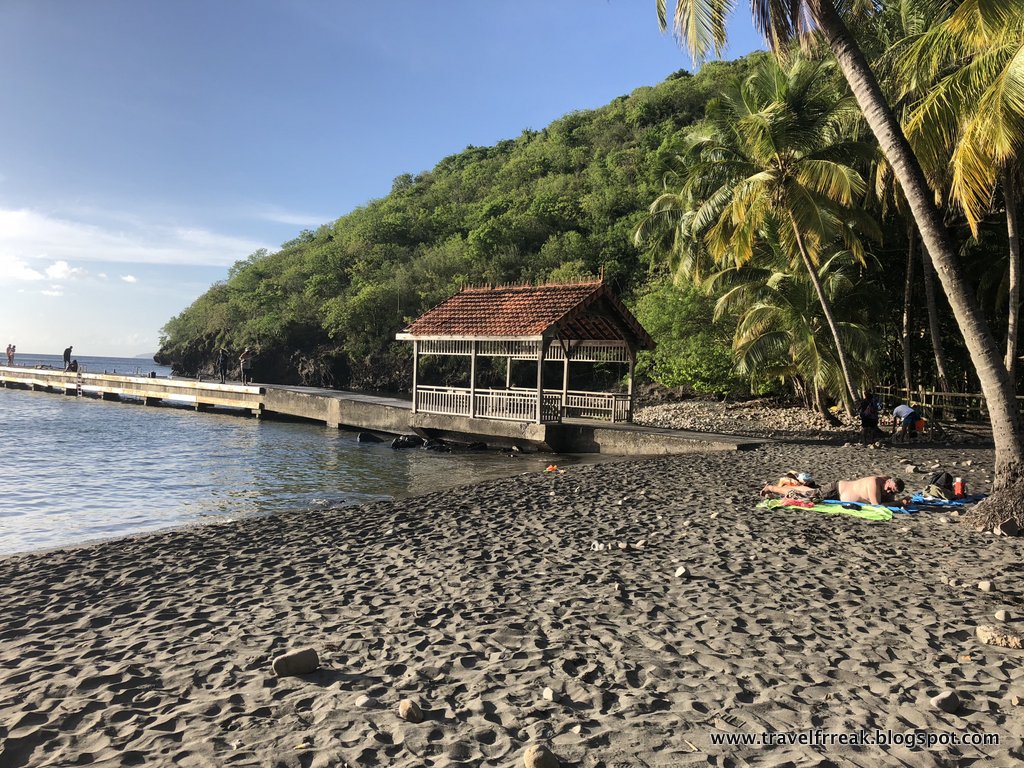
Anse Noir
On Saturday, we first drove towards a small black sand beach called Anse Noir. The drive there was amazing, up and down on narrow single lane roads through Caribbean rainforests which were very fresh, green and dense. It is among one of the best and freshest drives I’ve experienced. I totally loved it. We lost data at many places on the road but always continued on. It helps that there weren’t too many roads on the island, so getting lost was not really an option 😁.

Sunset at Anse DuFour
The beach though was a bit of a disappointment. It looked dirty even though it wasn't, and somehow wasn't as appealing as it should have been. There weren’t any facilities there either, so it wasn’t very convenient. Right next to it though was a small white sand beach - Anse DuFour - which definitely felt like an upgrade. It was lined with palm trees and as we were there long, I got some amazing sunset shots too. The water at both the beaches was perfect - warm, green and clear, just what you would expect from the Caribbean. Both the beaches also had a lot more white people than black, clearly marking it as a tourist spot. They had a lot more shops on this beach, which definitely made it more tourist friendly. We also sat at a cafe there which seemed a bit dodgy but provided great views of the sunset across the water.

While driving back, we first stopped at a village on the way and randomly explored the village and the local church. We then walked to the waterfront. And then we drove back to the tourist town of Les-Trois Ilets. It was an area next to the sea which was full of hotels and places to eat. We first walked into an open air area with loads of restaurants and stopped at one called le Bistrot D'en Face (I think). We sat outside for some time and had a hearty tasty meal there. It also started raining but thankfully it was the typical equatorial rain which stopped soon.

Then we walked a bit and reached a small bar on the waterfront called Kano. It felt like a hidden gem we had found and we sat there for some time just admiring the views of the sea and beyond. But when we were driving back, we realised that it was actually a main street restaurant which we had earlier crossed, so not really a hidden gem 😁. And then we were back to the capital later that night. Most of the island had felt quite safe, but while coming back, we stopped at a petrol station which felt dodgy. And that made us realise that we had to be more careful here than we were being till then.

Drive to Salines beach
The second day, I drove to a much longer and popular beach called Grande Anse des Salines, which was on the South most tip of the island. Google map there wasn’t helpful, so I ended up taking the longer route, and turns out that I drove through the posher parts of the island. On the way, I crossed some small towns - Vaughlin and Francois - which felt like the French Riviera, really. With beautiful palm tree lined avenues, orange roofed posh houses along the cliffs, and blue green clear water beyond. Isn't this what paradise would look like? 

Salines beach
On the way I also drove through the village of Sainte Anne, which had a lot of beaches too. I would really have liked to live in one of such places rather than the capital. These felt more fun and Caribbean. The Salines beach as expected was a huge white sand beach, extending for kms, with palm trees on the bank and people chilling in the water. There were loads of shops and facilities around, like any tourist place. And the water was warm, a lot of fun. And the drive back was through a different road, again very picturesque, with empty roads through green lands till wherever the eyes can see. I loved the drive totally.

In addition to the places I visited, there are more beaches in the north part of island which are worth going too, like Anse Turin and Anse Couleuvre (a black beach). And the volcano, Montaigne Pierre near the town of Saint Pierre too. All for the next time.

Overall Martinique felt like an interesting mix of European and Caribbean culture. In terms of quality of life, it was definitely French. As was the traffic, much more than other islands. The roads were top notch level, to European standards. Also service in most restaurants was quite bad, keeping the French-ness alive 😜. But when it came to the vibe, it was clearly Caribbean. Relaxed and fun. All in all, a fun place to stay on a weekend. I can now see why the French have kept the island still...

My biggest surprise on the visit: I realised Martinique was such a weird mixture of the French and Caribbean. With French rules and infrastructure, and Caribbean feel and air. But the locals don’t like to consider themselves Caribbean, they think of themselves as French 😊.


Caribbean diaries (2) - Panama City, El Salvador


Thursday, November 22, 2018

Japan, the land of the traditional and the modern - Kyoto and Koyasan (2/3)


Part 1 - Tokyo and Nagano

Day 6 - Shinkansen from Nagano to Kyoto; stay at Westinn; explore Kyoto - Ginkakuji temple; Philosophers path; lunch at Arasch; Heian Jingu shrine and gardens; Kiyomizudera temples; Gion street and Pontocho alley

The next day, we again took the train, first to Nagoya and then to Kyoto. It was a beautiful sunny day and the views outside felt even more scenic than before. The train to Nagoya was a slower scenic one where we passed by lots of small villages, with wooden houses and sloping roofs, people going about their agricultural activities, lot of hills faraway, rice fields extending till the hills, streams and ponds, and some snow covered mountains which apparently are known as the Japanese Alps. And on the way, there were a lot of cherry blossoms everywhere. Lining streets, canals and sometimes out of the blue randomly. We got a short glimpse of Nagoya town while changing trains and it felt very modern.

Cherry blossom in Kyoto
We finally took a bullet train in the day, from Nagoya to Kyoto and noticed how fast it was - touching 300 kmph regularly. It was banking a lot also as it moved. We were in Kyoto by mid-day (thanks to the bullet train) and our first view already gave us a different vibe than Tokyo. Kyoto felt like it was from a different era. It was a lot slower, lot more laid-back and lot more traditional than Tokyo. It had been the capital of Japan for more than 1000 years till 1870s when the capital was shifted to Tokyo. Also, we realised then that, Tokyo was named by inverting the alphabets of Kyoto 😇.

We took a shuttle from the station to our hotel and it took us through a main road right next to a canal, which was lined with cherry blossom trees. Even though the leaves had fallen a bit, the flowers still looked quite fresh and rosy. We also saw lot of women wearing kimonos, walking along the road. Our hotel, the Westinn was quite nearby and we checked in quickly. It had a history of hosting the rich and the famous in Kyoto. There were loads of photos in the lounge attesting to this fact. It had beautiful rooms and a nice hilly area outside. In fact, outside our window, we could see some beautiful gardens.

We left very quickly after checking-in as we had a busy day ahead and quite a few places to cover. Kyoto is full of temples and shrines, and they are the biggest attraction of the city. We however prioritised a lot and decided to skip a few of the spots. The first day we walked to all the close by places, and ran into tons of cherry blossoms lined streets on the way. And later in the day took cabs as we were too tired of walking. The second day, we rented cycles and cycled to the 3 places we had decided to prioritise and visit.

Ginkakuji temple
Today, the first place we went to was Ginkakuji temple which was built by a rich nobleman. The entrance was through a path lined with bamboo trees on both sides. The place felt a bit like a residence rather than a religious place though. It had a Japanese landscaped garden all along a hill and a few wooden shrines in the garden. The garden was very well landscaped with the typical Japanese themes of rocks, water flowing through and a variety of trees and shrubs. The garden looked stunning, with all the plants in differently hued greens, sparkling in the sun that was out that day.

Philosophers path
Our second stop for the day was one of my most favourite parts of Kyoto - the Philosophers Path. It is right outside the Ginkakuji temple and is a long pathway next to a small canal, again lined with cherry blossoms. The falling petals and reflections of the blossoms all along the water made this place seem stunning. There were many trees with weeping willow kind of branches, full of pink flowers and touching the water. And then there were small little bridges crossing the canal. It was picturesque and calm as we strolled along the path with every turn turning out to be a photo spot. It almost felt like a spiritual experience to me, just walking all along the path

After that, we finally stopped for lunch at Arasch which was a mixture of a Persian and Indian restaurant. They served naan, dal and ayran - a great mix and we devoured it all, it tasted so amazing. The food either was actually yummy or we were too tired after a full day of no food and would have liked anything anyways. But this restaurant became a favourite of ours very quickly.

Heian Jingu shrine
Our next stop was the Heian Jingu shrine which was a huge beauty in orange and blue. It was a huge shrine and full of people. There were loads of women in Kimonos who looked like tourists and were photographing themselves, everywhere in Kyoto. Apparently that is a popular thing to do among tourists.

Bridge in the garden
The Heian Jingu shrine also has a beautiful garden behind it with lots of cherry blossoms. We spent a long time exploring it. It had a long path, which ends in a small pond with a wooden structure right on it. The reflections there were beautiful and it was such a calm place, totally relaxing. Someone there was playing the flute and it almost transported the whole place to a different century. Slowly the lights started coming up and the place felt like someplace I could stay for long!

In the garden
Clicking the photo


View of Kyoto from the top
After that our group split and visited two other temples. And then we all converged at Kiyomizudera which is a Buddhist temple in orange on top of a mountain with a nice view of Kyoto below. The approach there passes through the Higashiyama street which is lined with small shops selling Japanese handicrafts. And the Kiyomizudera temple was all lighted up - all three structures shining in orange. And there was a beautiful cherry blossom tree on the top, which provided the perfect photo backdrop. By that time, there had also been some rains, the air felt clear and there was a very serene feeling everywhere.


Kiyomizudera temple
Kiyomizudera temple


After that we walked to our last spot of the day - the Gion area which is known as the Geisha district. We walked along Pontocho alley - the main Geisha street but did not spot any. It felt like a narrow but well lit street with a lot of narrow alleyways, small shops, tea places built of wooden structures and very quaint. I am sure we crossed Geisha houses but did not spot any.

We kept walking around for some time and then finally stopped at a sports bar where we had some American food for dinner. It was the most nondescript food we had in our entire time in Japan. And then walked back to our hotel. There were again lot of canals and cherry blossoms all along the way and it was again enjoyable. It did get a bit cold though by the end of the day. But all in all, it had been a lovely day, quaint and fun. And I had fallen in love with Kyoto by then.


Day 7 - Explore Kyoto: Tori gates at Fushimi Inari; bamboo groves in Arashimaya; Kinkakuji temple; dinner at Mughal; musical concert at Heian shrine

Fields on the cycle path
We kept the second day a lot more relaxed and visited less number of places. We rented cycles for the day and cycled to only 3 places during the day, plus visiting a concert at night. We got our cycles early morning from near the Kyoto train station and started for our first stop - the Tori gates at Fushimi Inari. It was fun to cycle on the roads, especially when we got slightly out of the city.

Tori gates at Fushimi Inari
Fushimi Inari is a shrine located around a hill. And once you walk past the shrine buildings, you come to the orange Tori gates which go all the way up the Inari hill. They create a tunnel of sorts, and when the light plays games, they look ethereal. Each of the gates have the name of the person who donated them written on them. There are thousands of them all along the way, and even though in many photos they appear red, they are actually orange. It is a bit hypnotising too walking through them all the way up.

And on the way up, there were many smaller shrines on the sides. All of them had the same theme, a few stones kept there and foxes sitting protecting them, with a few wooden tori gates put on the sides as donation. And at some of the shrines, there were Buddha statues too. So the whole place felt like a mixture of a shrine and a temple. Its a long way up almost like a trek, and given we had started late, we stopped on the way and came back. And some from our group went up there the next morning to finish the trek. I can imagine it would feel very very spiritual walking up through the gates early morning, something one should definitely do...

Countryside Kyoto on the cycle ride
Our next stop was the Bamboo groves in Arashimaya. It was a very long cycle ride there of about 1.5. It was fun, as we left town and cycled next to a river with rural landscape. It felt amazing, cycling at full speed, with the wind on your face while enjoying the scenes around. We also drove through some residential areas with pretty Japanese houses some of which were rich and some which were not, and then through some small back alleys .

Bamboo groves
As we started approaching the Bamboo groves, we could see the cherry blossoms concentrated along the river at one place. We parked our cycles there and then explored the area. There were again a lot of gardens and temples all around but we skipped most of them and just went to the bamboo groves. It was a nice walk, especially when the sunlight fell at different angles on the trees but honestly, I did not find it anything extraordinary. Also surprisingly, there was a separate and empty route for the rich people to explore the groves, which I found very interesting.

Kinkakuji temple
It felt like one of most touristy places around and was full of people, maybe because it was the end of the Sakura season. There were again loads of women in Kimonos. And the area was full of small shops. We had a quick lunch from a roadside stall as all the places were full of long queues. And then were off to our next stop - the Kinkakuji temple, a Zen Buddhist temple which had initially been built as a residence.

Kinkakuji temple
The Kinkakuji temple was a bit far and a few people told us not to go there, as apparently it was all uphill. We still did. And even though it had a bit of climbing up the mountain, it wasn't as tough as everyone had made it out to be. On the way, we crossed a few more shrines but did not stop as we had limited time. The temple was a golden one and its name means 'the golden pavilion'. It is set in the middle of a pond offering fascinating reflections and photo opportunities. It was nice to walk around and we got an excellent photo of a cherry blossom right on top of the temple.

Musical concert at night
Then we cycled back down to our hotel and were done for the day. It the evening, we visited a light and sound show at the Heian shrine. It was full of people to the point there wasn't enough space to stand or sit. The location of the show was around the pond. And the musicians gave a performance on 2-3 old Japanese instruments, standing in the wooden structure in between. The music was heavenly, and it was very easy to just get lost in the music, with beautiful views of cherry blossoms and the water all around. The garden was also all lit up which made the whole scene a lot more arresting. We spent an hour or so there and then were done for the day.

Another shrine I didnt visit
Our last stop of the day was the Mughal restaurant where we went for dinner. It was an Indian restaurant and had amazing food, though quite heavy. We had a hearty meal and soon called it a day. I loved Kyoto, the cultural depth and slow pace of life is something that I always prefer. We had covered the main spots in the two days but there are a few more places which were on our list but we never made it. They were Nanzenji shrine, Keage incline, Yasaka shrine, Maruyama park, Kodaiji, Haradanien garden, Ninnaji temple, Nijo castle, Tenryuji temple grounds and the Sagano scenic trail. Maybe you would?


Day 8: Train from Kyoto to Koyasan; explore the temples and shrines at Koyasan; stay at Ichijoin temple

The next day we had a relaxed morning in Kyoto and left for the train station in the hotel shuttle. We again went by the main canal of the city which looked charming with the cherry blossoms lining it, and men and women walking along in traditional Japanese attire. And the other side of the canal was full of pretty old wooden houses, right on the river bank. Part of it was also the Pontocho street where we had walked the day before. It all looked very old and ancient.

It was quite a trek to reach our next spot, Koyasan which was a very small village located in the hills and was a Buddhist centre of learning. So we took a bullet train to Shin Osaka and then a subway train to get to Namba. At Namba, you can buy tickets to Koyasan World Heritage which costs about JPY 3k. This provides for the travel to and back from Koyasan as well as entry to the site. Then you need to get to Gokurabashi. You can either take a direct train there or change two lines, both of which have a slight difference in fare.

Narrow stations on the way
We ended up changing the trains, and the second train to Gokurabashi goes through the hills through narrow ledges and narrow alleys in the mountains. It gains height every quickly and you start feeling you are in a different place altogether. Plus we encountered rain and clouds in the mountains soon and it started feeling heavenly, as if we were getting closer to the gods. And the last few train stations were located in a very narrow gap in the mountains, there was barely any place for the platform or for the train to pass. I wonder how (and why?) were all these stations made?

Once at Gokurabashi, you have to take a very steep funicular up to Koyasan. Once up the steep mountain, you can take the local circular buses which can drop you to the village centre and the temples you would be staying in. The same ticket that you buy from Namba in Shin Osaka is valid on all these modes of transport, all the way on the buses till your final location.

Koyasan is located in a valley with eight peaks all around, just like a lotus. The village was setup as a centre of Shingon Buddhist training. And there are many temples in the village where monks stay and pray, and which also offer a place of boarding to stay to tourists. Koyasan had 2000 temples at one time. Now there are only 80 left, of which about 50 take in tourists still. And even though its very remote and traditional, Koyasan still had all the modern amenities of living in a city.

Inside the temple
We got down from the bus at our temple stop - the Ichijoin temple - and then checked in there. It was a nice huge temple all built of wood. And you only wear the slippers from the temple when inside. We all had a very simple room with barely any utilities, but it had everything we needed. They had heated blankets under the table to keep warm. And even wifi, TVs and ACs. All the rooms had wooden floors. And even though basic, the place felt quite modern.

Garden outside the temple
Outside, there were loads of siting rooms for people to sit and meditate and some rooms to sit and have dinner. They were covered in traditional paintings and had a serene feel about them. Most of the rooms also had sliding doors, so you never knew if there was another room or just a wall behind the wooden partition. And they had different slippers for the bathroom too. There were even a vending machine inside the temple, I had never expected that. There was also a small little pond outside with fishes and its own Japanese garden. The whole place felt so disciplined and clean. There were lots of monks also around but we didn't see them much.

After checking-in, we went out for a walk in the village for about two hours and it felt completely like a hill station, with the cold, the trees and the mountains all around. All the houses around were wooden and simple. We also saw the local temple as well as a few pagodas. The first temple we went to was Kongobuji. And then we walked towards a collection of pagodas known as the Danjo Garan. One of the pagodas had a Buddha statue which was the first such big statue I had seen inside a building here in Japan.

By this time, I had started loving being in Koyasan, it gave a very beautiful feeling to be there , also because there were so less touristic crowds around. In the evening, it started raining heavily and started getting cold. So we went back to our temple. We had booked a night tour of the cemetery (which is a popular thing to do here) but it got cancelled given the heavy rain.

Multi-course dinner
So we all had an early dinner at 630 pm in the temple. They served pure vegetarian food there - a multi-course dinner with loads of different kinds of small servings, known as the Shojin Ryori meals. It was very tasty and all vegan. We also all dressed in the traditional attire of the temple for the dinner.

After dinner, some of the people in the group still went out for a walk in the rain to the cemetery! It was apparently fun (and scary and cold) but I chose to stay inside in the warmth of the temple. The doors of the temple are locked at 9 pm and after that, we just played some cards inside. There was also an onsen within the temple which was good to use at night. The whole stay in Koyasan felt like a great way towards the close of our trip, to slow down and enjoy the depths of Japanese culture, and I was totally loving it.


Day 9: Explore Koyasan: morning prayer at temple; visit to cemetery; train to Tokyo; stay at Otani; explore Shibuya and Ebizu; dinner at Priya

Children's resting places
The next morning, we first attended the Buddhist prayers in our temple in the morning, starting at 6 am. The inside of the temple was the most decorated Buddhist place I had seen in Japan as most of the other places were never so colourfully and lavishly decorated. It was within the temple complex and lot of the tourists were sitting on the side, while the priests sat in the prayer area and prayed. We did not understand what they were saying as it was in Japanese but we could feel everyone meditating. There was a lot of chanting during this time and again, I experienced peace. And then we had the simple temple breakfast, again with multiple courses of vegetarian food.

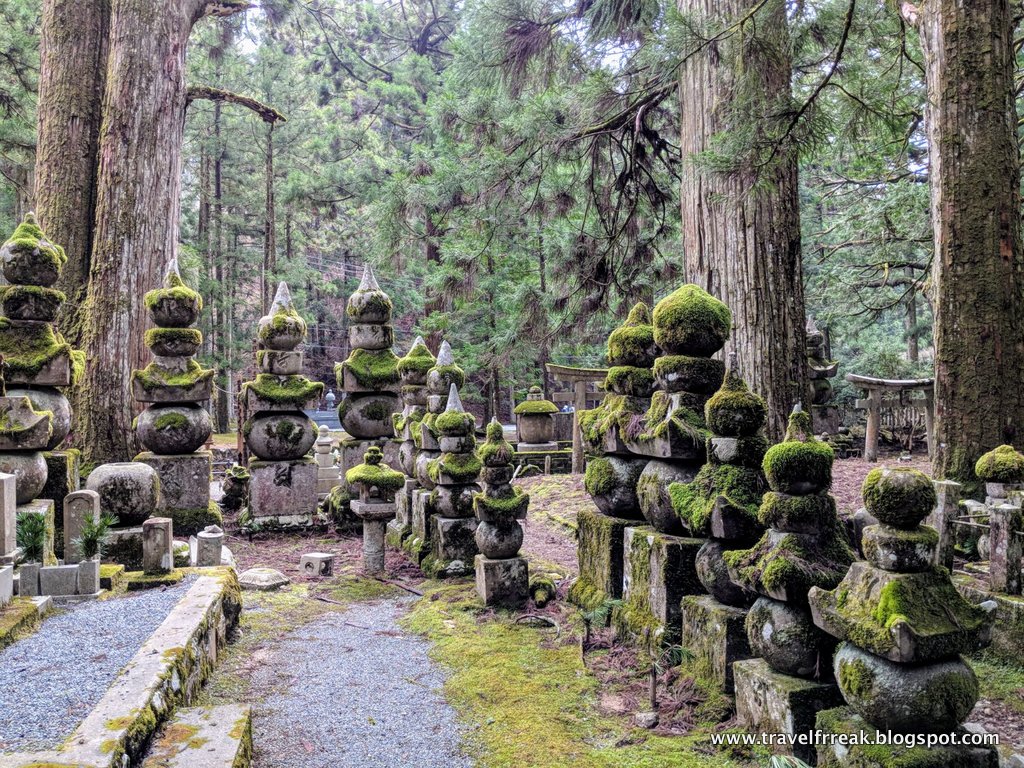
Tombstones in the cemetery
We then split into two groups. The first went back to Tokyo while the other stayed back in Koyasan as we wanted to stay away from the chaos of city life for as long as possible. We then went for a walk to the cemetery which the village was most famous for. Apparently, the version of Buddhism followed here was started by the monk Kukai (Kobo Daishi) who lived and died here and is buried in the cemetery. It is said that one day he will rise from here. And so lords and common people for the last 1000 years have been putting up tombstones along with him in the cemetery. And it is said that when he will rise, the rest will also rise with him.

We walked through the cemetery and it felt like walking through 1000 years of history. All around were huge tall Japanese cedar trees which must be 100s of years old. There were huge stones and monuments to famous people. And then smaller ones which you can see are for normal people. And then there were the small Buddhas with caps and red clothes which are children's tombstones. It was eerie walking through this but also again calming. And that is one of the things about Japan I remember a lot - the calm and peace.

Stone or pure heart
We walked till the end of the road and there were some places of interest on the way. There was a well where if you cannot see your reflection, you will die within two years! And then a stone where you can (apparently) hear the cries from hell underneath if you put your ear to it. And then a structure with a stone inside, a stone which you can lift and move easily only if you have a pure heart and haven't sinned.

Hall of lanterns
At the end of the walk is the huge Buddhist mausoleum where we sat and prayed for sometime. They had a hawan like activity going on there for a long time. Next to it was the hall of lanterns where the lanterns have been burning since eternity. The entire place felt like from a different era and this was also one of the highlights of the trip for me, the visit to Koyasan. While walking back from the cemetery, we walked into some shops which were very small coffee shops. And they also felt different after our whole spiritual experience at the cemetery.

Mt Fuji from afar
Once back from the cemetery, we went back to our temple and started our trek back to Tokyo - along the trains and the subways and the bus and the funicular. I felt sad saying goodbye to a place of such peace, to go back to Tokyo! It took us about 7 hours to get all the way back. We also crossed Mt Fuji on the way and were mesmerised by the view. It felt like Mt Fuji was a standalone huge mountain in the middle of nowhere and still covered with snow. I could also see why its revered so much, it looked so majestic even from the train!

We reached Tokyo by the evening and then went back to Shibuya to walk around before dinner. We saw the busiest intersection again and a couple doing their wedding photography there! We then had another Indian dinner at Priya. The food was as usual amazing - must say the Indian food at Japan did not disappoint us at all.

After that some people wanted to party and we kept looking for an hour for the area called Ebizu. We walked around a bit and once we reached there, it turned out to be quite a downer. The pubs were very small, had no place to stand and allowed smoking inside in the small places. Definitely not my kind of a place. Anyways it was time to say goodbye to Tokyo soon as we had an early morning flight. After a quick stop, we then came back to our hotel for a quick nap before leaving again.


Day 10: Flight back from Tokyo to London

We left quite early for the airport and were off for London, again through Beijing. Sometimes you can see Mt Fuji from the flight too but we sat on a side which didn't have the view 😔. We again had a long stop in Beijing and were subjected to the Chinese lack of politeness which felt quite the opposite of what we had seen in Japan. And they scanned everything again! And we were soon back in London. Surprisingly, we saw (or definitely noticed) a lot more cherry blossoms in London this time after having seen them all around in Japan.

The trip felt so long and deep, it felt like we really had got involved with the country. I loved experiencing the cultural aspect of Japan, a lot more than the lights and the developed side. And I also realised that we had been able to explore only a very small part of what all Japan has to offer. I think another trip back there is definitely going to happen someday.

Part 3: Impressions of Japan