After our stay in the Gran Canaria island, we spent a couple of days driving around in Andalusia, the southern (and warmer) part of Spain. We flew to Malaga from the Canary Islands and straightaway drove to Sevilla. We spent a day in Sevilla and then came back to Malaga. Once in Malaga, we spent a day exploring the town and then did a day trip to the hill station of Granada. Driving around was quite comfortable as all these towns are about 1-2 hours away from each other.
What I remember most about this leg of the trip was the warm(er) weather and the non-European culture of Andalusia. It was a lot warmer here in December than London, with temperatures ranging in the early 20s. This made the walking around and exploring the towns quite comfortable. And this region of Spain has a Moorish (Arabic) influence which was in juxtaposition with the European feel in the rest of Spain. This mixing of cultures made for interesting towns to explore; in terms of their architecture, handicrafts, look and feel of the towns, history and music.
All the three towns were quite similar in some aspects. They all had cathedrals in the city center, a fort or a major palace from Moorish times and an enchanting old part of the town with narrow lanes and memories of a very distant and different past.
Sevilla
 |
| Sevilla old town |
In Sevilla, we spent the whole day walking around the old narrow cobbled lanes of the city center, eating tapas in the various cafes when tired of the walk and enjoying the sun which had made the day very warm. We took a map of the old town which guided us to the main sites to see and the rest of the time, we just walked around on whichever street seemed interesting to us.
 |
| Church of del Salvador |
The first church we went into was the Iglesia del Salvador (which I mistook for the main cathedral). Inside the church, there were intricate sculptures made of solid silver and and huge Christian paintings all around. They were one of the best I have seen in Europe and very impressive. The square just outside the church was also fun, it was full of people enjoying the winter sun while being out for Christmas shopping. There were vendors selling street food and performers entertaining the kids.
 |
| Sevilla cathedral |
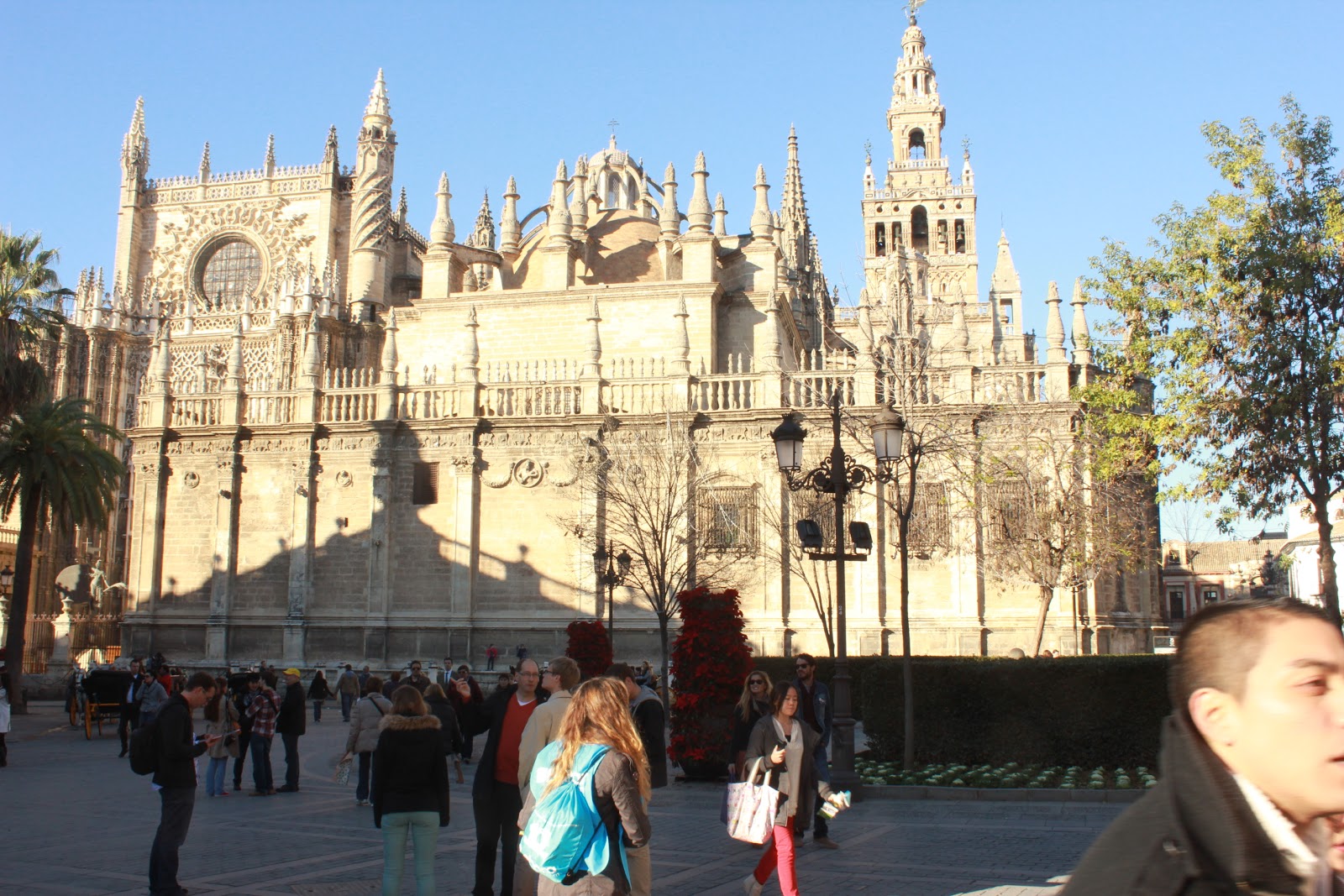
After del Salvador, we reached the cathedral of Sevilla which is a huge Gothic structure built of light brown stone. We had had enough church visits for the day and so decided not to venture inside but have heard that its a beautiful cathedral.
 |
| Giralda Tower |
Just next to the cathedral is the Giralda tower; a huge architectural marvel which provides good views of the city from the top. It might be worth visiting though we did not go up. (In a lot of European towns, every place is hyped up so much that you end up spending money on things not really worth it. I would say its a good idea to decide before-hand what place you would like to pay and visit, rather than going everywhere the guide books tell you to!)
 |
| Alcazar Palace |
 |
| Alcazar Palace |
We did visit the Alcazar palace though (or castle as its called), which is located just next to the cathedral. The palace was a remnant from the Moorish reign of Sevilla, and was built in the Arabic style. It had grand rooms with exquisite designs made in marble on the walls, all clean and well preserved.
The designs in the palace reminded me of the marble carved windows and structures from the Mughal architecture from India, in Agra, Delhi and some places in Rajasthan. I would say that the work in these Indian palaces and forts is grander than Alcazar, except that here, the structures were a lot better in terms of maintenance and preservation as compared to India (there were no names written on the walls by visiting tourists as it happens in India!). And this cleanliness makes it look a lot better than what we have in India, which is a pity given that we have much better palaces in India. But that's how it is!
We also took a horse carriage ride around all the touristic areas around; the Torre del Oro tower, a bull fighting ring, a couple of museums and the Parque Maria Luisa park. The carriage ride was a good way to just ride through all the worthwhile areas and then decide which of those places you want to spend more time at.
 |
| Playa de Espana |
 |
| Playa de Espana |
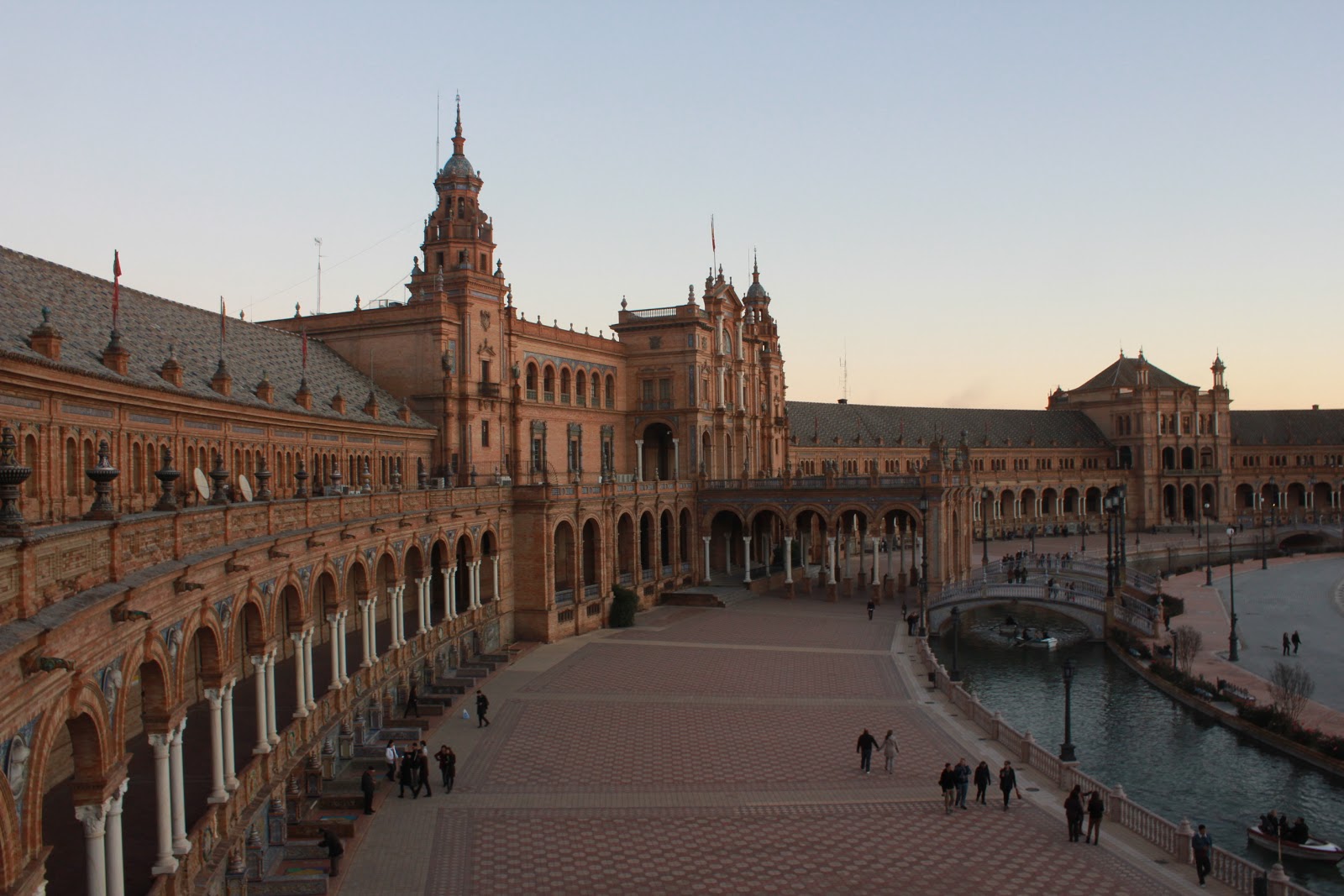
After the carriage ride, we spent some time at the Playa de Espana, which is a huge brown sandstone Parliament building located in the center of the Maria Luisa park. It is built in a semi-circular shape, with fountains in the center and a flowing canal in front where people can choose to boat (in Venice-like gondolas).
In the setting sun, the building looked mesmerising; the brown of the building and the yellow of the sun playing games with each other. We also liked walking next to the base of the building; around the semi-circle, there were mosaics contributed by each of the cities of Spain which were interesting to look at.
 |
| Santa Cruz |
After Playa de Espana, we spent some time in the Santa Cruz area of the town, which is another of the old and handsome part of town with cafes and eating places spread everywhere. It was relaxing after the hectic day to just walk around lazily and stop for a cup of coffee whenever tired or just flick through the souvenirs being sold in all the shops. Sevilla is also famous for the tomb of Columbus which we did not get a chance to see. Might be worth visiting next time.
We had dinner at a restaurant called Giralda, just next to the Giralda tower which actually had tasty vegetarian food. If you ever get to eat there, would recommend the paella, it was just so yum and tasty, a must try!
In Sevilla, we stayed at the Barcelo Renacimiento, an executive hotel located outside the town on an island. It was a good and relatively cheap hotel. I did realise though, that it makes sense to stay close to the city center, as it makes it much easier to go in and out your hotel especially if it gets cold and you need to either find a sweater or else buy one!!
Malaga
We spent the next day exploring the town of Malaga. It was not as extensive culturally like Sevilla, as Malaga is more of a beach town. Nevertheless, we found it to be very lively with lot of things to do.
We first went to the Malaga Gibralforo fort perched on top of a hill, which was again a remnant from the time the Moors ruled over Spain. It was quite average honestly, with a museum with some displays of those times. The view from the top of the fort though were fascinating, a birds eye view of the town below, the sea on one side and mountains far away on the other side.
The rest of the day, we spent exploring the narrow lanes of the town. The cathedral was a beauty; huge, light brown and with crowds all around. And surprise, there was a tower next to it for views of the city!
 |
| Malaga cathedral |
 |
| Malaga cathedral |
Malaga was the home of Picasso, and we visited his house since we could not see the museum as it was already closed by the time we reached. Picasso's house is definitely a miss as it has nothing commendable to see or appreciate. But just next to Picasso's house is a restaurant called Picasso, another place I would recommend as the food served there is a lot tastier than a lot of places around. Plus the waiters are quite fluent in English which feels like a boon!
 |
| Malaga main street |
The main street of Malaga was especially lively at that time of year as it was Christmas time. So there were lighted decorations over every street, christmas trees on every square, shops on sale and families all out having a nice time in the streets.
 |
| Street performers |
And then there were the street performers to keep the people entertained, and there is one I should definitely mention. The photo here shows two street performers and I am still not sure how they managed that! It was espeically interesting to see how the kids were all trying to figure out the secret of how the man was floating in air so effotlesslessly. Any ideas?
There were
hajaar places everywhere to just sit around and enjoy the scenes in the small streets of the city center. Each of them providing a good view around, plus tasty titbits to eat. There were also flamenco dancers and musicians carrying guitars coming in regularly to the restaurants to entertain the guests and ask for money thereafter. It felt a little like begging though, and very unlike a first world country. Visiting these towns also make me wonder how Spain fits in with the developed world; it did not feel so given the poverty among the the people in the smaller towns.
|
|
| Castillo de Santa Catalina |
The hotel we stayed in Malaga was earlier a castle: Castillo de Santa Catalina. It is a definte recommend. Castillo is located slightly outside the town but its a lovely place to stay. Its not a huge castle but a smaller one, with a couple of tastefully done up rooms and well-maintained gardens all around to spend time in.
 |
| View from Castillo |
From the towers of the castle, you can get a panoramic view of the city lights and the sea (and Africa also maybe?), and enough place on the terrace to relax while taking in the view. Also, given that the castle is located outside the town, its a very quiet place to relax on the trip.
 |
| View from Castillo |
We did not get much time to spend there though, but it was definitely a high point of the trip. I also noted that space management in the castle was not the best. They could have a lot more rooms than what they have currently, if they just would just optimise the space a little more. Then possibly more people can enjoy this beautiful experience.
Granada
The next day. we did a day trip from Malaga to Granada, with the drive taking us through mountains and fields and small villages on the way. It was not the most picturesque drive I have been through though (and not at all like the breathtaking views of the Spanish countryside we had seen in Zindagi Na Milegi Dobara) but it was short enough to not be boring:).
 |
| Highway 'services' |
On the way, we stopped at the local service eating places which were a nightmare to get vegetarian food at. The only options available would be potatoes and bread and cheese, and the fact that we knew how to say 'no meat' in Spanish was a big life saver.
 |
| Granada |
Granada was a beautiful town, maybe the most charming of the Andalusian towns we visited. It was located just next to the Sierra Nevada mountains which form a picturesque background to the town. They were snow covered at the time of the year, and consequently Granada was a lot cooler than the other towns. It is situated on hilly ground and hence has roads going up and down giving it a charm of its own.
 |
| Entrance to Alhambra |
We spent some time in the square next to the huge town hall, eating and then watching the local performer catching hold of tourists walking by and embarassing them. Then we went up the Alhambra, the royal palace, located on top of the hill. The entrance to the fort was pretty, green paths winding up the mountain; the image looked just out of a painting.
 |
| Shop in Alhambra for clicking pictures |
Inside the Alhambra, you again see the same Arabic architecture as seen in Alcazar in Sevilla. There are many old buildings within this complex too, for times of war and times of peace and for prayer. There is also an old Turkish bath in line with the fascination of the Arabic for communal baths.
 |
| Inside the Alhambra |
We had lunch at an Indian place just near the town square, called Mulgai. The food was strictly ok, but after a week of having tapas with limited vegetarian options, an Indian lunch felt almost like heaven. In case you are in the mood for desi
khana, at least you know that Granada has options.
 |
| Alhambra and Sierra Nevada |
Thereafter, we walked up the hill in the old town, to the top of the hill which provides a mesmerising view of the Alhambra fort from afar with the snow covered Sierra Nevada mountains in the background. On top of the hill, there is also a mosque from the Moorish times.
 |
| Sierra Nevada |
There were huge crowds of people at the top taking in a view of Alhambra from afar, a truly magical look. But there were many locals also spending time on the hilltop square just catching up with each other and chatting away before Christmas. Like a town square, there were performers entertaining the kids; and one I particularly liked were creating big bubbles using soap water which fascinated not just the kids but adults alike.
 |
| Granada |
While coming back from the view point, we walked along the squares of the old town, in front of old churches, taking in the view of the town (and the cathedral!) with the sun setting and washing the whole town in bright orange. We stopped at a couple of local restaurants just to have a bite and felt like we had come to a different world, almost expecting a belly dancer to appear out of nowhere and waiter wearing topis and carrying shishas serving us. We also ran into a local market by mistake which looked just out of Turkey or Morocco. The people were Arabic, the music was Arabic and the things being sold were all Arabic too, like shishas, topis etc. It did not feel like Europe at all!
 |
| Square in Granada |
After spending a few moments taking in the feeling of that place, we left to go back to Malaga and back to London the next day.
On the whole, the whole Andalusian experience had been a fascinating one for us. An exquisite mix of two disparate cultures coming together in such a beautiful form.
Food was the only tough part of the trip. For one, it was very tough to converse with the waiters at the restaurant since their English was not too fluent. And second, it was even tougher to get vegetarian food, so we ended up eating a lot of patatas (potatoes) and bread over the next few days. Getting vegetarian food and communicating in English were the only minor problems we had. That notwithstanding, it was a nice feel good trip. A definite recommend if you want to experience a different side of Europe or just want to go back in time to a different era.