Showing posts with label 2014 SEP. Show all posts

Wednesday, January 21, 2015

Trekking in the Alps - Courmayeur to Les Chapieux


Last fall, we went for a 2 day trekking trip to the Alps during which we covered a part of the 'Tour du Mont Blanc' trail. Mont Blanc is the highest peak in the Alps and located between Italy and France. It is very popular among trekkers and the 'Tour du Mont Blanc' is a multi-day trek around the Mont Blanc mountain.

We however, covered only a part of this trek - starting at the Italian town of Courmayeur which is on the south of the Mont Blanc tunnel, doing a day trek till Les Capieux in France and then coming back to Courmayeur the next day. It was a very beautiful and strenuous trail but I must say it also made me realise that I seriously need to do something about my fitness and stamina levels!!

Getting there

We flew in to Geneva, took the French exit, drove through Geneva city center (to avoid the Swiss tolls!), drove through France (touching the town of Chamonix) and then drove through the Mont Blanc tunnel to reach the village of Courmayeur in Italy. It was also my first time through the Mont Blanc tunnel, and I was amazzed! A 10 kilometer tunnel under the mountain is definitely impressive.

It took us about 2+ hours to reach Courmayeur and we missed the whole beauty of the area as we were driving at night. The town of Courmayeur seemed like a cosy little ski town with small wooden houses and mountains all around, though we did not get a chance to spend much time there.

The trek

Our first day of trekking covered approx 17 kms (it was 21 km but we got a lift the last 4 kms of walking on the road to reach the refuse) and we walked up 1250 mts and then came down approx the same. We started the trek from Val Veny, walked for some time next to a stream, and then took a detour up Mount Fortin.

View of green coloured stream

The mountain face that we climbed was full of loose stones and quite a steep hike. The trek up just to reach the Mount was by itself about 1000 mts of going up. It was the toughest part of the trek, which tested our strength and resolve the maximum. And of course it did not help, that the weather was wet and windy and cold!

Once on top of the Mount, we came across a structure built of stones laid out in the form of rooms but completely broken down. You can get a 360 degrees view of the scenery all around - stark hills and icy glaciers with some green vegetation but mostly covered with small rocks.

On top of Mount Fortin

After crossing the Mount, the trek down was also a bit challenging. The face on the other side consisted of walking on loose stones mixed with slate and clayey soil. There was a tinge of blue on the stones too, which might be due to some mineral common in this area.

Down Mount Fortin

The trail then goes over some hills and then into the valley. It passes by a lake, and you also see many streams and waterfalls on the way. We also crossed some refuse huts on the way but all were closed by this time of the year. On the way, we also caught some views of Mont Blanc in between but the weather was rainy and so visibility was limited. We also saw loads of wild flowers, and a red mushroom (!) on the trek. The landscape though green did look a lot like what I had seen in Iceland - a bit bare.

Down Mount Fortin

Once we reached Co De La Seigne (which is on the border of France and Italy), a meeting point of multiple trails, the trail got easier. After that point, there was about 5-6 kms on the trail going down into the Les Chapieux valley.

Right across the mountain we were climbing down, was a grazing ground for cows. There must have been a couple of hundreds of those cows wearing the bells (made famous in DDLJ) and grazing away to glory. The sound that was made by so many bells was very very loud in the valley, and irritating after a point.

View from Co De La Seigne

By the time we were down in the valley, I was almost dead. We had walked for 10 hours straight in wind and rain and over steep mountains. But the views during the trek were worth the effort.

Towards Les Chapieux

We were however able to avoid walking the last 1 hour on the road to our refuse, Auberge De La Nova as the very helpful owners of the refuse gave us a lift for the last 4 kms. Once at the hostel, we had a tasty dinner, and then crashed completely with thoughts of how we would complete the same trail the next day to go back to Courmayeur!

The next day, half of the trek was the same as the previous day but the weather was even worse. We covered about 17 kms in less than 7 hours, trekking from 1800 mts to 2500 mts and then down back to 1700 mts.

From Les Chapieux, we walked up to Co De La Seigne, but did not go up Mount Fortin (thankfully!) but walked directly back into the valley. The weather of course did not help - it was rainy and foggy and very very cold. But the views here were magnificent - of the mountains on either side, with moving glaciers and waterfalls. Here are some photos of the trek back.

Mountain views from valley

Waterfall views from valley

End of trek

Once back from the trek, we drove back to Chamonix, had a quick Mexican dinner at PocoLoco and then were back to take off from Geneva. It turned out to be a very very hectic weekend, but a good introduction to trekking in the Alps. A definite option for future vacations:)

Accommodation

At Courmayeur, we stayed at Camping Green Park, which was basically a camping ground plus with options to stay in a chalet. I wasn’t impressed with the chalet though, it wasn't good value for money. But the view just when you wake up and look out is breathtaking! Its also a good place to camp if you are into camping.

Auberge De La Nova
At Les Chapieux, we stayed at Auberge De La Nova, the last available refuse which was still open in September!! It is located in a green valley, with a beautiful view of the mountains around. The dorms are comfortable, though as expected quite basic. And they have an in-house restaurant which serves very tasty fare (or at least it tastes amazing after a 10 hour walk up and down the mountains!).

The owners are also quite friendly and helpful - they picked us up from the end of the trek and dropped us there the next morning, so that we could save time (and our energy) for the rest of the trek. It charges €50 per person which covers the dinner, breakfast and the dorm bed - very good value for money.

Refuge Mottets and Elisabetta are also located on the trail, in case someone is interested in trekking a smaller part of the trail, but as luck would have it, they had all closed down in September!

Map


(Google maps only shows the driving option from Courmayeur to Les Chapieux. What we did was walk right across the mountains in between:) )

Tips

Don’t rent a car from Europcar in France - we had a very very bad experience with them. Our flight landed at 1040 and we were at their booth by 11:10. The attendant had left the Europcar booth at 11 without waiting for passengers (us) who were on the last flight. And so we had to get a last minute expensive rental from the neighbouring booth at Avis.

However, the shocking part of the story is when we reached back and talked to the manager, she refused to accept that her attendant had left at 11!! She stuck to her guns that she had left only at 11:30 after waiting for us (even though we had a booking at their neighbouring Avis booth at 11:20!!). And on top of that, the manager also blamed us for not having called to confirm that we were on the flight and will be picking up the car we had booked!!

I am still very shocked with this whole experience, that in today’s day of great customer service, Europcar can get away with something like this. And I am guessing the relaxed labour laws in France surely have something to do with it... 


Thursday, November 6, 2014

Tryst with Eastern Europe - Budapest


Tryst with Eastern Europe - Prague

The train journey from Prague to Budapest was long - about 7 hours. It was scenic in parts, through green forests and fields and small villages; then came mountains with Alpine wooden houses and then we went along the Danube river to reach Budapest. After leaving the Czech Republic, we crossed Slovakia and then entered into Hungary to reach Budapest. The Budapest station felt quite run down though after Prague's modern train station, even though it did have a pretty Central hall. 

About Budapest

I had expected to find Budapest similar to Prague- both were famous Eastern European cities, bombed by the Nazis and then Soviets during the Second World War, fell under Soviet rule for many years and now both were coming out of Communism.

But I could not have been more wrong. They were similar in some aspects - both have a river splitting the city, a Castle on one side of the river, atop a hill, overlooking the city and both have Jewish history from the Holocast. But I think, that is where their similarity ended.

Buda at night

Budapest did not feel as rich as Prague. It felt more like a mix of the poor and the rich, the new and the old. A bit like India too! And while Prague has retained its old world charm, Budapest has managed to regenerate into a modern city, while still retaining some of its history. It was bombed a lot more during the World War and hence does not retain all its old heritage - some of the old buildings survived and some didn't. 

And then there was a liveliness I witnessed in Budapest that was missing in Prague. Every few blocks, we would run into groups of people playing music or singing or just dancing. Small local concerts seemed to be going on everywhere. People were partying and having a nice time everywhere; in parks, on the streets, next to the river - how could a city have so much energy?

Pest, from Buda
Budapest is actually made up of two cities on either side of the Danube - Buda in the West is hilly and houses the Castle. Pest (hate the name though!) is on the Eastern side and is more flat and densely populated. Both are connected by the Chain Bridge (yes, that's another similarity to Prague!).

Both cities are now one, but they still retain their unique characteristics from before. Buda is where the royals and high class people used to stay - rich, classy and aloof. And Pest is where the locals used to stay - humble, earthy and lively. And you can feel this difference between the two cities even now. I had read two statements defining the difference between the two cities and I agree with both. Its said that 'When Buda sleeps, Pest wakes up...' and tourists are adviced to 'Visit Buda but stay in Pest…’.

Places to visit and things to do

Chain Bridge
We spent two days in Budapest; one in Buda visiting the Castle and the area around it, and one day in Pest exploring its streets and Memorials and other places of interest. The Chain Bridge connects both the cities and was the first bridge that was built on the Danube in the 1850s. The Bridge has a majestic look, and provides panoramic views of both sides. Its difficult to imagine now but till the 1850s, the two cities on opposite banks of a river were not connected at all and boats were the only mode of transport!

St Matthias Church
The Castle and Castle complex are both located on top of a small hill in Buda. The Castle complex includes the Fisherman's Bastion - a set of structures (in marble?) overlooking the city and providing panoramic views of Pest; and St Matthias Church - a grand Gothic Church with a pretty orange roof. The Castle complex houses a couple of museums too, though we just spent time walking along its cobbled streets.

St Matthias Church
There is a restaurant in Fisherman's Bastion where you can enjoy a meal while taking in the views of the cities below. Is a definite recommend. We walked from the Castle complex till the Castle, following a deserted path on the other side of the hill overlooking Buda. It was a quieter and less crowded way to walk across the hill:) plus provided a prettier view of some very pretty houses of Buda, nestled in green forested hills.

Buda Palace
Also, since it was summer time, there were loads of food stalls everywhere and people in costume walking around, playing music and entertaining the crowds. The Palace was like any other European building - a grand stone monument. The Hungarian Art Museum is located inside the Palace (which we did not see).

I was surprised though with the number of lion sculptures everywhere in the Palace. It surprises me much, given that Europe doesn't really have any lions on the continent, why do all the coat of arms and palaces display so many lions? Anyways, after walking around the Palace, we walked back down to the Chain Bridge. It was a nice walk, with panoramic views of Pest and ending in the Grand Market complex just next to Danube. You also have the option to take the funicular up the Palace, which is definitely easier than walking up and down the hill!

The second day, we spent most of our time in Pest. First, we walked on the Andrazy avenue from our hotel to the Heroes museum. It is one of the main avenues of Pest, and is lined with many old and important buildings. A lot of those buildings still display the damage that was done to them during the Second World War. Budapest was majorly bombed during the war, and a lot of buildings were torn down just after. Some remained though but it looks like there are some more which will be taken down soon.

We passed by the Opera House and the House of Terror while walking down Andrazy avenue, and after a long walk reached the Heroes Monument. Its a big open square with statues of old kings as a reminder of the history of the country. The whole area around the Monument is worth a couple of hours by itself - the Museum of Fine Arts, Palace of Art and Museum of Agriculture, all are housed in pretty buildings around this square and can keep you gainfully busy for a couple of hours.

Szechenyi Baths
Just behind the Heroes Monument, is the City Park, a huge public garden along with a circus, a lake and the Széchenyi baths. Budapest has a lot of thermal springs in and around the city, and the Széchenyi baths are one of the thermal springs open to the public. Its a pretty little place, you need to buy a ticket to go in, but its worth it. You can spend a couple of hours in the warm spring water, which apparently has medicinal value. I was however more impressed with the yellow building all around - its quite pretty and well designed. In fact the whole scene felt a bit like the view of the baths from Roman times which are shown on tv.

St Stephens Basilica
Close to Erzsebet square and the Promenade is located St Stephens Basilica; a grand and impressive Basilica dominating the Pest skyline. There are lots of cafes and restaurants around the Basilica, if you want to spend time in the open outside. And inside, it is one of the biggest and most exquisitely decorated churches I have ever seen, with loads of elaborate paintings in gold all around.


St Stephens (inside)
There was a wedding happening that day inside the Basilica, so we could not explore much but it looked dazzling in the lights. Also, there were so many weddings happening all around the city that day; everywhere we went, there were couples getting photographed with the touristy sites in the background. Is Saturday a lucky/preferred day for Hungarian weddings?

One of the days, we took a tour of the Dohany Street synagogue - the second largest synagogue in the world - and the Jewish Quarters located just behind the synagogue. It was an interesting tour for me, as I have never ever been to any place affected by the Holocast before. All that I had seen before in movies and read about in books was finally right there in front of me - and it was not a pleasant experience. 

Our tour guide was from the US and told us many interesting things about the history of Hungarian Jews, what happened to them in the Second World War and what was happening in the Jewish Quarters now. Jews in Hungary had been persecuted before the World War too by the Habsburgs but they had finally earned the right to work and stay in Pest if they paid a tax and by the 1800s had got the right to own properties too. Of course, all of it changed with the World War. There were about 800 thousand Jews in Hungary before World War II but less than 200 thousand survived after. There are still 100 thousand Jewish people still staying in Budapest - the third largest population in any European country.

In the first few years of the war, the Arrow Cross killed thousands of Jews, but the real persecution began near the end, in Apr 1945. Hungary used to send 5 trains full of Jewish people to Germany everyday, to send to concentration camps. Other countries used to send 1 train a day, but since Hungary had entered the war late, they were trying to make up for the delay!

All the Jews in Budapest had already been shifted to the ghettos in the Jewish quarters, with 20 people staying in one small apartment. That was less than half a meter per person! Even when the war was to end, the Arrow Cross as a last measure killed many Jews by pushing them into the Danube! Apparently the Hungarian regime had killed a lot more Jews than the Germans!

In our walk around the Jewish Quarters, we saw some of the historic sites and heard stories about what efforts some people had made to save as many Jewish lives as they could. Raoul Wallenberg had provided thousands of Jews with Swedish passports, while Carl Lutz gave Jews Swiss passports and saved Jewish children by taking them into orphanages. These stories of brave souls made me think, that if a person wanted to help the Jews, he/she could have. All the voices who blame just Germany for all the ills that befell the Jews need to take a hard look inside themselves - if they were quiet, weren't they also in a way supporting what Hitler was doing?

During the tour, we also saw an orthodox Jewish synagogue - the Kazinczy Street synagogue- and Rumbach Street synagogue - a smaller one which may get demolished soon as the building suffered a lot of of damage in the World War. One interesting fact our guide mentioned was that, there were now some Orthodox Jews staying near the Kazinczy Street synagogue, who stayed isolated from the rest of the population in the city. It was interesting to hear about them, especially that in their area, the businesses all had two separate doors in their stores - one for normal people to use and one for the orthodox Jews to use.

Dohany Synagogue
The last stop on the tour was the Dohany Street synagogue - the second biggest synagogue in the world which also houses within its compound, a World War memorial and a Jewish Museum. This was the first time I had been inside a synagogue, and it felt a lot like a church with seats for people to sit on and a central altar to pray. Apparently, this synagogue was made with themes similar to a Church to get greater acceptance for the Jewish community from the local Christian population. And the synagogue was so popular with the Jewish community that it was a matter of pride to own a permanent seat in the synagogue - you could even get a mortgage to buy a seat!

The most disturbing place inside the synagogue though is the cemetery. When the Soviets liberated Hungary after the World War, they found about 2000 dead bodies lying inside the synagogue park. They were the bodies of the Jews from the Ghetto who had died because of starvation and cold. Some of the bodies were identified, some weren't. But they were all buried in 20 mass graves within the synagogue complex - about 90 dead bodies in one grave! This place is a reminder of how cold and brutal were the actions of the authorities on the Jews during the War. 

While visiting such places, on the one hand you want to know more about the history but on the other it pains to hear about it! Also, I find it tough to accept how people try to put the blame wholly on Hitler - I don't think its possible to commit such brutality without actually internalising that hatred that can make a person do something like this!
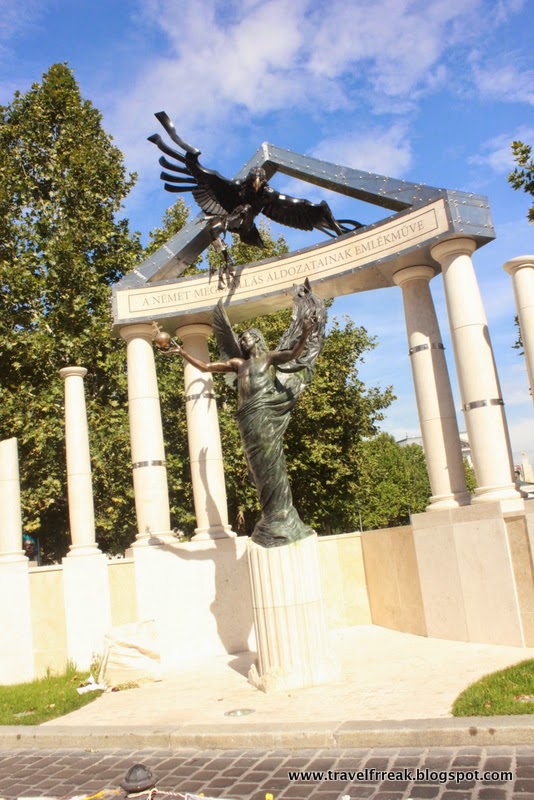
World War Memorial
During our walks in the town, we also passed by Szabadság Square - a World War Memorial which highly interested me. The memorial shows the Germanic Eagle circling the Archangel Gabriel (depicting Hungary). There has been a lot of protest against this memorial though, so much so that it was setup at night amid security and was never formally opened. The biggest criticism has been of the fact that it depicts the Hungarian government of being an innocent victim of Nazi German aggression while that was not the case at all - the Hungarian regime was a supporter of Hitler, killing thousands of Jews on its own and hence not as innocent as the visual from the memorial would depict. Still I found it interesting how PR exercises can help rewrite or at least distort history so easily!

Other than places to see, there are a lot of places within Pest to just hangout and relax. The Promenade on the Danube is one such walk. It runs along the river providing scenic views of Buda, the Castle, Chain Bridge and Matthias Church, especially at night. There are loads of eating places all along, and places where you can just take a break and relax next to the river. We also found couples dancing on one of the squares to music being played by a local musician - it was quite a relaxed and romantic moment. 

Buda at night


The Erzsebet Square right in front of our hotel was another happening place. It had a couple of eating places, but mostly hundreds of people all sitting out in the grass and enjoying their friends’ company. They all had beer which they were drinking in the open (not sure if its legal or not, as most countries in Europe forbid it). The whole atmosphere was so much like a full-day party, it was infectious.

Hungarian embroidered dress
Lastly, Vaci Utca is another very lively street for people looking for shopping. Its full of people, shops and lot of local Hungarian stuff. The embroidered tablecloths, sheets and dresses being sold here were something unique to Budapest, even though a bit expensive. Other than that, ceramics and crystal were the other popular Hungarian stuff on display in this area. And of course the ever present Thai massages!


Parliament on Danube
Other than these places that we visited, the Parliament, the Budapest Holocaust Memorial Center, the State Opera and Memento Park are apparently worth visiting. The Parliament is located on the river itself and apparently has a tour which is quite long but very interesting (which we did not see). But I've heard from multiple people that it is a must-see, so would recommend a visit there.

I felt like Budapest was quite a grand and lively city - with wide roads, beautifully built buildings everywhere, the Danube river in its majestic form, lot of history and of course liveliness everywhere. Since we had walked so much, we even felt we knew the city very well:). Wonder why it isn’t much more popular with tourists? I did not see many Indian tourists there either, though was overwhelmed by the number of American ones. Looks like the Americans have discovered this gem way before the rest of the world!

Also walking around the city, I felt that before the World War, Hungary would have been a country at par with the Western powers of today - UK, France etc. How did it get left behind? Was it the lack of Hungarian colonies? Or communism after World War? Its an interesting question which I would like to answer sometime..

My last note would be about the flight we took back, with Wizz air. Stay away from it! It was the worst low cost flying experience that I have had. I think EasyJet and Ryanair are definitely better! Wizz Air charges you even if you check-in before but try to get a printout at the airport - this isn't something I had heard before. Secondly, they charge for the normal sized cabin baggages too! They allow only a small purse in for free, and 40 EUR for a normal cabin suitcase. And to top it all, they sell discounted bus tickets to Central London on the plane which is even more expensive than you can get at the airport. A scam at every level, as I said, stay away from it!

Accommodation

We stayed at the Le Meridien on Erzsebet Square which was the perfect location. It was on 3 separate metro lines (going to the train station, airport and Heroes Monument) as well a 5 min walk from Vaci Utca, Chain Bridge and the Danube. It was a great hotel, and we witnessed a Friday night Hungarian dinner in the hotel, where dancers showcased their Hungarian heritage. I loved their dresses - white ones with colourful flowers embroidered on them. 

Other accommodation options I would suggest are either the Intercontinental or the Marriott, both of which are located on the Danube Promenade itself, providing panoramic views of the river and Buda. 

Food

We uncovered some good food options during the two days we were in Budapest. Trattoria Mamma near St Stephen Basilica has amazingly tasty Italian food. Dona Corso on the Danube offers live music, views of Buda and tasty Czech (?) food. (Plus we also got to see fireworks across the Danube, but I guess that had nothing to do with the restaurant!). And Gringos Amigos again near the Erzsebet square has very tasty on-the-go Mexican options. 

The first night however, we were looking for Indian options and the Curry House came on top of the search options. We did a huge research to check if it wasn't a Bangladeshi restaurant, and all signs pointed to it being Indian. Even at the restaurant, the decor (Hindu Gods) suggested that it was so, but then it finally turned out to be Bangladeshi. The food as expected had a different flavour and not great, but I would still rate it as one of the best Bangladeshi restaurants I have gone to.

Transport

The Metro and tram system in the city is quite good and efficient, even though it is the second oldest in the world, after London. We used the metro a couple of times, but not the trams but guess that should be convenient too. 

You can walk around the city if you don’t mind the exercise, but some places of interest are located a bit far off. So would suggest that buying the day pass might not be that bad an idea if you don't want to waste time in walking.


Tips

Budapest is very very cheap, one of the cheapest places I have been to in Europe. The cost of a 1.5l water bottle was 20 Rupees or 25p! Its even cheaper than in India! So make the most of it and shop n Budapest if you have time with you:).


Sunday, November 2, 2014

Tryst with Eastern Europe - Prague


This summer we were finally able to take our first trip to Eastern Europe and spent 2 days each in Prague and Budapest (with one whole day spent in travelling from Prague to Budapest!). It was completely a city vacation and we were quite impressed with both cities. They both had a lot of history and culture to keep us interested for long, but they did not turn out as different from the Western European cities as I had expected. Also, I think I am now over city breaks completely. Museums and palaces and markets don't hold the same sway over me as they did earlier. Its being closer to nature and experiencing different activities which are the way to go now.

About Prague

Prague is currently the capital of the Czech republic but has a long history from much before the country came into existence. It was the capital of the kingdom of Bohemia and then an important city of the Austro-Hungarian empire. Maybe the number of different empires is the reason why Prague has a lot of palaces to boast, and a touch of royalty is spread all across the city.

Prague panorama
The city is split into two by the Vltava river. The town is beautifully maintained just as if it would have looked like 100s of years ago. The lanes are all still narrow and cobbled everywhere, the houses are all still the same made of light brown stone with spires and red sloping roofs and even though they have been modernised from the inside, they all look the same from the outside.

Prague is the perfect city to walk in - squares after squares with cafes and fountains, huge churches abound, small shops in every lane attract you, well maintained gardens and palaces beckon you, museums on history and culture interest you and green parks in between provide the perfect place to take a break and relax. There is still something medieval in the look and feel of the whole historic town which is difficult to explain. Each building in the Central area is so grand and built with so much time and interest, its quite mesmerising everywhere.

Castle in Mala Strana
Prague or Praha as its called by the locals is split into areas called Praha 1, Praha 2 and so on. All the touristy places to visit are located in Praha 1. The Old Town on one side of the town is where all the action is. Lot of touristy stuff to do and shops to explore. Its also very crowded. The other side of the river is where the castle is located, atop a hill plus a couple of museums, parliament and palaces. This part of Prague is called the Mala Strana or the Lesser Town which was the part of town I liked. It was a lot quieter and relaxed than the Old Town.

Given that there are a couple of small hills within the city, it provides lot of places to get a good view of the city. Also there are hundreds of Museums in the city. For everything! We did not visit any but I have heard the Kafka museum is worth a visit.

Also, Prague is one of the most cultural cities I have visited - you can see music and the art at every turn. All the churches in the city have concerts (some free) every week, which is something I have not seen anywhere else. There is just so much music in the air, you can almost feel it all around.

Places to visit and things to do

Prague is a city to walk in. All the places are located close to each other and taking a round circle will take you to all the points of interest. Since we were there for two days, we spent one day mostly in the Old Town and one in the Lesser Town.

View from Charles Bridge
The Charles bridge connects both sides of the town and is the main boulevard of the town. Its a fully pedestrian bridge offering views of Vlatava river and the city on both side. Both sides of the bridge are decorated by sculptures depicting Christian themes. Local artisans sell their wares and showcase their arts to tourists here. Also while we were there, we saw a parade passing the bridge with dancers from many countries - France, Brazil, Canada etc. Maybe it was a parade by all the expats staying in the city but the high number of Canadians was definitely surprising.

On one side, there is the Old Town with all its lanes and cafes and shopping. One of the speciality of Prague is its crystal - intricately carved pieces of coloured crystal adorn a lot of the shops in this area. The shops also sell many different types of Czech dolls and ceramic pieces too. They are quite exquisite pieces of art but I would say a bit on the expensive side. Walking along these shops you can reach the Town Square, which is a huge open area with the usual street performers entertaining the performers.

Prague Town Square
There is an astronomical clock on one of the towers which puts up a little show at the hour - a small door above the clock opens and the faces of the Christian apostles appear through the door, one by one. Just next to this Town square are the Jewish Quarters where there is an old synagogue and some walking tours to take you through the history of the Jews in Prague and what happened to them during the Holocast. We missed the tour, but took a similar one in Budapest.

We spent a lot of time in the Old Town, walking while admiring the buildings around. The Municipal house and Powder Tower were impressive. We finished our walk that day at the Mustek which again looked like one of the bigger streets in the city. We caught a glimpse of the Museum at the other end of the street but did not get close. The Opera is also located next to the Museum and apparently worth a visit.

St Vitus Church
The Lesser town or Mala Strana was a lot less crowded than the Old Town. We spent one morning at the castle located in Mala Strana which is quite majestic in itself, sitting atop a hill overlooking the city. The main point of interest for me within the complex was the St Vitus Church which is a huge Gothic Church with intricate work all around. It has mosaics and carved gargoyles and beautiful stained glass all around. It also has a sculpture of Christ in silver, which looks impressive.

Silver Statue
Other than the Church, you can go to the Old palace which is now mostly just an empty hall. It has a couple of rooms where the Bohemian kings used to keep all their bureaucratic papers and some painted walls from that time. It also houses the Bohemian crown jewels replica which I must say are the most garish crown jewels I have seen till now. St George’s Basilica within the castle is the oldest church in this complex. Also located within the castle complex is the Golden Lane - a quaint little street with coloured houses, it was here that Kafka resided briefly.

The walk down from the Castle to Mala Strana provides breathtaking panoramic views of Prague which are worth going up the Palace for. We also had lunch at the Panoramic Cafe on the way back which provides an amazing location to take a break and take in the views of the city.

The neighbouring hill to the Castle Hill is a wooded Petrin Hill, on top of which is located a tower which is a small replica of the Eiffel Tower. We did a small hike up, which felt like being miles away from the city; while walking in forests and fruit orchards. Also, from the top you can also get another side view of the Castle, which is even prettier and less crowded than the one from Charles Bridge. On the top of Petrin Hill, there are a couple of old churches and other monastery buildings. It did make me wonder - for a country which is not even 40% Christian, Prague does have a lot of Churches!

Wallenstein Gardens
Within the Lesser Town, there were two other places we stopped by. One was the St Nicholas Church, another big impressive Church, and a walk through the Wallenstein gardens which are a huge landscaped garden housing the Czech Senate.

The last thing we did while in Prague was go to an Opera in the Estates theatre. Surprisingly, it was quite cheap, with tickets ranging from about 400-600 CZK (12-20 GBP). It was a Mozart composition called Cosi Fan Tutte and starred 5 main characters. The theme of the play was a bit chauvinist, but still the performances were amazing. The singing, acting and the fact that they were subtitling in English what they were singing made the the whole show memorable. I would suggest that if you do go to Prague, catch a local opera show - its different from most other shows you would have seen.

Another must-do in Prague is to get a Thai massage in the city. I was amazed with the number of Thai massage places all around the city; there is one located every 100 mtrs. And its so cheap than elsewhere in Europe, that it isn't a bad idea to get one when you are very tired from all the walking. We went to Ambassador Thai at Mustek, which was a hotel spa, giving an hour foot massage for 900 CZK (25 GBP).

Inside the Post Office
After spending two days in Prague, we took a train to Budapest which took about 7 hours. I must say I was very impressed with the Prague train station too - so new and shining, haven't seen any like this in Europe for some time. The old station building had a painted ceiling, as did the Post Office where we had to go once.

Overall, Prague felt like a very compact and beautiful city, with a lot of culture and pretty buildings and cobbled streets, as if from a different era.  It has managed to retain its old world charm, but overall, I did not experience anything so unique which will make me want to go back there again...

Accommodation

We stayed at the Three Storks hotel - a boutique five star but reasonably priced hotel, located near the Mala Strana train station. It was the perfect choice - located in the quieter part of town, with a view of the castle above and 5 mins walk from Charles Bridge. There were tram and metro stations within 5 mins of the hotel, the walk to the metro station being through the pretty Wallenstein gardens! A definite recommend.

Food

We found a Vegan place called LoVeg, very close to the church of St. Nicholas in Mala Strana which has a variety of vegetarian dishes from across the world. Its a small place on the top floor of the building, but a nice find. We also had lunch at Panoramic Cafe, a small cafe on the path from the Castle to Mala Strana with breathtaking views of the Prague skyline - a good place for a quick break. Other than that we ate at Pizza Colosseum and Yammy Asian near Mustek. Both places were just about ok - I guess the place is too touristy to get any tasty food!

Transport

Since it was a city trip, we did not hire a car and decided to give the local transport a try. I was honestly impressed by the local transport system in the city. It was very comfortable to get from the airport to our hotel, and then travel around. There are three Metro lines and multiple tram lines which criss-cross the city. I would definitely recommend taking the local transport if you really want to feel a part of the city. Also the day pass costs about 110 CZK (3 GBP) which is worth taking if you don't want to walk much.

For international train tickets, it makes sense to buy tickets early on and online to get the cheapest fares. On the day (as we realised) you need to go to the train station to buy tickets. Also, buy your tickets from a travel agent called CD train, its located next to the train sales desks and sell cheaper tickets!

People

We did not interact much with the locals but whatever little we did, I noticed two things. One its not very easy to get around with English, a lot of people don't understand any of it. The second is the locals did not come across as very helpful. In most cities in the world I have seen people being helpful to tourists, but it was not so here. Most questions were met with a 'don't bother me, go and ask someone else' kind of attitude.

Also thing about the city which disturbed me a lot was to see some people begging by bowing and lying on the ground. I found it more surprising as whatever I had read about Czech led me to believe that it is quite a developed country. As I said, it was not a good sight and disturbed me quite a lot.