Thursday, February 13, 2020

The enchanting Himalayas (2)


Day 4 - Drive to Renukaji lake, stop at Paonta Sahib on the way, stay at the HPTDC hotel "The Renuka"

Today we drove from Uttaranchal to Renukaji lake in Himachal, and it took us most of the day to get there. We also realised that we had taken good roads as a given, when it is not always so. And sometimes, it can take much longer to get somewhere if the roads are not what Google Map expects them to be.

On the way to Renukaji, the first part of the drive was going down the mountains; then a bit in the valleys, and the last part was back in the mountains. The drive down was stunning as before, but it did get too hot and sunny and we didn't get down the car much. Except at the maggi point 😁.

In the valley drive, part of the drive was next to a huge river canal. We also drove by a place called Asan Barrage which was a huge lake next to the canal and offered water sports during summer time. We stopped near there to have the Chakotra, a local fruit of the citrus orange family. Apparently it is known as Pomelo in English. It is much much larger in size than an orange, has a very thick skin (up to an inch or so), pinkish and longer slices and tastes yummy with sea salt. It took 5 of us 10 mins to finish one of those fruits! We also bought a few for the rest of the journey.

Paonta Sahib gurudwara
We next stopped at Paonta Sahib on the way, which is a huge gurudwara made of white marble, on the banks of river Yamuna, its history linked to the history of Sikhism. Guru Gobind Singh, the last Guru of sikhism had stayed here and planned some of his resistance against the Mughals from here. His weapons from that time are also kept in this gurudwara.

Banks of Yamuna
We had a quick langar there, and bought some local ber from town. We also did a short walk to the Yamuna which barely had any water flowing through it here. What was most appealing about this gurudwara was its location, right on the banks of the river and with the mountains surrounding the Gurudwara from all sides. I think its location added to its spirituality.

After a bit of drive in the valley, we reached Himachal and were back to driving through the mountains again. We got some grand views of the valleys below and the villages across the valley during this drive. The mountains were greener and covered in forests. The road was much narrower this time though.

We stopped at a chai stop on the way, where there was an old style khat kept outside, to enjoy the views below. The weather had got very hot and sunny by then too, so we were very happy to take a break and walk around. The route we had followed was through Mandara. We soon reached a dam, which had a huge lake next to it and from there, the last 4 kms to the lake were the worst ever. It was barely a road, very muddy and barely there. We started to have doubts whether the place would be worth it or not.

Renukaji lake
We were thankfully pleasantly surprised when we reached the lake. It almost looked heavenly. The lake is in the middle of the mountains, though not in a valley. Just surrounded by mountains. It sparkles, like a green emerald, all due to the reflections of the forests from all sides. There were loads of tourists there in the evening by the time we reached. But still it felt away from it all...

Renukaji lake is named after the temple of Renukaji, who was Lord Parshuram's mother. Legend says that Lord Parshuram used to stay in this area, in his father's ashram. His mother had once jumped into the lake to save herself from a king who was trying to abduct her. But once a year, she appears at this lake, to meet her son. And that's when a grand mela is held at the lake, every year. To celebrate the meeting of the mother and son. I think religion and mythology also added to the heavenliness of this place, somehow.

The Renuka
We were staying at the Himachal Pradesh government's HPTDC hotel called "The Renuka", right on the banks of the lake. It was a nice newly built hotel, spread over 2 floors, with simple, cheap and convenient rooms. Service though was quite average. We quickly checked in and then started exploring the area. There weren't many buildings there, just the Renuka, a few forest guest rooms, the Mandir, and an ashram. There were loads of tourists initially when we reached, some of them boating and the rest walking around. But they all left by 5 pm as they may have been driving back home the same day.

We first walked around the lake, along the pedestrian path which went all around. On one side were deep woods, and the other side was the lake. And at some places there were enclosures of the local zoo. We saw the barking deer, sambhar and spotted deer, all eating away to glory in their enclosures. Then we came to two of the black bear enclosures, one of which was walking around and entertained us. The second one was sleeping in its cave. And last were the leopards but they had been locked in their cages by then.

The zoo had closed by then and there was no one else on the walk other than us. But it turned out to be quite a refreshing walk for a few kilometres, right when the sun was setting. The lake was like a wetland and it had an interesting flora and fauna. It was full of birds, some of which migrate here during some seasons. We saw lots of monkeys and langurs in the forests around. And I heard there are leopards too. There were loads of grasses in the water and many types of trees on the side. The view around had everything - high mountains covered in forests, a lake, wetlands and tons of animals and birds. With no humans around, it felt like we were in the wild.

Ashram on the banks of the lake
Towards the end of the walk, we came to a small temple to Renukaji, which has a water spring right next to it. It is supposed to be holy and healthy, so we drank some cold mineral water from there. All along the walk, the lake reflected the green of the forests all around. And towards the end, the reflection of the local ashram. Every scene on this walk was breath-taking.

After the walk, and after layering ourselves with many other warm clothes, we went to the Mandir next door for the aarti at 630 pm. It had gotten very cold by then and it was tough to make oneself go out for the aarti, but we somehow did. There are three small temples here, one dedicated to all of Lord Vishnu's avatars, one of which is Lord Parshuram. Second is dedicated to Lord Parshuram. And the third is Renukaji's temple.

The old statue from
Treta Yug
The aarti happens in Parshuramji's temple and we all sat there while the panditji got the aarti ready. We talked to him during this time and it was a knowledge increasing and inspiring discussion. Apparently Parshuramji is not allowed to be in many places. So he has temples or can exist only here at Renukaji, in Orissa, at Mahendargarh (where he is said to have retired) and the Konkan. Panditji said that his last 9 generations have been praying at this mandir which was impressive. He also said that the statue of Parshuramji at this temple is from the Treta Yug. It did look old, but maybe not that much.

Another very interesting part about this mandir was that the prasad and dakshina that the Panditji gave us, included some money too. I've never seen this before! I was somehow very impressed with all I saw. We found the aarti to be quite a spiritual experience. Being in this remote place in the mountains, with barely 3-4 buildings and very few people around. And praying to God. It felt ephemeral and eternal at the same time.

After the aarti we were back to our hotel and had a Pahadi dinner. The local dishes of the state include dishes made in curd. All of which the hotel had run out of! But whatever they made was extremely tasty. Or we felt so after the long and cold day. Again, we called it a night soon as it was so cold; all we wanted to do was get into our blankets and go off to sleep.


Day 5 - Drive back to Dehradun and visit IMA

Morning at the lake
We had asked the hotel to get breakfast ready by 8 am and they had been surprised. We realised in the morning, why that had been the case! The morning was very cold, and no sunlight came into this gap till about 930 am as the place was surrounded by high mountains. And it takes a long time for it to reach the lower reaches of the lake. So everything and everyone wakes up late here. Also in the morning, the lake was lined with a layer of vapour which was blowing the whole time. It was quite a magical view. I tried capturing it on my camera and managed to capture a bit at least.

Morning at the lake
We had been unable to see the leopards last evening, so we went for a walk around the lake again in the morning. Around 9 am. And the leopards were not out then either. We waited a bit and then the handler let them out. There were two couples of leopards there. And they were majestic. One of the leopards jumped onto a branch and gave us nice poses. I hate seeing animals in constrained spaces. But I must say, I still enjoyed looking at them for some time. Lazing in the sun, ignoring us. But being alert at the same time. I still feel if I could keep any pet I want, I would want a leopard. I just love their eyes, and how they move. So royal and majestic!

We then spoke to the handler for some time. He told us that they only fed the leopards once a day in the evening. And fasting happens for all animals on Tuesdays (looks like they are also Hindus 😜 ). All the animals in this zoo are those that were found injured in the areas around and brought here to revive. He was also saying that these leopards don't come near the cage edges as people poke them with sticks. Also the bear stands on its feet entertaining people, as people then throw him food. Both are such wrong behaviours from the tourists, it pains me to hear such stories.

Parshuramji's mandir
As we were walking back, the sun had finally come out and the whole valley had brightened up. It had definitely become warmer. Back from our morning walk, we went to the mandir again. The whole place felt even prettier in the morning as the sun was out and everything looked brighter. I was surprised by how big and clean the mandir was, definitely an inspiration for other mandirs.

After the visit, we bought some rusk to feed the fishes in the lake. And we had just started when the monkeys around picked up our husk packets and made good with them 😮.

Overall I really loved the place. It had a very serene feel to it, especially in the mornings and evenings when no tourists were around. It was very peaceful, very quiet, very immune. I am sure this place can be made more tourist friendly, with more hotels and restaurants. But selfishly, I didn't mind not having it all then. We had the place to ourselves. And I definitely did not mind it. The lake did get busy after 11 am. But by then we had left, so it didn't matter to me 😊.

While coming back, we could have gone to Jamu peak from where you can get a good view of the lake and the ashram where Parshuramji's father used to reside. But we didn't have time. So we started back. This time we wanted to avoid the 4km broken road we had taken going in. So we took the route through a town called Sataun. The guys at the HPTDC hotel had told us to take this road. It was definitely a shorter route but much worse for much longer. And not as enjoyable as far as the driving was concerned. So clearly asking the hotel guys didn't help us much. (They had told us the wrong time for the aarti and leopard feeding too in fact). The road was broken for at least 40% of the time, till we got to the plains. The local drivers though are more used to these tough roads and drive very fast. They would swoosh past us while we were trying to avoid all the potholes.

This route was also along a huge valley with some stunning views of the villages on the opposite sides. There were large green terrace fields on the other side, next to the villages. We saw lot of locals out and about that day given how sunny it was. They were all smiling and wearing Himachali topis. They were dressed in the typical Pahadi clothes of this region and spoke in a singsong accent. This area is known as Sinaur, and the people are easygoing, relaxed and happy in their lives. Even though they lead quite a difficult life. We saw lot of women and children also walking on the road carrying huge loads of leaves on their heads. There were also lot of small schools on the way, so this place wasn't as godforsaken as it initially appeared.

During the drive, we ran into a person standing near a bridge in a village, asking us for a lift. We stopped to tell him that our car was already full. He said its ok, he will find another ride. Then he asked us where we were from, and so on, starting to chat with us as if he (and us) had all the time in the world to talk about normal topics 😊. It felt very weird, as no one just generally talks to people anymore. We are always in a hurry, aren't we?

Sataun
Sataun was the last village before the plains and it was on a plateau on the opposite side of the valley, where you could go using an aerial ropeway, across the valley. Like Henna did in the movie Henna.

This route was definitely shorter and then we were soon in the valley, on our way to Dehradun. The valley road was lined with litchi and mango trees and we bought some very tasty and huge local guavas from the roadside vendors. There were lot of river beds on the way which were full of trucks picking up the stones. My guess is they are all taking the rocks illegally? Coming down the plains felt like a downgrade, back to the heat and dust and too many people. And driving also felt much worse today. We also noticed people were on their phones more often than not, even on two wheelers :))

The rest of the day we spent in Dehradun, visiting some of the places we had lived in in the 90s. All the time feeling, how the city has changed since then. Dehradun has always been famous as an education centre, for its schools and universities. This has been the case since British times but even since then, there are newer institutes opening up all the time. And you can't miss it, with all the noticeboards put up everywhere. The entrance to Dehradun was full of trash, lining both sides of the road. For a couple of kms. It is a scene which stayed with me for a bit. What have we all done to such a beautiful city?

After entering town, we first went to IMA - the Indian Military Academy, which trains the officers of the Indian Army before they join the forces. This institute is a small standalone campus which was built by the British and it still retains some of the old buildings from those times.

Chetwode Building
The most famous of these is the Chetwode Building, where the graduation ceremony, called the passing out parade (POP) happens. Even after so many years, I found the building impressive. And it brought back memories of waking up at 7 am to go and watch the parade there in the cold winter mornings. We then drove around the campus to look at all the places we used to stay when we there. And again, I was again super amazed by the wide tree lined roads and the greenery all around. Memories from old times, and the trees are still there.

FRI main building
Right next to IMA is FRI - the Forest Research Institute - where the IFS officers are trained. The main building of FRI is grand and it too brought back memories of old times. And the icing on the cake were the Mussoorie hills right behind. They provide such a captivating background. The grounds at this building are huge and you can see it is very popular with the locals. There were 100s of people walking in its grounds, out for a picnic.

The FRI campus is full of forests and trees, and I remember us cycling here as kids. It feels like a different world all together, the safe and green life of cantonments! The accommodation in both these campuses include some massive British bungalows which stand tall and strong even till today. And it was a pleasure to see it all again.

After that, we went to visit one of the resorts in nearby areas and saw how wide and far Dehradun has extended. The road kept on going and there were tons of huge houses, located on the river beds. The govt just keeps selling all the land. Turning this hill side place to a normal huge city. The resort though was located in the lap of greenery and it felt like a good place to come away from the city for a short break.

In the evening, we celebrated 2020 New Year party in town, army style. And I again loved the twinkling lights of Mussoorie in the background. They are just so serene and calming. And being in Dehradun also made me miss the small town living in India, which Delhi and Bombay cannot offer.


Day 6 - Drive back from Dehradun to Delhi

The last day was quite lacklustre, as it was all about the drive back to Gurgaon. The weather was sunny and data connections were back, so that was helpful. We again took the Deoband road to Meerut. In Meerut we took a rural road to get to our friends' place for lunch which was through the back lanes through villages and sugarcane fields. It was a narrow road and felt interesting to drive through. Sometimes I am surprised how close to cities, life still goes on like it did many years ago. These villages were 2-3 kms from town but still felt years away from any city life.

Traditional kohlu
The highlight of the drive back from Meerut was us picking up a few sugarcane stalks from one of the farmers on the way, so we could eat it raw. He gave us more than what we wanted, and refused to take any money for it. How big hearts farmers have? We also saw a kohlu on the way which is the traditional way of making gud (jaggery). This is how gud was made in the villages before the sugar mills led to its downfall. The whole process looked quite unhygienic, though my parents insisted it was hygienic due to multiple rounds of refinement that the juice goes through. We also drank many glasses of the sugarcane juice while waiting to buy the raw gud and it was one of the tastiest juices I have had in a long time.

Diving back to Delhi was full of traffic jams and it brought us back from the mountains to the plains life very quickly. How people drive, are always in a hurry and that isn't changing anytime soon 😊.

We had a lovely time in the mountains, bringing back memories, but also a lot of peace and simplicity in our lives. I also reflected on the life of the people in the mountains. It felt awesome to be there, because it was so disconnected from the plains. But the downside is the Pahadi people still live their lives in relatively low modernity. What is development for them, should they or should they not change their lives? I don't know the answer to that, but would tend to go with - let them live their lives like they are living. And not corrupt it was the busy-ness we all have in our lives.


P.S. I know the state is now known as Uttarakhand, but the name Uttaranchal sounds so much more soothing to the ears that I prefer to use it 😊.

The enchanting Himalayas (1)


(This is my 200th blogpost. And I am happy I wrote it about the magical Himalayas 😊)

This winter I got a chance to visit the Himalayas after many years. We went to Uttaranchal and Himachal for a few days and enjoyed warm sunny times even though it was winter. The temperatures during the day were warmer than in Delhi and the sun was out everyday, which made the experience even better than expected. We spent a few days driving through the hills and enjoying the raw nature of the Himalayas. And being there brought back all my childhood memories of time spent in the mountains.

Gorgeous Himalayas
As a kid, I have spent some months every year in the mountains of Kashmir, Himachal, Uttaranchal, Sikkim and Arunachal. And those were fun times. We would just drive for hours, stop and picnic wherever we wanted, spend time walking up and down through forests and just enjoy the fresh air every day. It was also the time of no phones and internet, or sometimes even regular electricity. So when we were in the mountains, we spent all our time just exploring nature, as there wasn't much more else to do.

Things have definitely changed now. You can use your GPS in the mountains, there is internet and data everywhere, and you can research and see photos beforehand of where you are going. But a lot remains the same, which I really valued on this trip. Being in the Himalayas still feels like being far away from civilisation, they are so pristine and untouched even now. This simplicity comes from its people. People in these areas still stay in beautiful remote villages and have uncomplicated relaxed lives. It felt so refreshing to see all the simplicity and calmness there. And of course the air was refreshing too, definitely a well deserved change after the unhealthy air of Delhi. And we all totally loved our time there.


We spent a few days in the Shivaliks, one day in Renukaji lake in Himachal and some time in Dehradun where we had stayed for 3 years in the 90s. We also spent a few days going to and from Delhi to Dehradun. Our itinerary was as follows:
Day 1 - Drive from Delhi to Dehradun
Day 2/3 - Drive to Shivaliks, stay there; trek, explore the town and enjoy the sunset
Day 4 - Drive to Renukaji lake, stop at Paonta Sahib on the way, stay at the HPTDC hotel "The Renuka"
Day 5 - Drive back to Dehradun and visit IMA
Day 6 - Drive back from Dehradun to Delhi


Day 1 - Drive from Delhi to Dehradun

Our first day was spent mostly driving from Delhi to Dehradun. The drive takes about 6 hours as per Google maps. And in reality, much longer given the quality of roads and driving in India. As we got out of Delhi, we saw markings of Meerut Expressway, and got very excited given the amazing quality of the road during the first hour. But that happiness was not to last long, as the expressway was only till Ghaziabad. The rest of the way, there was no sign of any expressway at all 😂.

Also, this was the time of the student protests going on in the country and the government had stopped data services in many districts in Western UP, expecting problems. So as soon as we entered Ghaziabad, there was no signal. And we had to use the original Indian navigation systems on the way - stopping and asking passersby for the way 😜. So a lot of times we wondered if we had taken a wrong turn and missed the expressway but turned out we hadn't.

The route we were taking was Gurgaon -> Ghaziabad -> Meerut -> Deoband -> Dehradun. And as soon as you leave Delhi and other such big cities, you realise the rest of India still retains its relaxed small town living vibe. Which is so different than life in these big cities. I feel it every time. And I don't think it is only because I don't live in India anymore, I think even in India, so many people are very far from life outside their metros.

We reached Meerut within 3 hours and stopped there for lunch. Meerut is my and my brother's birthplace but we have never been there after the first 3 years of my life. We drove through Meerut Cantt, which was green and spaced out unlike the rest of Meerut. Driving through any Cantt area always feels like being home and it felt the same here too. We stopped at a friend's place for lunch and then were off to Dehradun. We took the toll road from Deoband which had been recently constructed and was almost like an expressway.

All along our drive there were loads of very small towns. And there was literally no empty area between them. Uttar Pradesh is really the densest state in India and it was quite visible during the drive. Driving was all over the place, with all kinds of vehicles moving together on the road at their own speeds and their own rules. All along the road we saw miles and miles of sugarcane fields. And the roads were full of trucks carrying sugarcane to the mills, as this was harvest season.

The road to Dehradun was mostly good after Meerut. A lot of places, the road circuited the towns and crossed them from the outskirts. In Deoband, the expressway literally went over the town. We also saw loads of huge mosques from the road which provided a nice skyline over the town.

Towards the end, we drove past some 30 mins of small hills, right next to a river, to get to Dehradun. They were not high at this point but you start to get the feeling that you are leaving the plains and off to the mountains. And right when we were out of the mountains, we got our data signal back too as we were now in Uttaranchal.

Even in the small mountain patch, there was so much trash thrown around, it was depressing. This green area is known as Rajaji tiger reserve though I doubt there are any tigers left here. And the road was lined with monkeys, thousands of them all along (this hasn't changed in the last 25 years when I was last here). They sit next to the roads, waiting as passengers throw them food all along the highway.

Dehradun doesn't feel like a mountain town anymore though. It used to be a nice small town when I grew up there. Green, clean and cold, given it was in the foothills. That has changed now. It felt so much bigger now, it looks like there has been a lot of uncontrolled development for the last few years. It still has the narrow roads of old. But the traffic has increased multifold.

One thing about Dehradun hasn't changed yet though, you can still see the twinkling lights of Mussoorie in the background at night, and the mountains during the day. And that is still the same. (Apparently the town is now dirtier but can't see that from down below 😁). The twinkling lights brought back scenes from my childhood again, when so often we would sit outside and just enjoy watching the twinkling lights of the mountains at night.

We drove a bit in town and visited St Josephs Academy where my brother had studied for a few years. It was started in 1934 by the British and had a very huge campus. I don't think we build such schools anymore. Just walking in there felt like having come to a different era. Dehradun was a popular place with the British and the Europeans during the British Rule given its cooler climate. That's why there are so many old educational institutes here, famous schools like Doon school and Welhams but also government institutes like IMA and FRI (which I will write about later).

We also then drove past the Ghanta Ghar which was the centre of town and a memory from my childhood as our schoolbus used to drive past it everyday. It felt weird to relive memories from a different time. Scenes I remembered which had been put in the back closet of my mind for so long.


Day 2 - Drive to Shivaliks, see sunset

Today, most of the day was spent in the drive from Dehradun to the Shivaliks. In the evening, we just enjoyed a magnificent sunset and called in an early night. Google Maps showed the drive would take us about 3 hours but given how we were back in Himalayas after many years, we stopped a lot and took our own sweet time to reach our destination. The weather was perfect, the sun was out and the sky was blue. It definitely helped in taking spectacular photos.

The first half of the drive was in the Doon valley itself. It was a wide valley with wide river beds next to the road. It was green all around with lot of sugarcane plantations and litchi trees on the sides. The road was lined with villages all along and was densely populated throughout. And all of them had similar names, a pre-fix and then 'wala'. Ranging from Suddhowala, Jassowala to Dharmawala and so on. And you can also see the overhang from the British times, with a lot of places still having very English names - like Herbertpur.

There was a lot of traffic there though and it still felt like being in the plains. The villages did not feel like mountain villages at all as they had huge houses and even buffaloes there. The residents looked like they were from the plains, and were a mix of Hindus and Muslims. They were also selling lot of local fruits on the roadside which looked very inviting and healthy. After Herbertpur, we slowly moved into the mountains, and as soon as we got up there, everything changed. The air got cooler, the people simpler and the views captivating.

The roads on the mountains were quite good. They were narrow though and at times it felt scary looking down. Again it brought back memories of the 80s. When we used to drive so much in the mountains. For hours at a stretch. And in much less comfortable vehicles! So this time we stopped quite often to take photos, or just stretch our legs.

Villages in the mountains
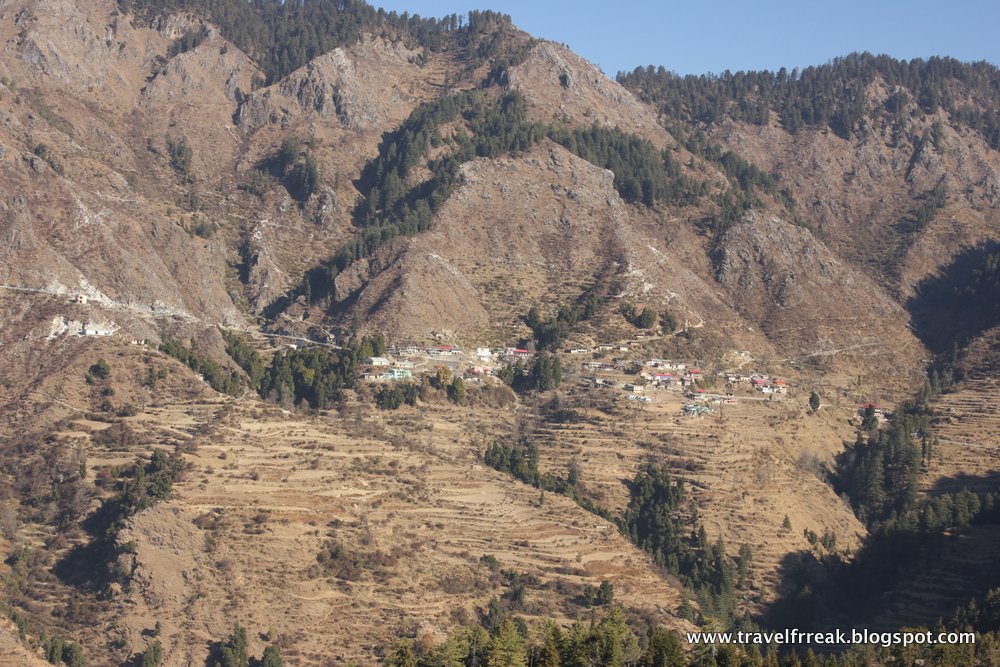
Every turn was so picturesque, with the bright sun, the bare mountains and the imposing villages on top of them. The mountains were huge, sometimes forested and sometimes bare. And on most of them you could spot some picturesque villages. I was very impressed with all these majestic views of villages on every turn. It felt almost unreal that in today's age, people would live such isolated lives, in places which seem almost unreachable to us. We also passed by a few locals on the streets, lot of them wearing the Himachali caps and all walking slowly. Smiling at us, when we passed them.

Village on a hill
Each of these villages had terrace farms around them. Sometimes all the way down till the valley. And you could see some goats and cows grazing around them. I also noticed that the cows here were of smaller size than the typical cows from the plains. We stopped at a maggi spot and I came across a small village which was made up of just a few houses on the mountain (spot them in the photo). And the only way to go up was walking. With all your luggage! This was just the starting of my fascination for these picturesque villages in these mountains. And I stopped everywhere to click a photo. I felt these are more captivating and natural than the alpine ones. But they don't get their due.

A tough trek down
At some point on the drive, we stopped at a spot to take a few photos. In a few minutes a passing vehicle dropped an old man. And then we saw him pick up his huge heavy bag and walk down to his village which was quite a walk down, on the cliff far away. Walking on the mountains has to be a slow moving activity, and he kept walking down, slowly. Everyday life in the mountains is tough. And I wish I could be as healthy as that old man I saw, who walked down the mountains, with a huge load on his back. One day I would like to go and live in one of these villages to actually experience how people can live like this even today...

There were tons of bikers on the road, all coming here for a weekend away from Delhi. Going for biking trips (especially on Bullets) is definitely something that has picked up in recent times. We also passed a few areas where there was snow and sleet on the road, left in the wake of the mountains where there is no sun. A biker group had skid there too before we came.

Villages in the mountains 
Before reaching our destination, we stopped at a picnic spot which had a hut to sit under and eat lunch. And I was saddened to see the trash next to it. Overall the mountains were so clean, but at places where tourists would stop, you can see so much trash. It pained my heart to see how heartless people can be with their own country. At times I picked up some of the trash to keep in the car, but it was too much for me to be able to do much.

View from our accommodation
Soon after the picnic spot, we came to a greener part of the mountains. There were pine covered mountains here unlike the bare brown mountains most of the way. And soon we came to our accommodation. It was an old English bungalow on top of a mountain peak. And had spectacular views of the mountains all around. We could see till 100s of miles, at range after range of smaller mountains in front. And there were trees all around. It totally felt like being in a fairytale. And our relaxation on the trip started here.

Sunset from the peak
We had reached our destination in time to see the sunset there, and were mind-blown with the view from the sunset point, which was on top of a peak. We could see snow covered ranges on one side and the sun setting on the other, over 10-15 different mountains of varying height. It was a magical feeling being on top of the mountains and watching this 360 degrees surreal scene. As the sun set, more and more colours came out in the sky - pinks, oranges and reds. And the colours varied depending on whether it was on the setting side or the other. This view lasted for at least half an hour, and felt really magical.

The snow covered peaks far off
As soon as the sun set, the weather changed and it got very very cold all of a sudden. In the mountains, it is customary to call it a day very early. So we came back and had our dinner early. Food feels tastier when in the mountains, and you eat a lot more when here. We were all guilty of that. We then spent time indoors playing cards and called it a night soon. The temperatures outside were around -10 degrees and the bungalow was quite cold inside even with the heaters. So it felt nice to be tucked under the blanket as early as possible.

Things have definitely changed here since we used to travel in the mountains around 20 years ago. We had no electric heaters then, or even electricity. We used bukharis, a locally made device for heating, known quite often for killing people with too much carbon monoxide if someone forgot to close it down before going to sleep. Also, we used to have generators only for a few hours in the evening to do all we wanted to do. But now there is electricity and cable tv all day. It felt different and more convenient now. But still it felt magical to be in the lap of nature, and feel that for a bit of time you are disconnected from the fast pace of life in the plains.


Day 3: In the Shivaliks, a small trek and the sunset again

The day today was quite a relaxed one. We just spent time casually exploring the areas around, as the main aim was to just be in the woods and take in the fresh air. We were lazy that day but my dad woke up early in the morning to see the sunrise at the same peak where we had seen the sunset the day before. And the colours were even brighter than the sunset the day before (we know it as we all saw the photos later on).

Spot the village
After a heavy breakfast, we all set out for our trek - we were going to visit one of the caves in the region, said to be linked to Mahabharat, which were an hour's drive from where we were staying. On the way, we again saw some magnificent views of the majestic mountains around, the deep valleys below and the dangerously perched villages all around.

The roads were of good quality, though quite narrow all the way, and every turn got us to a new viewpoint. It was very tough to not want to stop everywhere and just take in the scene. The sky was coloured a much deeper blue here, the hills more green and the sun very bright - it all felt very refreshing. Also, some of the mountains were fully forested but a lot of them were totally brown and bare too. It might have something to do with the wind or the sun direction I guess.

Villages in the lap of mountains
We gained height on the drive and started to encounter snow, on the road and in the forests. This was from the snowfall which had fallen a bit earlier in the starting of December. This was all the leftover snow, in the shadows wherever there was no direct sunlight.

The trek we were going on started from a forest rest house, but as we were driving towards it, we saw some of the cars had stopped and parked much before the resthouse. We were thinking of still taking our cars ahead, but then decided to park and walk the 3.5 kms till the resthouse. And it turned out to be a good idea, as soon we saw a lot of snow on the road, and there would have been no way we could have driven on it!

Snow on the trail
So we started walking on the snow and it was fun. The trail was wide enough and flat as it was still the road, and there was a lot of snow there, on the road, on the sides, on top of the trees, everywhere. Some of it had also turned to sleet. It made the walk quite interesting as at times, we were all slipping and falling (but not too badly). The whole trail had high deodar trees all around. And far off, we could see high mountain ranges (Himachal ranges I think), with their peaks covered in snow. The blue, white and green all around made for some very bright photos.

After walking around 3.5 kms, we came to the forest rest house which was from the British times (built in 1848). We stopped and had our picnic lunch there. We ran into a few local goatherds on the way and then some locals who were walking back to their village. They were carrying supplies on their head and mentioned that the next few weeks, they would be doing regular trips to the plains to stock up their groceries for the winter months. As the roads will soon close and make it tough for them to get out. It's a life most of us can't imagine, right? They also spoke Hindi with a Pahadi accent, and in a singsong voice. I really liked the accent, it was so calming, so friendly and cheerful to listen to.

Snow covered Himachal range
From the guest house, there was 2.5 kms of steep climb to the caves, but as we had already walked a lot, we decided to call it a day and walk back. While walking back, we ran into a lot more tourists on the trail, some of them walking in heels! Clearly they were tourists from Delhi, here for the weekend, with no idea what to expect in the mountains! And some had come here just to see the snow. Once they walked 5 mins in the snow, they were ready to walk back. Also as expected, we saw a lot more trash on this route too. It was quite disappointing to see it all. In fact, I decided that going forward, every time I go to the mountains in India, I will always carry a few plastic bags with me, to clean up as much trash I can.

We finished our trek in about 3.5 hours and then drove back to our accommodation, enjoying the grand views of the mountains all the way back. Again, we could see the multiple mountain ranges till where the eyes could see, with haze in between. And there were a few hotels on the way too, though most were in the large towns nearby.

I also learnt a bit more about the Pahadi people of these regions. The Uttaranchal region is made up of mostly the Kumaonis from the Kumaon hills, the Garhwalis from Garhwal and Jaunsars from this Jaunsari region. They lead simple lives living in the mountains, graze animals and farm one crop in a year in their terraced farms. They do have tough lives and are generally not rich but are still laid back, content and happy people. Religion is quite important in these mountainous regions and there are lot of temples all around. Dahasu Devta is the most revered devta in this region.

The evening sky
Once back, we went to see the sunset again as we had missed it by a few minutes the last day. And it felt as magical today as yesterday. Snow covered mountains on one side of the peak, and layers of mountains coated in hues of orange, yellow and red on the other. And this lasted for almost an hour after sunset. It was truly a spectacular show.

Our guide then told us, that in these mountains, there was some wildlife, like langurs, monkeys and leopards. The leopards generally come out at night, sometimes to eat the local dogs. Our guide told us to not fear them though and just walk back if we see one. I've heard this so many times, but I don't really know if I can remain calm at such a time or not. Either because of fear or even the excitement of seeing such an animal out in the wild! Am not looking to test it out soon though 😝.

Picturesque villages
After that, we walked into town for a bit. Most of it looked new and only one of the buildings seemed to be original, made of wood. To deal with the growth in tourists I suppose. The streets were all full of eating places and some hotels. We did come across one unique shop here though. It was selling some 10 different types of rajma, and many other spices and lentils which were local from this region. I found it quite interesting, to see all these different varieties available. And stocked up on a few too. I am sure, if nothing else, this is more organic than what we get in the plains.

The town looked quite touristy, and quite dirty I must say. Walking through the town, it did not even feel that the place was in the mountains. Seeing scenes like this I wonder, as much as I and everyone else enjoys exploring such new places in the mountains, we also bring so much trash along with us. Very soon these places lose their charm. Is it worth it?

At night, from our accommodation, we could see a lot of the twinkling lights of the villages till far away. That is when I realised there were lot of villages here. All far away and distributed, but still this place was more populated than I expected. Till quite late at night, there was still some moonlight and we could see the contours of the mountain ranges till very far. It looked especially scenic, with the twinkling stars and the moon in the sky. And we could also see more stars in the sky than usual. This was all so captivating, I loved the time I spent outside in the night sky that day.


continued... The enchanting Himalayas (2)


Thursday, December 19, 2019

Long weekend in Tenerife


This autumn, I finally made it to Tenerife for a four day day vacation (after having once cancelled a holiday there). Tenerife turned out to be quite a surprise for me. I was expecting an island with lots of beaches and a humid relaxed kind of island life, while it turned out to be a bare desert kind of place. However, it did offer quite an interesting mix of activities and our vacation turned out to be a busy one. We experienced the entire range of touristy activities, from diving, hiking, spending a day in the water park to driving to gorgeous coastal Spanish villages. And it was interspersed with relaxation at our Balinese themed resort.


Getting there and first impressions

Somehow it always feels that you can get to anywhere in Europe very quickly, but it turned out to be a long flight to get from London to Tenerife. It was more than 4 hours! Most of the flight was over the sea with not much to see. We flew over Portugal and North Spain for a bit. And I saw a striking view of the Portuguese coast, with the white waves lining the cliffs on the coast. Then it was the ocean again for a long time.

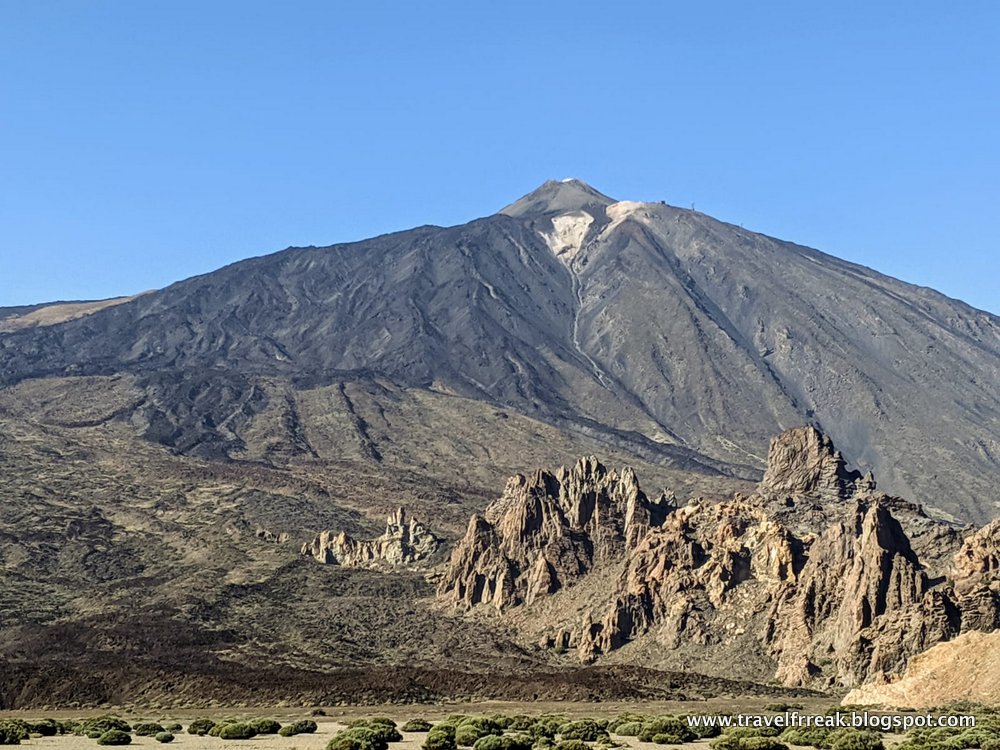
And then all of a sudden in front of the plane, appeared the first glimpse of Tenerife island. In the middle of the ocean, I spotted a huge mountain peak rising above the clouds. It was a magical view, especially as I hadn't expected it. When I saw the peak, I realised that Tenerife is a volcanic island surrounding this volcanic peak. Later, the smaller peaks around the main one came into view. And the waves of the lava flow that created the contours all around the island.

Teide peak and western coast
There are two main airports on the island, one in the north and one in the south. As we were flying in to the southern airport, our plane flew all around the Teide peak and we got a glimpse of the northern and western part of the island. On the north, it was totally covered with green forests but looked uninhabited. And then along the western coast, slowly the small villages came into view all the way to the south of the island where the villages got quite dense.

The landscape in the south was a yellow brown barren desert, which was the opposite of what the north side of the island looked like. There were miles of barren lava fields everywhere, with only some shrubs vegetation. Closer to the airport some artificially planted greens palms of the city came into view, and then the area was full of high storeyed holiday homes. The greenery in the city felt a bit fake though, given all around was just barren land.

The airport was small and you could see that the island is quite popular with sun starved Britishers. There were direct flights from interior UK, like Newcastle and Midlands too! And just coming out of the airport you realise why! The place felt like bliss, the sun was out and the air was warm. I already felt that my vacation had started, given the warmth in the air.

I took a cab to my hotel which was slightly away from the city. It was in the mountains and the way there was on the motorway. I could also see how touristy the whole island was - Chinese mall, Thai themed water park and a Bali type hotel billboards lined the highway. And down the mountains, I could see all the newly built multi-floored holiday homes.

Over the next few days, we did a few activities. The first day, we went diving; the second was spent trekking on the Teide, the third in the Siam water park, and the last day driving along the western coast. And of course, everyday we would come back and chill in our amazing resort. Let me just talk a bit about all these activities.


Diving

Tenerife is a popular diving destination and we decided to go diving on our first day on the island itself. We booked 2 dives in advance the day before with Aqua Marina (https://www.aqua-marina.com) after reading the reviews for a few of the dive schools there. And I must give a special call out to them for their service.

Anyways divers are a friendly bunch, but the staff and instructors at Aqua Marina took helpfulness to the next level. They understood each diver's capabilities and limitations, and let everyone on the group dive and explore the dive sites based on their own skill levels. Not pushing them to do more, but being understanding to how each one preferred to dive. I would totally recommend them any day.

We took a boat till the 2 dive sites, the first being a bit far in the sea while the second one was closer. That day, there was a lot of wind and the water was very very choppy. We were all feeling sea sick because of that. There was so much wind that even getting into the water was a bit of a toughie as you kept getting drawn away from the diving line. Though once you got down deep, the water was calm and clear. And swimming got a lot easier.

Turtle during the dive
We went diving at two locations, El Condesito and Palm Mar wall. Both the dive spots did not have much coral, but had more of basalt rock formations. The El Condesito is a ship wreck dive site which still has cement blocks on the ship from the time the ship was transporting those blocks to Tenerife. The Palm Mar wall was made up of rock formations, with some smaller colourful fishes around. The highlight of the second dive were the two turtles we spotted. They swam around us for a bit and were a pleasure to watch. Apparently three of them stay there and you always run into some of those on most dives.

Camouflaged fish
One of the dive instructors was on his off day and was doing a deeper dive (100 meters) using 3 oxygen tanks. We dropped him off at a different location and were to pick him up at the end of our dive. We had a few anxious minutes when we didn't see him for 10 minutes when we went to pick him up. We did eventually spot him, though very far from the spot we had dropped him because of the wind. But it did give us all a few difficult minutes for sure.

Overall, the water was coldish but very clear, and the dives were lovely. We totally enjoyed it. Sometimes if you are lucky, you can also spot dolphins in this area but we didn't get to see any.


Teide

Mount Teide is kind of the soul of the island. It is located in the centre of the island and everything on the island centres around it. No visit to the island is complete without a visit to Teide and there are many ways you can explore it. My friends cycled till there one day which is quite tough. You can hike all the way to the peak, which again some of my friends did. It is quite a strenuous climb and takes more than usual effort, given its high altitude. Or you can take a cable car up the peak, which is what I and a few of my friends did.

It takes an hour or so to drive up to the Teide, and on the way you pass through some bright coloured Spanish villages and a few vineyards. The vegetation on the way is mostly scrubs, with only a few trees as you get closer to the crater.

Teide is a peak within a volcanic crater, as when the eruption happened, the crater collapsed inwards and then erupted again. This created an interesting landscape where there is a huge very high circular crater all around and a gap in between through which the peak emerges. And once you get inside the crater, it has its own micro climate, different from the rest of the island. Inside the crater, all structures are from the volcanic eruption, and it feels like a place from outside of earth, the kind they show in Star Wars and other such movies.

Teide peak
We drove to one of the stops inside the crater - Rocques de Garcia - and hiked around that area for about 2 hours, while the rest of our friends started the trek up to the Teide peak. Even our short hike turned out to be quite strenuous as we had planned and dressed for a cold weather trek while it had got very sunny and hot when we were walking. But overall, it was fun to do the round trip around the rock formations.

We got some magnificent views of the Teide and its neighbouring Piejo peak, but also of the different rock formations and the soil layers which were all created during the eruption. This place would be heaven for anyone studying lava flows and different kind of rock formations from lava flows. We could see different coloured rocks, layers of different rocks and many other different formations all along the trek. In fact, there were so many intricately and differently structured rock formations along the way that you would not be blamed for thinking all of this was man made rather than naturally created!

After this trek in the heat, we headed to the cable car to the peak. There was a cafe at the base where we had something to eat, with a stunning view to the crater outside. And then we took the cable car up, to be greeted with even more spectacular views of the crater around. You can even go higher till the peak but you have to register beforehand if you want to. So we only went up till where the cable car takes you and spent some time there.

View of crater from the peak
It was very sunny up on the mountain but windy too, and we had to take out all our warm clothes. We walked to one of the viewpoints (mirador) nearby and could also smell sulphur on the way there. Once at the mirador, we got a full 180 degrees view of the crater, with its various layers. We saw the different shades of the lava rocks, depending on when it erupted, from which part of the earth, and how the lava cooled down. It was actually quite a fascinating view to see what an artist nature can be.

Lava Lake
On one side we got a view of the lava lake of the neighbouring peak. Next to it, we could see clouds below us, at a height of 1500-1800 feet. Apparently, the clouds on that side of the mountain always stay at that height, every day. On a clear day, you could even see the faraway island of Gran Canaria from the top, though that day they were not visible because of the fog.

From the top, you can also see bits of the north side of the island which is green, full of dense forests, where it rains most of the year. It was just the opposite of what we had seen in the south, bare, yellow rocky desert and only dotted with some shrubs. We stayed there for a bit, as it was very interesting to be there. And we were actually one of the last ones to take the cable car down to leave. But good we made it as as none of us wanted to walk down.

The most popular walking trail up is about 9 kms, though there are multiple other routes. And all along, you get some stunning views of the crater all around. It was very very warm, sunny and bright that day which made it easier to climb. There were also too many people as compared to usual, given the weather. I didn't do the trek that day, but may go back sometime, to get a chance to walk all the way up. Lets see...

It is said that Teide crater is one of the places on earth to stargaze, given the limited light pollution. And you can see the milky way on a clear night with no moon. One of my friends drove to the crater one night as it was clear and the moon wasn't as full. Apparently the views was breathtaking and he could almost see the Milky Way. Its definitely something I missed this time, maybe this will also be for some other time?


Siam Water park

Siam Water park is a popular water park located in the south of the island and we got complimentary passes to the park along with our hotel stay. So we spent one day, morning till park closing, in the park, enjoying all its rides. The park is made on a Thai theme, the names of the rides all have a Thai touch to it, the buildings and ride structures are built in the Thai architecture style and there is a lot of greenery in the park which is also very tropical in its feel.

There are multiple rides in the park for adults, plus some smaller ones for kids and a few relaxing areas with wave pools when you are tired. We spent most of our day on the rides and they were exhilarating. The slides were not extraordinarily scary, but still fun. It was a warm day and all the water showering on us during the rides was totally welcome! The best rides of the day were the Kinnaree and the Tower, both a definite recommend. Other than the rides, they also had a pool with small sharks and fishes, and one with sea lions, for anyone who wanted to just enjoy the sea life.

We went on a Monday expecting crowds to be less given it was a weekday but it was not to be so. So we had to buy fast track to be able to get onto the rides without having to stand in queues for long. And by the evening we were tired with all the running up the rides, and going down. But it was definitely a fun day and when the passes are complimentary, it feels even better 😜.


Villages of the north

The last day on the island was particularly enjoyable for me as I got out and explored the island beyond the resort areas of Costa Adeje and Los Cristianos. I saw what else was Tenerife about, the relaxed pace of Spanish life, the brightly coloured yellow and orange Spanish villages nestled in the mountains, living their life just as they did years ago.

There were two options to drive, either to go along the west coast of the island, or the east all the way to the north. Since we didn't have a lot of time before the flight, I drove towards Masca which is along the west coast of Tenerife. The drive was first all along the coast, through small towns, beaches and resort areas. And there were impressive views all along, of the sea, and the mountains right next to the sea.

Los Gigantes cliffs
My first stop was the cliffs of Los Gigantes, right next to the sea. Then I continued driving, towards Masca. The drive to Masca thereafter was through single laned mountain roads snaking along the mountain side. It was a dicey drive, with lot of turns as you go up and down the mountains.

Santiago de Teide
I passed a few beautiful villages on the way, some of them in valleys and some on cliffs next to the sea. I wish I could have stopped and taken pictures of those villages, but whenever I got a good view, it wasn't a place to stop! One particular village on the way, Santiago de Teide was especially picturesque, located in a valley, surrounded by high mountains on all sides.

Drive to Masca
And the drive from there to Masca was even more risky, but breathtaking at the same time. It was single laned with lot of hairpin bends going up the mountains. On the way, I stopped at a viewpoint, where I finally got a view of the nearby Canary islands of Las Gomera and Las Palma. And also of the snaky road, all the way to Masca. The weather was gorgeous and it was quite a picturesque drive. At times I had to force myself to focus on the road and not the fabulous views around!

Masca on cliffs
Masca felt like it belonged to a different era all together. The village had houses perched all along the cliff, and a ledge, culminating on a huge rock. Apparently the locals of the island used to hide here from the authorities. I was surprised by how many restaurants there were in the village. And how many tourists too!

Lunch view from El Guanche
I had lunch at El Guanche, a restaurant serving vegetarian food and with an interesting history. Everything they made was grown here itself in Masca. It also had a striking view of the village on the ledge. The food there was tasty, and it was fun to sit there in the sun, eating lovely food and feeling disconnected from the world.

There were a few other pretty villages along the way if I had continued on, but I had a time limit and couldn't. So I headed back to the resort and the airport. But when I read about them later, I realised that these are definitely worth going to: Garachico (the prettiest and unluckiest town in Tenerife) and San Cristobal De Las Lagunas (with its pretty coloured streets).


Resort area of Costa Adeje and Los Cristianos

This is the resort town of the south near where we stayed. To be honest, there wasn't a lot to do there. It was full of holiday homes, and some beaches which did not look inviting. It was all built up, with multi-floored buildings, huge roads lined with palm trees, lot of malls and anything else a tourist would need. The town felt greener, but all around it was bare and yellow.

 We went into the city centre twice to eat, eating lunch at a Pizzeria which had an outside seating area and made one the tastiest pizzas I have eaten. We also once ordered food from Mr Singh, which offered very tasty Indian food. Apparently there are a few Indians on the island too, one of whom was from Punjab and had opened the restaurant. Other than that, we didn't really explore the town much as the place didn't look very inviting.


Hotel Regency Club

We stayed at the Hotel Regency Club which is located in the mountains, overlooking Los Cristianos and the sea below. All around the hotel were bare mountains, with nothing growing on the them. Its location made it ideal to watch sunsets, and you could see it from most of the rooms. Down below, the twinkling town, behind it, the sea and the orange sun dipping into the water slowly and slowly, every evening...

Twilight at the hotel
The hotel was quite spread out and had lot of things to do. It looked very inviting, and relaxing because of its Balinese decor. It had a heated infinity pool and jacuzzi in the main area. It had a library, a spa and mini-golf to keep people busy. And they also organised events in the evenings for the guests. We got to see a Flamenco show one of the evenings which was fabulous. And at night the resort literally twinkled.

We were staying in a grand villa, all decorated in Balinese style, with painted roofs, huge wooden doors and sculptured cupboards. The villa had its own jacuzzi and sauna which felt perfect after all the active days we had. And we enjoyed a few nice evenings, sitting outside on the terrace, enjoying the views of the sea and sunsets below.


The weather was overall warm during the day. And it got coldish at night which I hadn't planned for. Given it was such an active vacation, I didn't even realise how time passed. We were either doing an activity, or eating or enjoying the sauna/pool/jacuzzi or sleeping. And the vacation soon got over. I don't really think we relaxed as much as I thought we would😊. But I totally enjoyed the vacation. I just wish I had got more time to do some of the things I couldn't, like star gaze, trek up Teide and explore the other parts of the islands. As I usually say, maybe for the next time...


Monday, October 21, 2019

A week in the Emerald Isle, Ireland (2)


A week in the Emerald Isle, Ireland (1)

Day 4 - Drive to Killarney (4.5 hours drive); stop at Galway, Dunguaire castle, Doolin village, cliffs of Moher (Maybe Black head, Fanore beach); stay at Killarney

Today, we were shifting our base from Galway to Killarney, and it was a driving day with a few stops on the way. We first stopped at the town of Galway and walked around in the town centre. We were surprised to see that it was actually quite pretty.

Galway Latin Quarters
We first walked along the Latin Quarters street which was quite lively at that time of the day. There were a few street performers around and we stopped to listen for a bit to one of the Irish band which was playing there. The weather had suddenly turned warm and sunny which made walking about a pleasure.

We shopped a bit there and then walked towards Eyre Square which was quite a picturesque square, with a small garden full of colourful blooming flowers. After that, we walked along one of the canals in town which was lined with some scenic buildings next to it. And a few museums too. It never stops to amaze me how much tourism is promoted even in small towns of Europe.

Dunguaire castle
After seeing all there was in Galway, we were off on our long drive to Killarney, which was towards the south of the island. On the way, we first stopped at the Dunguaire castle which is known to be one of the most photographed castle in the country. It was quite standalone, located in the middle of nowhere next to a water body which might be filled with water only during high tide. The castle was closed when we stopped there so we just walked around it. Apparently, you can host a dinner at the castle for special occasions, which would certainly be impressive.

Our next stop was Doolin, a small little village on the way. It was not like a typical village but quite spread out, with some colourful houses located right next to the sea. It shows up on tourist recommendations but I would suggest to give it a miss. There is a walking path of about 14kms, all the way from Doolin to the Cliffs of Moher, and I could see a few people taking the route. I am sure it would have had some majestic views on the way. We however didn't walk there. We drove from Doolin to the Cliffs of Moher, which turned out to be adventurous in its own way. The road was quite steep and narrow, all along the edge of the mountain, with some crazy turns. It was scary to drive there at times when you looked down at the sea!

Cliffs of Moher
The Cliffs of Moher are again quite famous and apparently the most visited tourist place in Ireland. As you enter the area, you come by a visitor centre. From there you can go either north or south, along a narrow walking path all along the top of the cliffs. Part of this walking path is maintained by the visitor centre and protected. You can also continue walking must further after the visitor centre if you wish but there are no rails to protect from gusty winds.

At the Cliffs of Moher
These cliffs were quite high, rising up 700 feet from the sea and have quite steep faces. They look quite majestic actually, extending all the way facing bravely the waves from the sea. We walked along the route for a bit and saw some interesting birds around. But it was extremely windy, and just walking on top of the cliffs felt quite brave (and tough!).

There is a small island near the cliffs which apparently has a colony of puffin birds. We didn't spot any of them though. Other than the walk on the cliffs, you can also explore the visitor centre there which had a few exhibitions on. Overall, I would say that the Cliffs weren't anything extraordinary. And can very easily be given a miss. (Tip - you can buy online tickets for the cliffs at 50% of the price at the entrance)

Views during the drive
Most of the drive to Killarney was along the coast. And whenever it was next to the sea, it was quite scenic. We once drove past a few mountains all of which looked like they were covered with purple coloured flowers except they were grey stones which were shining in the sun! There was a lot of greenery around, with majestic valleys, inland waterways, beaches, small castles, huge luxurious houses, villages with coloured houses, golf clubs, and it was a pleasure to drive through these narrow country lanes. Especially with all the green around, the rolling hills made for some pretty grand views. The weather was predicted to be rainy but it turned out to be sunny, definitely something we didn't mind. The second half of the drive was not along the coast and wasn't as picturesque. One town stood out though, Adare which seemed different and definitely worth a stop.

Our stunning airbnb
After a long drive, we reached Killarney in the evening, and checked into our airbnb which was located in a farm outside town. It had a huge lush green garden and lot of space outside to walk around. Right in front were views of huge mountains and behind our airbnb were woods with a small stream, to go for morning walks. It was such a stunning place to stay, it felt like we had come to the countryside from old times.


Day 5 - Day trip to Muckross House, Muckross Abbey and Lake, Torc waterfall, Ladies View; stay at Killarney (1 hour drive)

The day today overall was a relaxed one after the long drive the previous day. We started our day with a morning walk around our airbnb, just taking in the fresh farm air. And finding a Lidl nearby to stock up on our groceries 😜. We spent the rest of our time today in Killarney National Park, in and around Muckross House.

Muckross House
We first drove to Killarney Park, which was a densely forested area with huge trees which almost blocked out the sunlight. It already felt so refreshing drive up to here. We first stopped at Muckross House which is an old manor house located right next to two lakes and with a huge estate around. You can explore this whole area on old style horse drawn carriages run by Irish ponies. They seem to be quite popular with tourists in this part of the country. We however decided to explore the place on our own pace, walking around the woods and the gardens.

Around the lakes
We first walked around in the park around the House, with its flowers and well manicured gardens. And then, we just walked into the woods next to the lakes and just kept walking on wherever we wanted to. We first walked around the Muckross lake in the woods around it. Sometimes there was some sun, and sometimes it would get windy. We stopped at a few places which had gorgeous views. The walk was mostly through wooded areas with huge trees, and some grasslands, and flowers peeping in. And there was lot of moss everywhere, it was so humid here all around. The walk felt like being away from everything else, like being in the tame wild.

In the garden
We then reached the other lake, Lough Leane and walked towards Muckross Abbey. It was totally in ruins and seemed like one of those places in horror movies which always have a deep dark history. We then walked back to the House and spent some time shopping the local Muckross brand there. They have a shop in the House itself which sells purses and scarfs, all woven by local artists. The designs were quite exquisite, and we bought a few things from there. Though simple, the whole Muckross House turned out to be quite interesting and we spent about 4 hours in and around the area.

Ladies viewpoint
Then we drove off a bit on the Ring of Kerry. We first stopped at Ladies View which you can reach through a narrow road up the hill and had a panoramic view of the lakes we had just left behind. While coming back, we stopped at the Torc waterfall which was also nice, though small. There were many other walking trails all around the park and one could explore the area walking through them too. There were some tourists doing that but not a lot. Most like us chose to drive around.

After Torc waterfall, we drove back to our airbnb through a smaller non-descript road which had huge grand houses on the sides. It felt nice to drive there, through the rich side of Ireland. And at the airbnb, I sat outside in the sun for a bit as it had been some time without the sun. But I couldn't sit outside for long, as the air was still coolish. So we went inside, from where it all looked very warm and bright 😊.


Day 6 - Drive around Ring of Kerry Road (3.5 hours drive); stop at Kenmare village, Derrynane Beach, Portmagee village and Valentia Island from Portmagee; stay at Killarney

Irish countryside
Today was a long day, full of driving and stopping. We covered the round on the Ring of Kerry, a scenic road will runs all around the peninsula, passing through some small and big towns, islands, cliffs and other places to visit. There is a long list of places to go to, we did a few of those given the time available. But I can imagine most of them being absolutely magnificent.

Kenmare village
We were driving (clock-wise) along the ring as apparently the buses all are obliged to drive anti-clockwise. And this way you can avoid the bus crowds wherever you go. Our first stop on the drive was Kenmare village where we drove directly through a shortcut rather than along the Ring as we had covered the first few places the previous day. We walked around the city centre and it was stunning. With its bright coloured market street and some amazing crockery and antique items (and of course Aran sweaters!) it was a pleasure to explore all it had to offer.

Glenbeg caravan park
It was then a long drive of more than an hour to our next stop, the Derrynane beach. On the way, we caught site of Glenbeg caravan and camping park, located on a beach which was absolutely fabulous. It was visible right from the main road itself, and made for some very stunning pictures. It would definitely be a place I would recommend. Imagine staying on your own very private beach!

Derrynane Beach
Our next stop was Derrynane beach near Catherdaniel town for which you had to take a small detour inside the Derrynane park, away from the main road. The beach was huge and swimmable. It had white sands, and blue green waters which sparkled.

Abbey on the side of the beach
There was an old abbey on the mountain on one side, and huge boulders under which you could sit on a sunny day. It wasn’t sunny that day though, it was a bit cold and not really worth getting into the water. But it would have been a lovely place to chill for a bit, when there was sun. There were also a few watersports options on the beach though not many people were out there that particular day. But it still felt nice to sit there for a bit, and have our packed lunches, with the sounds of the waves lashing on the stone, in the background.

Colourful Portmagee village
We then drove through some breathtaking countryside, with views of islands, mountains and the sea all around. It was very refreshing and there were more than a few stops to just get out of the car and walk around a bit. Our next stop was the town of Portmagee which was a small place on the sea and had the typical rows of colourful Irish homes. There is a heritage walk there to take you through its history. You can also visit Kerry cliffs, or take a ferry to Skellig island, which is an isolated island, and home to a very old monastery. We didn’t have time to do it though but it comes highly recommended.

Valentia Island
Then we drove to Valentia island right across Portmagee. Apparently this island was isolated from the mainland for years, with only boat connections till the 1900s. It was a pretty and huge island, with a view of Skellig island. We drove to Bray head for the view, and some memorable vistas of the sea. This is also the farthest point of Europe and was used to telegraph to the US during the ware years. There was something like a Scotland like feeling when we got to this island.

Killorglin town
While driving back to Killarney along the Ring, we stopped at Kells town which had a view of the Dingle plateau. And then walked through Killorglin town which was quite pretty. It had a small river flowing through and brightly coloured houses all around.

It had been a cloudy day today, so was not as much fun as usual. Bit it wasn’t too cold, so that was good. The upside of the weather though was that there weren’t many tourists around. Places were definitely busy. But not overcrowded. July is the worst time to go to Ireland apparently but June is relatively quiet.

Killorglin town
Overall it was a fun day. And the Ring was picturesque but nothing extraordinary I would say. There are a few other places along the way which are popular with tourists but we couldn't stop at, like Skellig Islands boat tours, Kells, Cahersiveen village and Cahergal Stone Fort. Maybe you would have the time?


Day 7 - Hike Gap of Dunloe, visit Inch beach and explore Killarney town; stay at Killarney

Gap of Dunloe
We started the day today with a hike on Gap of Dunloe. You can drive up to the Kate Kearney's cottage and then you have to walk up to the gap and beyond. You can always take a horse-drawn carriage to explore the place but we chose to walk it around. It is a bit of a hike to get up to the hike, but after that, you can walk all the way through the long plain valley. The Dunloe gap is actually a plain valley located between two mountain ranges on both side and goes for a couple of kms. There are lakes in the valley, small houses, some fields and a lot of greenery. It felt very refreshing to walk there in the rural green world and it was a fun hike.

The vast Inch beach
We then went driving on the Dingle plateau which was north of the Ring of Kerry drive. The drive was less dramatic and picturesque than the Ring. So we drove only up to Inch beach which was an extremely long never-ending beach. There were hundreds of cars all parked on the beach with some people brave enough to get into the water. A lot of people were surfing though which was perfect, as it was a windy day. We spent most of the afternoon walking on the long beach and at the cafe there. And I could easily imagine how stunning this place would be on a sunny warm summer day. But that wasn't our luck clearly as it was a cloudy day all day.

Killarney city centre
After Inch beach, we came back from Dingle plateau to spend some time in the town of Killarney. It is a small town by itself, with a population of only 1500. But since its a tourist hub, it seems much bigger. It had a few majestic churches to explore in the city center. Most of its shops and houses were painted in bright colours, giving it a nice pleasant feel.

It also had loads of shops, for all the tourists around. And there were lot of Irish bands playing local music in the city centre. The most popular shops of course were of woollens. We also found some very unique antique pieces in the antique stores. It looks like Ireland is a storehouse of antiques. I also noticed lot of tourists come back to Ireland to trace their Irish roots, as lot of Irish have left their country in the last few centuries. So there were a few such shops helping people find their ancestors. On the whole though, there wasn’t much to shop there other than woollens. So after buying some, we just spent our time walking around and enjoying the city centre.


Day 8 - Drive back to Dublin (3.5 hours drive); stop at Adare; fly out to London

Our last day was quite a slow day actually. For one, the rains finally caught up with us and the full day it was raining. As we were supposed to be driving all the day to Dublin, we had a late start to the day. The drive overall was quite boring too and we ended up reaching the airport earlier than planned.

Ancient Abbey
We stopped at the town of Adare on the way which we had noticed while driving towards Killarney. It was a very small village and surprisingly had a long traffic jam! We wanted to avoid the jam too and decided to stop there. And were pleasantly surprised, that even such a small village had so much history and tourism to offer. It is home to the Desmond castle located on the river. And two huge Augustinian and Francisian Abbeys from the 1300s. We explored these two places which were quite majestic in their appearance. And we walked around in one of the parks in the area. We also went in to the museum where I learnt that this town was an important one in olden times. But after Desmond Castle was destroyed, it lost its significance. There is also a huge country house, the Adare Manor located inside the park which is a picturesque place to stay. It was raining a lot through the day, so we didn't really feel like walking outside too much. And left Adare once the traffic jam had cleared.

Another stop which came up on the way was the Barack Obama Plaza which is apparently the village where Obama's great grandfather belonged to. The plaza however turned out to be just a statue of Barack and Michelle near one of the service exits! So we didn't stop there. And as I said, it was raining most of the way and the drive was boring, so we didn't stop anywhere else and reached the airport much before planned.


And it was very soon time to say goodbye after a week long vacation. I would say that Ireland is a place for visitors who are keen to experience the culture and nature of the country as its got some majestic and dramatic landscapes. Its perfect for people looking to just walk in the woods, admire the greenery and enjoy the fresh air. But its not for people who like more urban tourism. For me though, it was the perfect place to be close to nature, and I loved the refreshing experience of this week.

Map